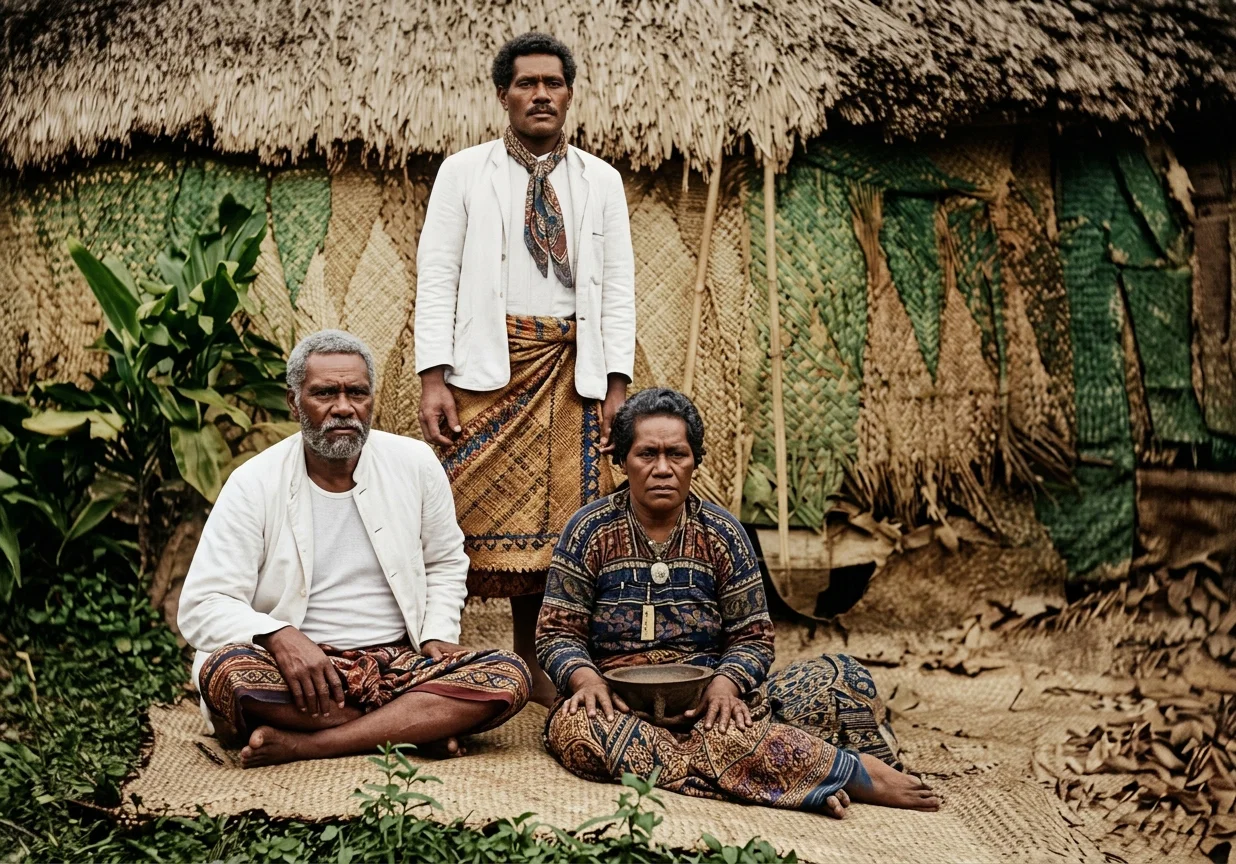
More than one year ago the island missions in eastern Polynesia were organized into what is now known as the Eastern Polynesian Mission. At that time we were convinced of the value of such an organization, and now can see that it was a move in the right direction. After visiting our missions in Central Polynesia during April and May, I reached Rarotonga, Cook Islands, June 22, and was joined by Brother and Sister Jones and Sister Gooding, and reached Tahiti three days later.
A FAMILY OF NATIVES
Our annual meeting was held at Raiatea, an island one hundred and twenty miles from Tahiti. Here is located the training institution, on the plantation bought by Brother and Sister Cady, which is now recognized as the Missionary Training Home of the Eastern Polynesian Mission. Though owned by Brother and Sister Cady, all the income of this farm is devoted to the Lord's work. Young men and women who are willing to work can here get a training for service, without cost.
The farm produces cocoanuts, manioc, sugar-cane, vanilla, oranges, bananas, limes, etc. The location is an ideal one. Along one side of the plantation flows a beautiful stream of pure, cold water, which never dries up. In the background, verdure-covered mountains rear their lofty heads. Oftentimes after a storm on the mountains, great cataracts go plunging over perpendicular cliffs to the valley below. All these things tell of God's power and love. Here, separated from the dreadful wickedness of the town six miles away, the youth are receiving a fitting-up for usefulness here and immortality hereafter.
The home is in charge of Miss Anna Nelson, of America. Besides the students from the Society Islands, there is one student from Pitcairn, one from the Austral group, and one from the Cook Islands.
In this beautiful spot the annual meeting of the Eastern Polynesian Mission was held, July 7-18. The laborers present were Elder B. J. Cady, chairman of the mission; Pastor G. F. Jones, of Rarotonga; Brother Paul Dean, our half-caste preacher; Brother S. A. Roth, who has been laboring among the French in Tahiti; and the writer. Sister Iva Cady, secretary of the mission as well as Sabbath-school secretary, and Sister Jones, secretary of the Cook Island Sabbath-schools, represented that department of the mission work. The church- and training-schools were represented by Miss Nelson, and Miss Evelyn Gooding, of Rarotonga. All the churches in this mission were represented by delegates except one, and a few lay members were present from other islands. All our members at Raiatea attended most of the meetings.
The delegates and laborers came to the meeting to receive the blessing of God and to impart it to others. There was no excitement, but calm, trusting faith in God. The service on the first Sabbath lasted about three hours. The Holy Spirit's influence descended on the con-
gregation like heavenly dew. All felt that we had reached “times of refreshing . . . from the presence of the Lord,” and all testified of new spiritual desires kindled in the heart, and of new courage to push the triumphs of the cross “to them which sit in the region and shadow of death.”
Seeing the millions yet unwarned in our great mission field, our brethren in the Eastern Polynesian Mission do not call for more workers from abroad, but will endeavor to develop native talent, and let the experienced workers go to the more needy fields.
Considerable time was given to the consideration of tithe paying. While some were faithfully giving the Lord his own, others did not see the importance of the subject. Instruction was given showing that as God is the owner of all things, it is but reasonable that he should charge a small rental on the property he allows us to occupy, in order that his ambassadors may be supported as they go out to the revolted provinces of his kingdom. Many testified of blessings received in paying tithe, and a unanimous vote was passed both to pay and to urge all the churches to pay tithe.
Most of the brethren are poor, and the natives have but little on which to pay; but a faithful tithe on the part of all would nearly, if not quite, support the mission. The report showed that Tahiti and Pitcairn Islands paid in tithe about one hundred and twenty-six pounds, while the little church of twenty-three on Rarotonga paid thirty-three pounds. The Sabbath-school offerings were also good.
Sister Cady and Sister Jones, Sabbath-school secretaries of the Tahitian and Rarotongan Missions, made deeply interesting reports of the increased interest in their fields. The former translates the Sabbath-school lessons, and makes mimeograph copies for the churches and isolated members. The proposed monthly paper for the Cook Islands will contain the Sabbath-school lessons.
Sister Anna Nelson reported for the Mission Training Home at Raiatea, and Sister Evelyn Gooding told of her church-school at Rarotonga. Speaking of the interest in missions, Miss Gooding said: “The good missionary spirit was manifested in the Rarotongan church by the brethren and children when, at the close of the week of prayer, the sum of five pounds eight shillings was passed in for the work among the heathen. The children, instead of asking their parents for money, went to work and earned it, and so were able to give sixpences and shillings, while the parents gave pennies.” Remember that sixty years ago the grandparents of these children were all heathen. (On my return to New Zealand I stopped one day at Rarotonga, and had the pleasure of seeing the new church which had just been dedicated, also the new church-school building. The church is twenty by forty feet, built of stone and lime, neat in appearance, and a credit to the cause.)
Brother Paul Dean, our native minister reported his work among the natives, and Brother Roth told of the work for the French.
In order to give our people in this mission field a deeper interest in our missions in heathen lands, it was voted to set apart the fourth Sabbath as missionary day, using the readings sent out, and making donations.
During the larger part of the conference, Bible lessons on the gift of prophecy were given by the writer. A deep interest was manifested in these studies. Light, clear and abundant, shone into the hearts of the people.
The following-named persons were elected as officers of the Eastern Polynesian Mission: Chairman, B. J. Cady; Secretary, Mrs. Cady; Executive Committee, B. J. Cady, G. F. Jones, G. T. Beckner.
After the close of the meetings a few changes were made in the working force. As there were serious difficulties in the way of Brother Teasdale's going to East India, it was arranged for Pastor Jones to go to Singapore, while Brother and Sister Piper will take his place in Rarotonga, their health being fully restored.
Brother S. Roth, of Tahiti, will return to America, and connect with the health food work in California.
The conference recommended that B. J. Cady and G. F. Jones receive credentials, and Paul Dean ministerial license, from the union conference.
At the close of our excellent meeting, a praise service was held. Every one present told of the precious blessings received, and of a determination to do more to disseminate the light during the coming year. One of the laborers said he had attended important and excellent meetings in other countries, but had never before been blessed so much as at this one. It was good to be there.
But the crowning blessing came on the last Sabbath before I took the steamer for home. At that time Brother Cady baptized five of the students of the training home. One of these was a descendant of a missionary associated with John Williams eighty years ago. Two were children of a white man who attended our first meeting in Raiatea, in 1891; one was a girl from Rurutu, and one a boy from Sister Gooding's school.
This is the result of the work done by our faithful teachers. The Holy Spirit brooded over the scene as these dear youth and children took upon them the baptismal vows. Cheered and greatly encouraged, I took the steamer the next morning for home.