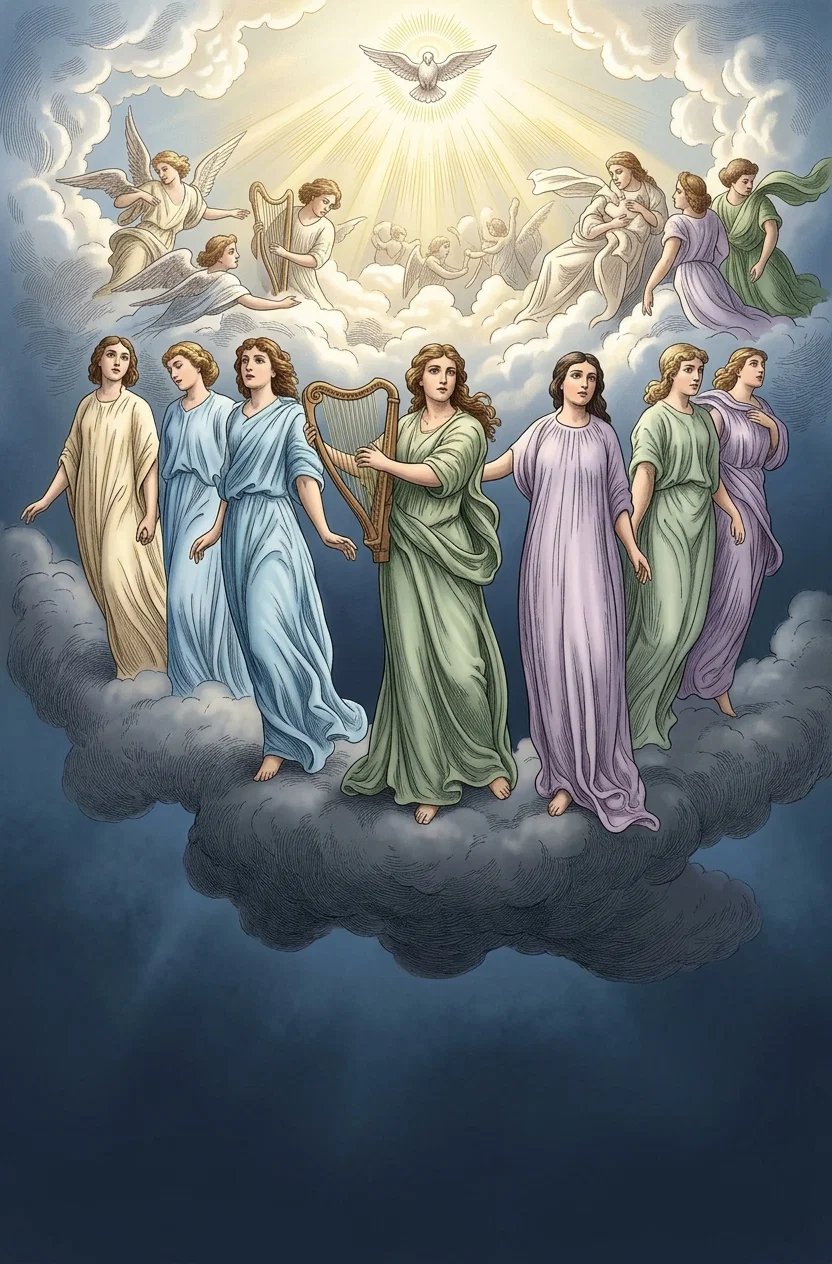
There is no idea more common among religious persons than that those who during their lives have accepted Christ and have joined themselves to the spiritual world shall at their death become angels. Such religious persons believe that in ways which they confess they cannot wholly understand the soul at death is carried away to heaven; that there its nature and being are changed; that it ceases to be a human soul, and becomes an angelic soul; and that in this beatified state it continues forever. In connection with this theory many absurd notions have grown up, as that the chief occupation of the heavenly world is traveling upon clouds or playing upon harps. But here we need not address ourselves to the refutation of sentiments that may not be seriously entertained. We shall simply consider the plain proposition as to whether the Scriptures ever or in any place teach that human beings, in any way or in any form whatever, shall at any time become angels.
BIBLE SILENT ON THIS QUESTION
At the outset of this discussion we come to great difficulty, for the reason that the Bible has nothing whatever to say about men's becoming angels. On this matter it is silent, offering no such promise, and making no such statement. As far as Scriptural authority is concerned, the idea is as baseless as the notion that the forbidden fruit that Eve ate in the Garden of Eden was an apple, rather than a pear or a persimmon or a mango. That to become angels is the highest goal of human existence is no more taught in the Scriptures than the common legend that the three wise men who came to worship the infant Saviour were named Gaspar, Melchior, and Balthazar, and that one of them was a negro! All such views and statements are merely traditional; and concerning them we, as Protestants who hold to the Bible and the Bible only, must consider that they are not proved and not provable.
The Scriptures say that man was made a little lower than the angels. (Hebrews 2:7.) They do not state that man will always remain lower than the angels. Christ Himself reveals that there are greater heights for those who seek the heavenly kingdom. When the Sadducees, the skeptics of the Jewish nation, came to Him with a problem that they deemed insoluble, concerning the validity in the future world of consecutive marriages lawfully contracted in this, our Saviour answered their question; and, going further, declared of those who are “accounted worthy to obtain that world, . . . neither can they die any more: for they are equal unto the angels; and are the children of God, being the children of the resurrection.” See Luke 20:27-38.
In the world to come we shall not be angels, but we shall become equal unto them. Although created “a little lower than the angels,” the redeemed will enjoy a knowledge of salvation that the angels will never know.
BECOME EQUAL TO ANGELS
And it is indeed strange that in all the places where the Scriptures mention angels, their work, their being, their nature, their deeds, no word is ever dropped that men may one day be among their number; and that among all the multitude of promises given to those who are faithful, there is no promise given to them that they shall ever become angels. They shall indeed, says our Lord, become “equal unto the angels;” they shall no longer be inferior, no longer be “a little lower than the angels;” but that they shall become angels, shall in nature and essence be transformed into angels,—this He does not say.
What then does the Bible reveal as to the future state of the redeemed? It is not silent on this topic.
Every prophet of the Scriptures to whom these matters have ever been revealed in vision, declares that there is to come a better world than this. Isaiah glances forward to the time when “the desert shall rejoice, and blossom as the rose.” In that day, he tells us, “the parched ground shall become a pool, and the thirsty land springs of water.” “The ransomed of the Lord shall return, and come to Zion with songs and everlasting joy upon their heads: they shall obtain joy and gladness, and sorrow and sighing shall flee away.” Isaiah 35:1, 7, 10.
BETTER AND ETERNAL EMPIRE
The prophet Daniel sees the end of this world, when “the God of heaven [shall] set up a kingdom, which shall never be destroyed: and the kingdom shall not be left to other people, but it shall break in pieces and consume all these kingdoms, and it shall stand forever.” Daniel 2:44.
Jeremiah, living in the decline and weakness of an earthly kingdom, is encouraged by the vision of a better and eternal empire, where “a King shall reign and prosper, and shall execute judgment and justice in the earth. In His days Judah shall be saved, and Israel shall dwell safely: and this is His name whereby He shall be called, THE LORD OUR RIGHTEOUSNESS.” Jeremiah 23:5, 6.
So Paul tells us concerning Abraham that as the patriarch wandered through Mesopotamia13and Egypt and Canaan, from city to city, and from kingdom to kingdom, he was looking, not for some metropolis that the monarchs of that age had built, but rather “for a city which hath foundations, whose Builder and Maker is God.” Hebrews 11:10.
MADE HEIRS OF A BETTER KINGDOM
It has never been the purpose of God that this world should, under present conditions, endure forever. Its sin, its suffering, its wretchedness; its diseases, physical and moral; its griefs and agonies; its swarms of evils so sickening that it is not wholesome for the mind even to think on them; its vices and crimes; its very joys and pleasures, which must be soon extinguished by unrelenting death,—all this order is not in the purpose of a God of love and life. A better world is offered to us through Jesus Christ. “I am the resurrection, and the life,” He declares; “he that believeth in Me, though he were dead, yet shall he live.” John 11:25. Although of ourselves we are not fit for that heavenly kingdom, although in our fallen nature we would be blots and blemishes to it, and although we can no more change our disposition and traits than snakes can transform themselves into doves, yet in Christ there is power to make us heirs of that better world. “As many as received Him, to them gave He power to become the sons of God, even to them that believe on His name.” John 1:12. For the sins and errors of the past His blood can atone,—“though your sins be as scarlet, they shall be as white as snow” (Isaiah 1:18); and for the weaknesses of our present nature He is able to provide a way of escape when He by His Spirit will put His laws into their minds, and write them in their hearts; and will be to them a God, and they shall be to Him a people. (Hebrews 8:10.) This is redemption, this is salvation,—the forgiveness of sins that are past, the writing of God’s law, His will and character, within our hearts, so that by nature we are made ready for that better world, where righteousness shall reign.
REDEEMED MEN AND WOMEN
We shall not be angels, but redeemed men and women in that world which is to come. Concerning this it is written that “since the beginning of the world men have not heard, nor perceived by the ear, neither hath the eye seen, O God, beside Thee, what He hath prepared for him that waiteth for Him.” Isaiah 64:4. And, indeed, we do not mean to say or imply that we can fully understand that eternal kingdom. Yet in that land which shall blossom like a rose, where sandy wastes shall bring forth springs of water, and where the very deserts shall be gardens, we are told that the people of God “shall build houses, and inhabit them; and they shall plant vineyards, and eat the fruit of them.” “The wolf and the lamb shall feed together, and the lion shall eat straw like the bullock: and dust shall be the serpent’s meat. They shall not hurt nor destroy in all My holy mountain, saith the Lord.” Isaiah 65:21, 25.
In vision the apostle John is shown the glories of that heavenly city, which he calls the New Jerusalem,—“the holy Jerusalem, descending out of heaven from God, having the glory of God: and her light was like unto a stone most precious, even like a jasper stone, clear as crystal; and had a wall great and high, and had twelve gates, and at the gates twelve angels, and names written thereon, which are the names of the twelve tribes of the children of Israel. . . . And the building of the wall of it was of jasper: and the city was pure gold, like unto clear glass. And the foundations of the wall of the city were garnished with all manner of precious stones.” Revelation 21:10-19.
We are aware that atheistical persons may declare such descriptions fantastic and absurd. Yet such doubts primarily arise, not from a doubt of the description, but from a doubt of the power of God. Let us not, because of the meagerness of our experience, disbelieve what God has declared to us in His word. Let us not scoff at a city of gold, or at walls of jasper. We would build walls of jasper—if we had the jasper! We would make cities of pure gold—if we had the gold!
Shall we doubt that the eternal God, who made iron and lead, can make gold also? Is it too hard for God, who made clay and rock and land and sea and air from nothing, to make jasper from nothing? When men refuse to believe, it is because they err, not knowing the Scriptures, nor the power of God. (Mark 12:24.)
In that new world “the tabernacle of God is with men, and He will dwell with them, and they shall be His people, and God Himself shall be with them, and be their God. And God shall wipe away all tears from their eyes; and there shall be no more death, neither sorrow, nor crying, neither shall there be any more pain: for the former things are passed away.” Revelation 21:3, 4. In that perfect world, that perfect city, shall be the throne of God; its light shall be the glory of God, and Christ Himself shall lighten it. Through it shall flow a river whose waters are called the “water of life, clear as crystal.” In its territory grows that tree of life, whose leaves are “for the healing of the nations.” “Blessed are they that do His commandments, that they may have right to the tree of life, and may enter in through the gates into the city.” See Revelation 21, 22.
ALL QUESTIONS SHALL BE MADE CLEAR
There, in that better world, we have no doubt but that we shall know more about the nature and existence of angelic beings than it is possible for us to know here. “Now we see through a glass, darkly; but then face to face: now I know in part; but then shall I know even as also I am known.” 1 Corinthians 13:12. As anciently men, looking into their mirrors of polished bronze, could see but dimly, so in this present world we can behold only with faint and distorted vision many things which in that world we shall see and know face to face. Yet even now, on the authority of God’s word, we may understand that we shall have eternal life through Jesus Christ our Lord. We may understand that we shall be equal unto the angels, having powers and abilities that we do not now possess. We may understand that the difficulties and mysterious things,—
“The things which our weak judgments here
have spurned,
The things o’er which we grieved with lashes
wet,”
the seeming contradictions that now obscure so much of our knowledge of God and of His providences,—in that day shall be dispelled, for “we shall see Him as He is.” 1 John 3:2. In that more perfect world, with more perfect knowledge, things that are dark to us now shall doubtless be made clear.
It is through Christ, the Son of God, that these promises are laid before us. “Thanks be unto God for His unspeakable gift.” 2 Corinthians 9:15. Better than any prospect of earthly preferment, more priceless than any gift of human bestowal, more true than any enlightenment of carnal wisdom, is the assurance of eternal salvation in that eternal world, through Jesus Christ our Lord! Amen!