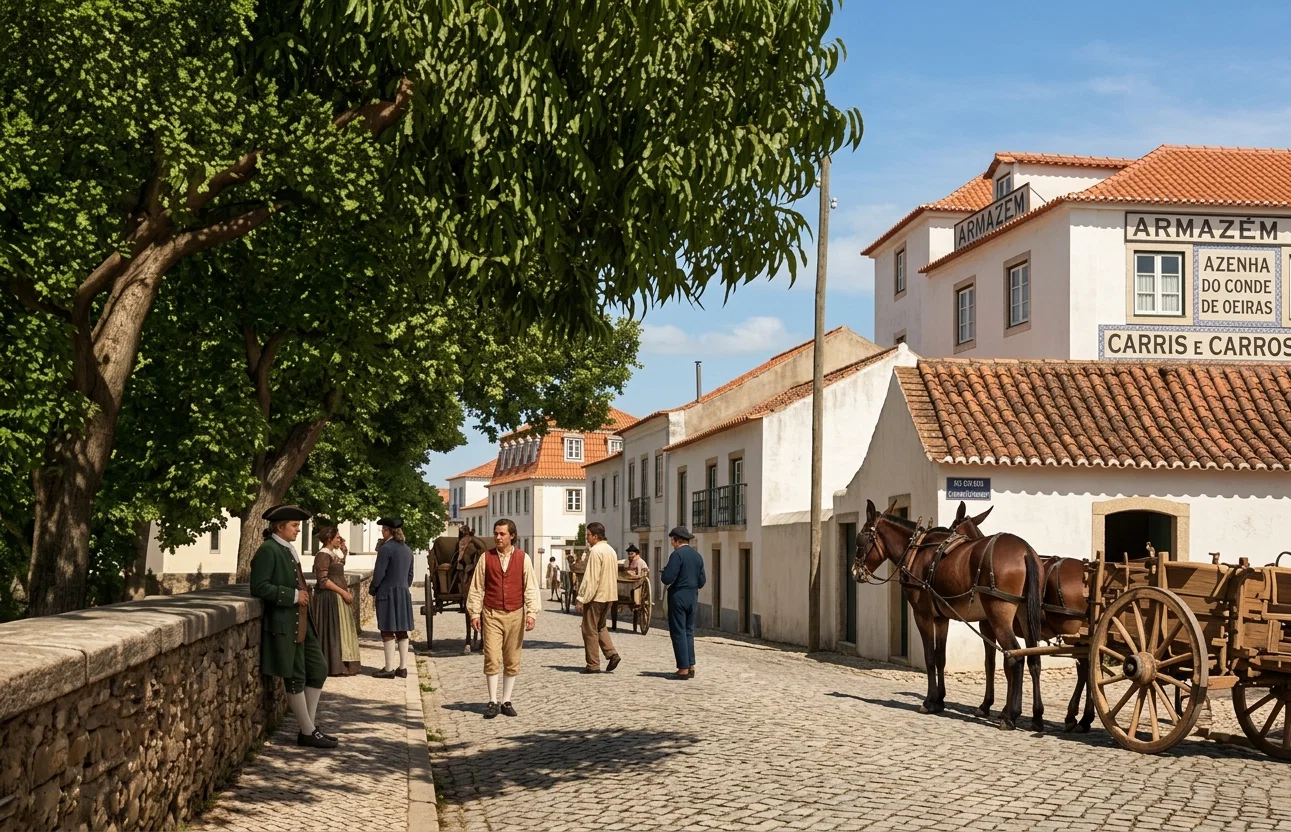
Many are the interesting items in the history of this small country. As the Portuguese seemed to be foremost in opening the world to the travels of later generations, during the fifteenth century and the opening of the sixteenth, so we find them among the foremost in advocating the freedom of mankind. I will proceed to show this by giving some results of researches in Portuguese histories.
A STREET SCENE IN CARCAVELLOS
In this work of reform figures very highly a noted statesman named Sebastian Joseph de Carvalho Mello, whose title was first Count of Oeiras, because of his lands near a village of the same name, and afterward named Marquez de Pombal. He was born May 13, 1699, at a place in Lisbon where now is published a daily paper called O Secula (The Century). He lived to reach the age of eighty-two years, dying about six years before Washington was elected president of the United States. One may see at once that his were stirring times.
This man served his country as ambassador to England in 1733, procuring for his country a concession of important rights. Also he represented the Portuguese government as mediator between the courts of Rome and Vienna, in 1745. Finally he was raised to the position of prime minister of the kingdom, in which position he was enabled to bring about many important reforms. As these were times when the lords were tyrannizing over their vassals, and the Jesuits with the Inquisition were in control of affairs, his acts assumed great importance.
Two great principles were expressed by the historian. “In the land of the free all are free.” “Among Christians all are Christians.” These have been brought together in the United States under civil and religious liberty. For this liberty men in those times were seeking. The Indians of Brazil who were in slavery had their liberty proclaimed by one of the first acts of the marquez as prime minister, in 1751. Slaves in Portugal were given freedom, and the natives of India were put on a par with humanity in general by a special law. In those days there was a distinction between persons who by birth were Catholics, and others who had been converted to Catholicism by fear or otherwise. These were called Old Christians and New Christians. The new Christians, mostly Jews, were much despised by the Jesuits, and were subject to noxious laws and penalties of the Inquisition. The reforms of this statesman gave them shelter from the insults of the old Christians. Thus ended distinctions most odious between nobles and plebians, lords or masters and slaves, and new Christians and old Christians.
Following these reforms, work was begun to increase national riches. He founded companies to fish whales and tunny fish, and others for exploration, for commerce with South America, and for other purposes. He attempted to create a greater interest in agriculture, and started industries in different lines, and protected those already begun. Some important factories were those of wool and silk and paper.
It was during the reign of Don Jose I, and while the marquez was prime minister, that the great Lisbon earthquake occurred. The latter was asked what he would do in view of so great a disaster. He replied, “Bury the dead and look after the living.” He rebuilt the city, arranging the different trades, shops, etc., in separate streets, calling the street by the name of the goods sold there or by the industry carried on. These are seen yet, such as Gold Street, Silver Street, Silk Street, Linen Drapers Street, etc.
One of the most important acts of the Marquez de Pombal was the expulsion from Portugal of the Jesuits, Sept. 3, 1759. From his early public life he was convinced that they were a hindrance to reform, and sought to find proof for a foundation of his accusations. They dominated everywhere, reigned in the consciences by confession. In the education they were the teachers, so that whatever14was done by them brought to the country naught but ignorance, superstition, and eternal degradation. They claimed that the earthquake came as a judgment on account of the grand reforms in the years preceding. After their expulsion from Portugal, Spain, France, and Naples followed suit in driving them out, but they were readmitted in the other countries by Pope Pius VII, Aug. 7, 1814. But Portugal refused to admit them; yet they have come in one by one until their power is felt in private to a great extent. The present Marquez de Pombal, a grandson of the former, is said to be a Jesuit also.
It was under the power of this strong-minded prime minister that the Inquisition lost much of its power in Portugal. One may see what determination will do in reading of the life of this great statesman, one of the greatest in Europe, especially in his days. The people are raising a subscription to erect a statue to him.
Surely since Portugal at one time was swayed by a great reform, it can and will be moved from one side to the other, from king to the lowliest subject, by the greatest reform message the world has ever known. May God grant that the threefold message may go with power in this land, and the coming of the King of kings be hastened.