Prosperity and Its Blessing—Health of the Workers Institutions Needed
By ARTHUR G. DANIELLS
Leaving Bombay, we traveled through central India northeast to Lucknow, a distance of nine hundred miles. One must travel in India in order to get anything like a true conception of its vastness in land area, population, and wealth in natural resources. In every part of the empire—in the great shipping ports along the coasts, in the large cities, and in the immense agricultural areas—there is abundant evidence of great economic development and industrial activity.
TRADE AND LAND VALUES
One finds ample confirmation of the impressions obtained by observation. The statistics reveal a marvelous progress during the last half century. In that time the ocean trade of India has increased from three hundred million dollars to nearly a billion and a half. The value of the land has increased, during the same period, by a billion and a half dollars. Writing of this industrial and commercial development, Mr. Sherwood Eddy, who has spent the last fifteen years traveling over India in gospel work, says:
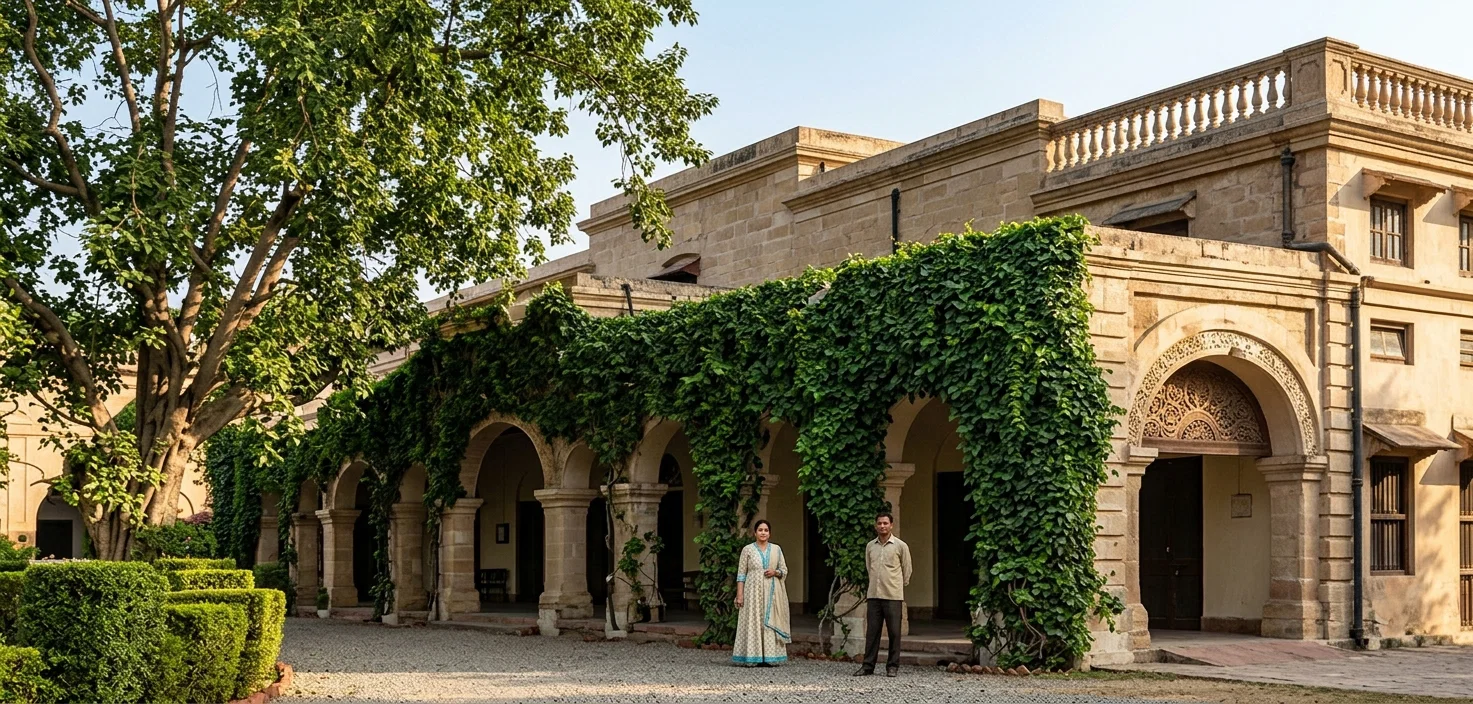
OUR MISSION HEADQUARTERS AND PUBLISHING HOUSE, LUCKNOW, INDIA
India “is the largest exporter of rice in the world. She holds first place in her exports of tea, and together with Ceylon, exports more than half the tea crop in the world. Next to the Argentine, she is the largest exporter of hides, and next to the United States, the largest exporter of cotton, in the world. Next to the United States, she is the largest wheat producing country in the world, while Bengal holds the virtual monopoly of the jute trade. Her increase of iron and steel is more encouraging. The Tata Iron Works in Bengal, employing eight thousand men, have laid down iron in San Francisco at less than the price charged by the United States Steel Corporation. . . . The trade of India now holds the first place in Asia, with $595,000,000 exports, and $609,000,000 imports.
Her system of irrigation stands easily first in the world, being far more extensive than that of Egypt or America. Her more than 15,000 miles of irrigation canals have reclaimed more than 17,000,000 acres of land.”
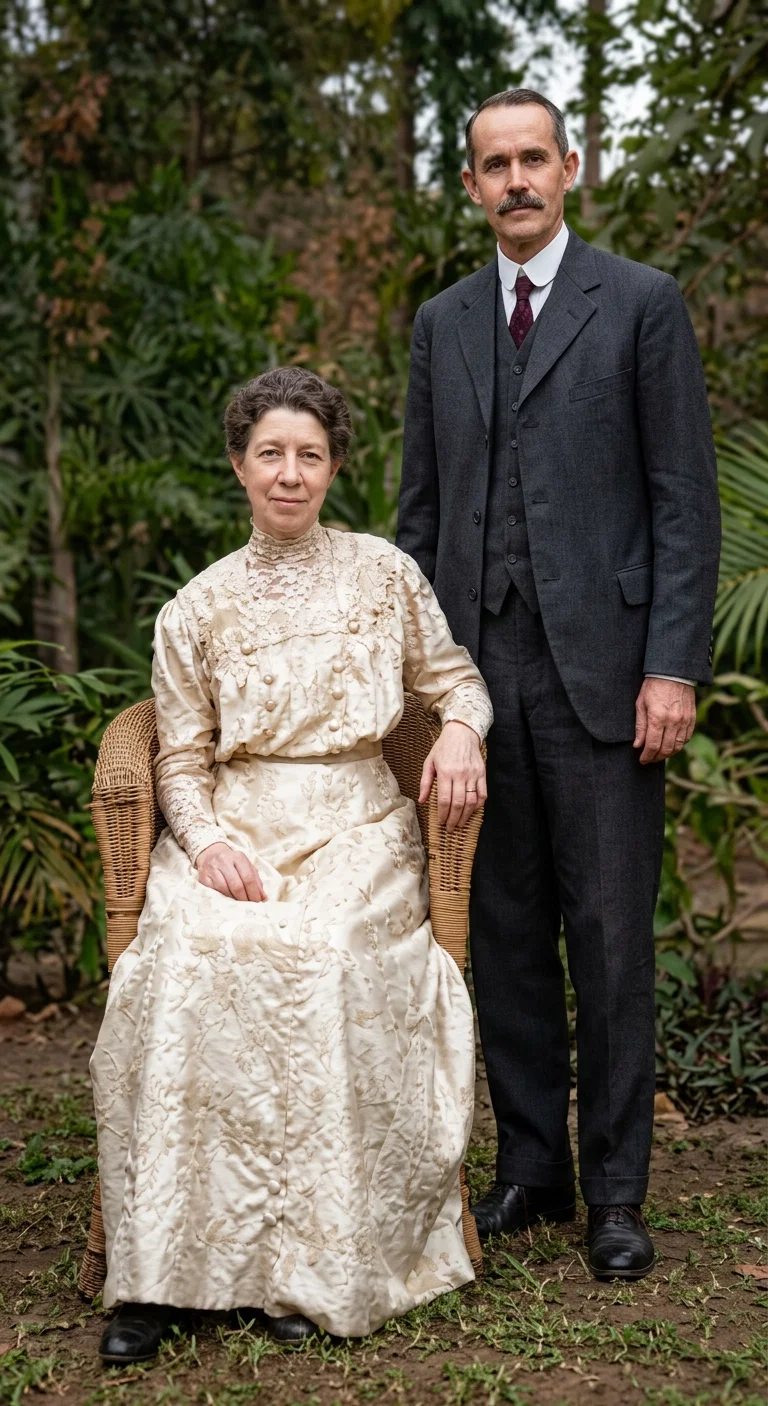
R. D. AND MRS. BRISBIN
THE BLESSING IN THIS PROSPERITY
In one way, this great prosperity is a distinct help to the cause of missions in India. It is far better so than to be on the brink of financial disaster. These blessings are from Him who has sent us to India’s teeming millions with His last message of invitation and warning.
Lucknow is the headquarters of our missionary enterprises in India. Our printing plant is located here, also our school for the training of evangelists and other gospel workers. Here I had the pleasure of meeting Pastor S. A. Wellman, editor of our Oriental Watchman, and superintendent of the North India Mission; Brother W. E. Perrin, manager of the printing office; and Sister Quantock, treasurer of the India Union Mission. I had the pleasure also of forming the acquaintance of our zenana worker, Miss Vera Chilton, and Nurse Scholtz, who has charge of our dispensary. These workers all looked well, and were of the best of courage. It is a great satisfaction to be able to give such a report
of conditions in India, where the climate is so trying.
WORKERS—THEIR HEALTH AND PROGRESS
The North India Mission embraces the United Provinces of Agra and Oudh, with a population of nearly fifty millions. It touches Tibet on the north, Bengal in the east, the Central Provinces in the south, and the Punjab on the west. Lucknow is the center from which the work in this mission is carried on, and from which I visited its different stations.
At Najibabad we found an encouraging work in progress. Brother R. P. Morris and his wife, who are in charge of this station, are in good health, and want all their friends and old classmates of the Foreign Missionary Seminary, in Washington, D. C., to know that they are glad they came to India, and that they intend to remain here while there is work to be done for the Master. Nurse Kurtz, who is from Pennsylvania, has charge of the dispensary, which is operated principally for women. She is assisted by Sister Shoto Mitter, an Indian nurse. From thirty to seventy-five patients pass through the dispensary daily, giving these nurses all the work they can carry.450
PROF. I. F. AND MRS. BLUE
I was glad to find the workers in this mission very comfortably housed in the bungalow recently erected for them from funds sent out by the Mission Board. They are a mile and a half from the crowded part of the town, and have land enough to grow vegetables and fruits. There are thousands of people living in the villages all about Najibabad. The workers in this mission will itinerate among these people, giving them all the help they can. Some of the natives who have embraced the gospel in Najibabad are laboring with our European workers and rendering valuable help.
SCHOOL BUILDING NEEDED HERE
At Mussoorie we were pleased to meet Sister Bruce, who came from the Washington, D. C., Sanitarium seven years ago, and Brother and Sister R. D. Brisbin, who came from South Lancaster, Massachusetts, Academy a year and a half ago. As these workers were located in the hills away from the heat, they were looking strong and rugged, and able to do a large amount of hard work. They were in charge of a school that has been established for the children of our missionaries and our European and Anglo-Indian members. Annfield House, which was purchased a few years ago for a summer hill station for our workers in the plains, is used for the school. It was crowded to its utmost capacity when we were there. This enterprise means much to our people in India, and in the near future a permanent and suitable school building must be provided. The people of India will do their part as soon as this step can be taken.
WELL PATRONIZED TREATMENT ROOMS
During the hot season, we operate what are known as the Kirkville House Treatment Rooms in Mussoorie. These are under the supervision of Brother and Sister William Lake, who embraced the message years ago in India. The patronage is good through the summer; and by careful, efficient management, this enterprise more than pays all expenses. This institution forms a center from which rays of light are received and taken to all parts of India.
FAR UP IN THE HIMALAYAS
On arriving at Simla, we were met by our dear friends, Dr. and Mrs. Menkel, whom many in the home land will remember. Simla is located far up the Himalaya Mountain ranges. Our train meandered around the mountains so long, and traveled so far, that we really seemed to be going far away from everywhere and everybody. When we reached the station, we received more than a cordial welcome. Every hour of our stay in Simla was greatly appreciated. Dr. and Mrs. Menkel are not as robust as they should be to follow up the many avenues of service that are open to them.
Simla is in some respects the most important hill station in India. It is the headquarters of the viceroy and his administrative staff during the summer months. Large departments of the general government are permanently located here, and this gives Simla a more permanent population than is to be found in any of the other hill stations.
During the last two or three years, some of our ministers have spent their summer vacations there. While there, they have carried on evangelistic work. As a result, a small but active church has been organized. Some of those who have embraced the truth hold important positions in government departments. These members have a good, strong influence in Simla, and are earnest, active missionary workers. We found quite a number of influential persons deeply interested. A good, strong church in Simla will be of great value to our cause in India.
A SANITARIUM NEEDED
Dr. and Sister Menkel are in charge of this station, and for a time they will devote their energies principally to evangelistic work. The Lord has blessed their efforts in this line. Of course, they are very anxious to see sanitarium work established there; but while waiting for the funds necessary for this, they will do all they can to win souls to obedience to the truth. It certainly seems as though a sanitarium in Simla would be a great help to our work, and that from it the light would radiate to all parts of India. We hope that some day a good institution may be opened there.
After visiting Mussoorie and Simla, and reading about Darjiling, Murray, and other towns in this great range of mountains, I am convinced that the providence of God has placed within our reach in India means by which we can live and work in this mission field a lifetime without breaking down. This problem should have more careful study, and efforts should be made to take advantage of the favorable conditions within our reach.
Elder Wellman is superintendent of our North India Mission, and is also supervising editor of the “Watchman.”
Schwartz, Judson, Carey, and other missionaries in the pioneer days lived here twenty, thirty, and forty years without returning home. At that time, there were no railways, and hill stations were unknown. They were also deprived of many other advantages that can be secured at the present time.
CONSERVE OUR FORCES
The end of all things is fast approaching. Millions are unwarned. Much work is to be done, and all our forces are needed in the field, preaching, teaching, preparing and circulating literature, and directing the native workers every day until the end. Our workers in the field love the people and their work. They want this to be their field of labor until the end. Why, then, should we not take advantage of this great mountain range all the way from Assam to Afghanistan? We can work in the plains during the cool months, and then go to the cool, refreshing, invigorating temperature of the Himalayas during the intense heat, and continue our work there.
I am sure we have hundreds of interested friends possessing means, who would gladly unite in providing the money necessary to carry out a plan of this kind. May the Lord of the harvest direct His workers in all their plans for the hastening and finishing of His work.