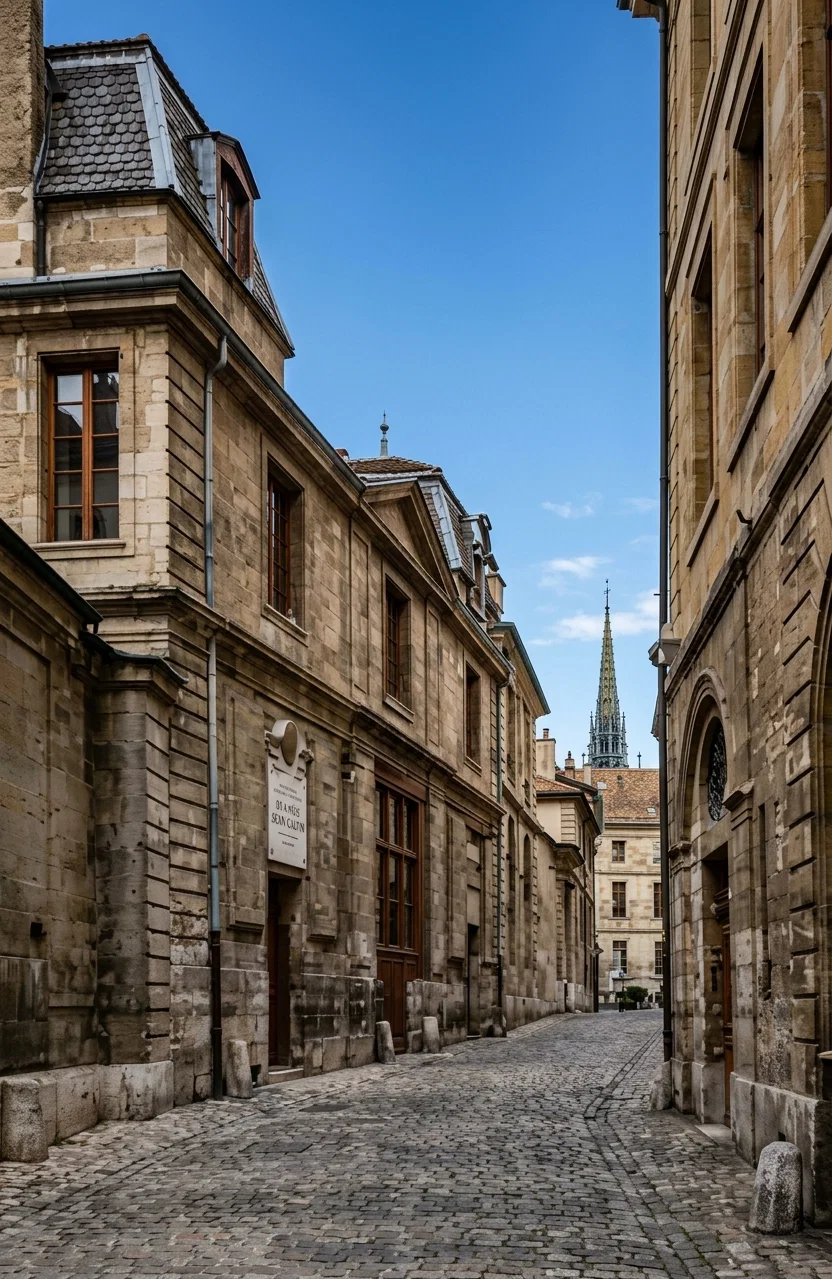
Calvin Street II. At the left, the house where Calvin lived
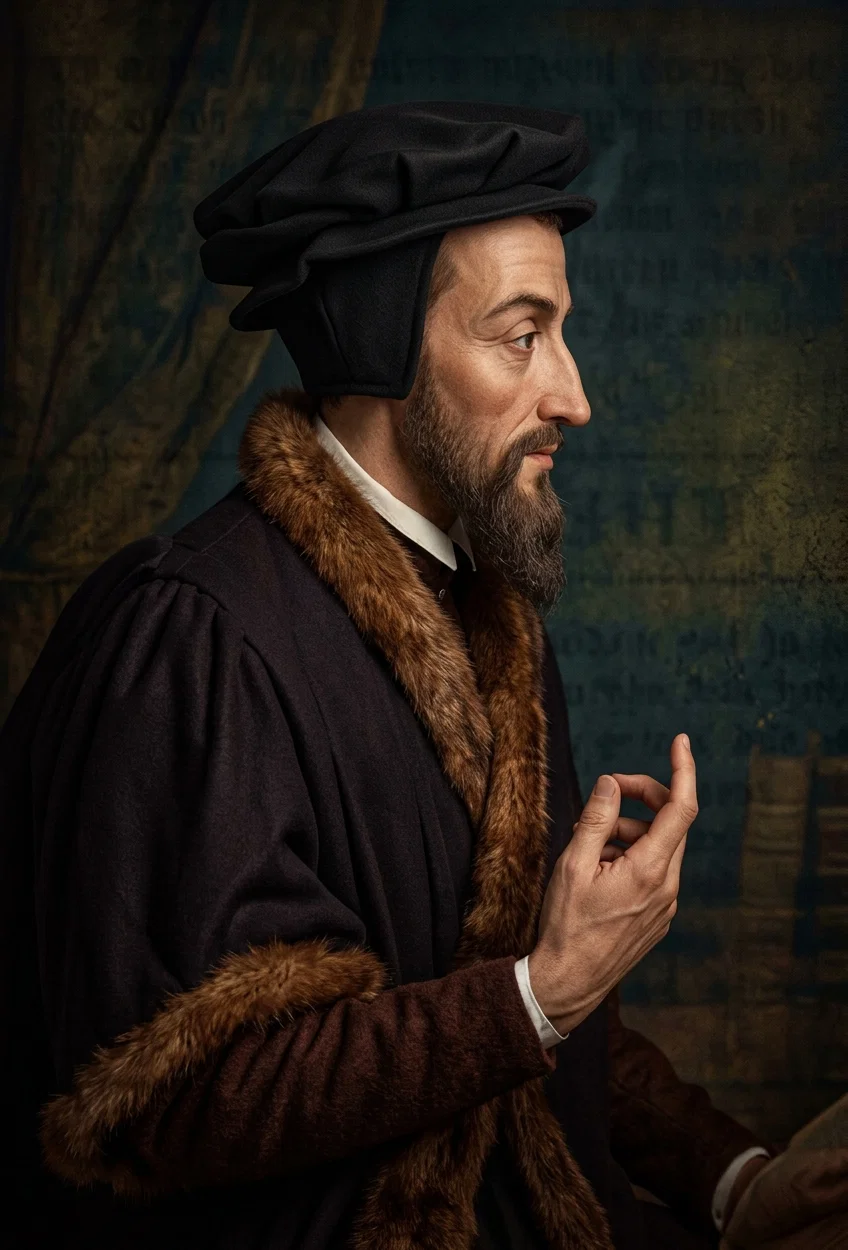
John Calvin
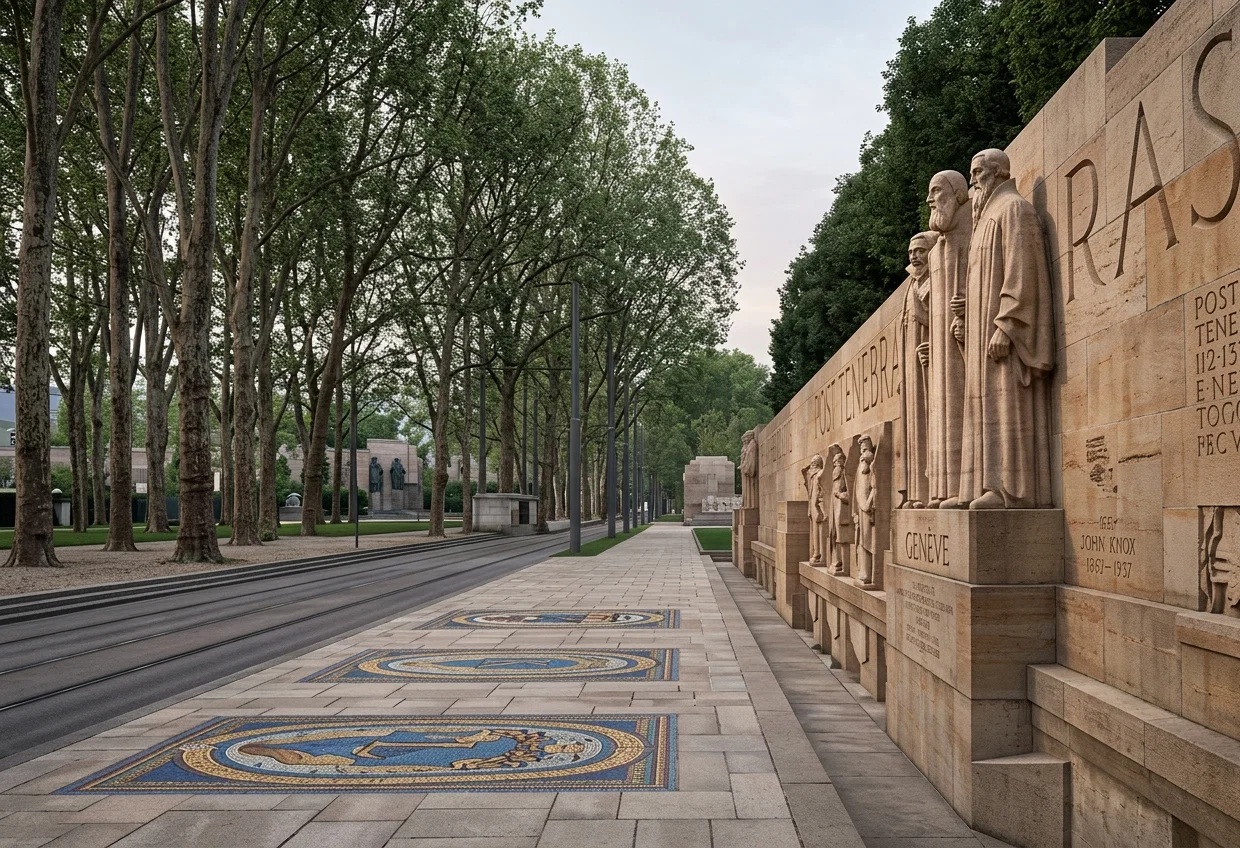
The Monument of the Reformation as it will be when finished
A Great Jubilee
During the first week of July, the city of Geneva, splendidly decorated, was the happy host of hundreds of distinguished visitors, who had come to attend the festivities of a great jubilee. It was just four hundred years, on July 10, since the birth of John Calvin. When it is remembered that to this man, under God, this city owes everything it has of worth, it is not surprising that Geneva should make an effort, after four centuries, to honor his memory. The university and the church celebrated their jubilee together. June 5, it was exactly 350 years since Calvin formally opened, at the Saint Pierre Cathedral, the academy of Geneva, of which the present university is the outgrowth.
Things were done generously and sumptuously, rather after the manner of the world and not at all after the manner of Calvin and the early Geneva customs which now seem too austere. Fine banquets were offered, and many of them; grand meetings were held, in which many eloquent tributes were paid to the Reformers and their work; a cantata, “Post Tenebras Lux” (After Darkness Light), the city’s motto, specially written for the occasion, was sung at the cathedral by a special choir; the first stone for a grand monument of the Reformation was laid; the guests were taken in steamers around the Geneva Lake, stopping at the historic Castle of Chillon, where a noted tragedy, “Abraham Sacrificing Isaac,” was played by university students; and last, but not least, the University offered the title of Doctor, honoris causa, to 150 of her learned guests.
So much about the jubilee festivities. Let us now take a look at the hero and the meaning of this jubilee.
The hero was graphically described at the opening meeting held in the cathedral, in which Calvin used to preach, by Prof. E. Doumergue, dean of the Montauban (France) Protestant Theological School. Professor Doumergue is the author of a monumental work on Calvin, and was well chosen to speak on “Calvin, the Preacher of Geneva.” He described him at his home near the cathedral, now Calvin Street II; among his friends; at the state house, conferring with the city councilors; at the Auditoire, teaching the Bible to his students; at the cathedral preaching to the people at six in the morning or at three in the afternoon.
The preacher was middle-sized, his complexion sallow, his face small and sickly, but beaming with intelligence and decision, his delivery slow but energetic; his style was simple and familiar, abounding in colloquial terms and comparisons from daily life; alternately rude with the thunders of the law, and graciously sweet with the love of God.
All phases of life, all realms of thought, were dealt with by the pastor of Geneva: the home, the church, the state, social economy, industry, commerce, legislation, hygiene, fashion, marriage, recreation, education. And where did he find the wealth and variety of his teaching? Where did he take the authority which accompanied his words?—In the Bible, of which he was but the humble servant and expounder. The Bible was the leaven with which he kneaded the Huguenot dough of the sixteenth century. The Bible faithfully preached for twenty years, preached daily and, if need be, twice a day, the Bible as the only rule of faith and life, the Bible, whose writers are as “the sworn notaries of the Holy Spirit,” the Bible fearlessly, perseveringly and intelligently studied and preached,—herein lies the power and success of Calvin.
So far as he had the light, Calvin preached the pure Gospel, in its simplicity and logic, in its austerity and mercy. Not all law or all love, but a commingling of the two at the cross of Christ, the law as our schoolmaster to bring us to Christ, and Christ bringing us back to a law fulfilled in Him. The Cross of Calvary and the Ten Commandments stood out as the two great pillars of his theological temple, as the two light-houses set out by God on the shores of life, albeit he did not see the claims of the fourth precept. On this point I take pleasure in quoting Prof. Williston Walker, from Yale, one of the delegates at the jubilee, in his “Life of Calvin”: “Calvin introduced so much clearness and order into Christian theology, that he is par excellence the theologian of the Reformation, and one of the three or four greatest interpreters of religious truth to be found in the history of Christianity. This portion of his work is found in his commentaries and especially in his great work, ‘The Institution.’ These commentaries are the best that the Reformation produced. Such as Calvin expounded it, the theology of the Reformation arose to a clearness, a dignity, and a logical precision in the definitions which were never surpassed.”
This teaching, coupled with a faithful catechizing of the growing generation by Calvin’s collaborers, could not but produce fruits of a high character. Indeed, to John Knox, who was one of Calvin’s students, the Reformer’s system appeared “as the most perfect school of Christ which ever existed on earth since the time of the apostles.” And the well-known French historian, Michelet, writes thus of the marvelous transformation which took place among the turbulent Genevians: “The laughing, sarcastic, changing city, where so many fine intellects were drowned in the superstitions of the Middle Ages, where so many noble hearts were polluted in the defilements of dissipation, became an astonishing city, where every thing was ardor and prayer, reading, labor and austerity, the great school of faith and martyrs.”
In order to deserve such eulogistic testimonies as these, it would seem that Christians to-day might feel like giving up some of the luxuries and fashions forbidden in Geneva during the sixteenth and seventh centuries. Let us read some regulations published twenty years after Calvin:
“To artisans and mechanics, their wives, their children and servants, it is forbidden to wear costly and glaring cloth, precious furs, or braids of silk; neither shall said women and girls wear bonnets costing more than an écu.”
“Servants and room maids shall not wear high-priced goods, but shall be content with cheaper ones, as heretofore, and shall not wear bonnets costing more than eighteen sols, neither any fashionable collars.”
“It is also forbidden to tailors to make henceforth any new fashions of clothes without permission from our said lords.”
Other regulations, dated 1639, recommend to women to dress in all modesty, without powder, paint, precious stones, not to curl their hair or uncover their chest. Other regulations were addressed to men with the same import. Still other rules served to check the appetite, forbidding the use of too many dishes at one meal.
The Geneva of to-day differs widely from the Geneva of the past. In greeting the delegates to the church jubilee at the Reformation Hall, Pastor Guillot said: “We have ceased to be a city of the Spirit, a school of faith and martyrs; Geneva has taken the aspect of a worldly and cosmopolitan city, a city of pleasure. And yet pious hands pass to each other the sacred torch: may you perceive it?”11
During the jubilee, a Geneva writer and professor, Philip Monnier, wrote in the Journal de Genève: “We are no more the austere city molded by Calvin after his own image. We are no longer the united, studious, and cultivated city of a hundred years ago. The walls have crumbled which encircled us so tightly. The principles have fallen which gave our public life such a fragrance of virtue. Other interests lead us, and other cares solicit us. A cosmopolitan crowd has invaded the open place. All opinions are being ventilated, all winds are blowing. We are ourselves divided, discordant, and contradictory.”
Such a marked and sad change is not without a cause. What is it? Can it be discerned? Can it be pointed out without error or injustice? Might it not be that the very principles upon which the Reformers built, and which, from common consent, produced such a beautiful edifice, have been abandoned? The writer just quoted confesses it: “The principles have fallen which gave our public life such a fragrance of virtue.” But where have the principles fallen? We are forced to answer: At the very sources of life, private and public, in the very religious teaching it self. Geneva theologians have not kept the sacred trust handed down to them. The inheritance of the Reformers has been exchanged for scientific discovery so-called; the Bible has been laid aside, or rather, torn and dissected by higher criticism, to such an extent that nothing of it is left, neither historical records nor doctrinal teaching. And of course the belief about God the Father, Christ the Son, the majesty of the law, the character of sin, the atoning value of the sacrifice on the cross, eternal life, the glorious return of our Lord,—all these pillars which the Reformers had placed under the dome of the edifice they built, have been undermined and laid waste. What else could be expected than the sad results which have been portrayed?
To prove the above statement, let me just quote a few words which crept out from the carefully written discourses made at the jubilee. In the very pulpit in which Calvin used to preach, the dean of theological professors at Geneva defined religion as follows: “A feeling of dependence toward an unknown power above us, which religious souls call divinity, and others force, ideal, and duty.”
Speaking of the Son of God, the same teacher called Him the “Jesus deified by tradition,” “the Christ who is no more.”
Another pastor, speaking officially in the jubilee, referred to “the error into which the Reformers had fallen in opposing an intangible Catholicism, an intangible Bible,” and he added: “In a general way, we can no longer admit their conception of the Bible nor their theological method.”
Need we go any further in search of the cause for the ravelling out of the noble work of the Reformers? Is it not even a little surprising and extremely illogical, that with such convictions regarding the principles of the Reformers, Protestants of to-day should have given themselves all the trouble of organizing the grand jubilee just witnessed in the city of Lake Léman?
Whatever plausible explanation may be given for this, may I be allowed, in closing, to draw from this whole matter a conclusion which I do not think any one will contradict? The teaching of the Reformers brought out beautiful results, religious, social, and political. The world is hungering for just such a state of society as those principles created. Let us, then, return to the principles of the Reformation, which are the same which Christ gave to His apostles to preach, and which made the apostolic church.