TREES

8%

Pacific Press Publishing Company · Oakland, California · Oct 1, 1902

FromSigns of the Times, Vol. 28, No. 40.

Read the full edition

TREES

The grandest, the most magnificent, the most durable of earth’s vegetable products are the trees. Including their fruits, they are the most valuable of earth’s gifts to man. Barren indeed would be the earth bereft of its trees. The first thing the Lord did for our father Adam was to provide him a home, and the most prominent feature of that home was its trees. “The Lord God planted a garden eastward in Eden; and there He put the man whom He had formed. And out of the ground made the Lord God to grow every tree that is pleasant to the sight, and good for food; the tree of life also in the midst of the garden, and the tree of knowledge of good and evil.”
GOD chose a tree through which to impart a continuance of life to the race, and He also chose a tree by which to test the man’s integrity and faithfulness. The two trees stood side by side “in the midst of the garden.” Gen. 2:9; 3:3. The one tree held out the promise of life; the other, as long as it stood as a test—during the man’s probationary period—implied the possibility of death. A choice of trees was the test whether man would prove obedient or not. The woman was deceived into believing that she could get wisdom through disobedience, the deceiver having taken his position in the forbidden tree, so near to the tree of life! Thus men are constantly being deceived by dogmas so near the truth, yet leading to death.
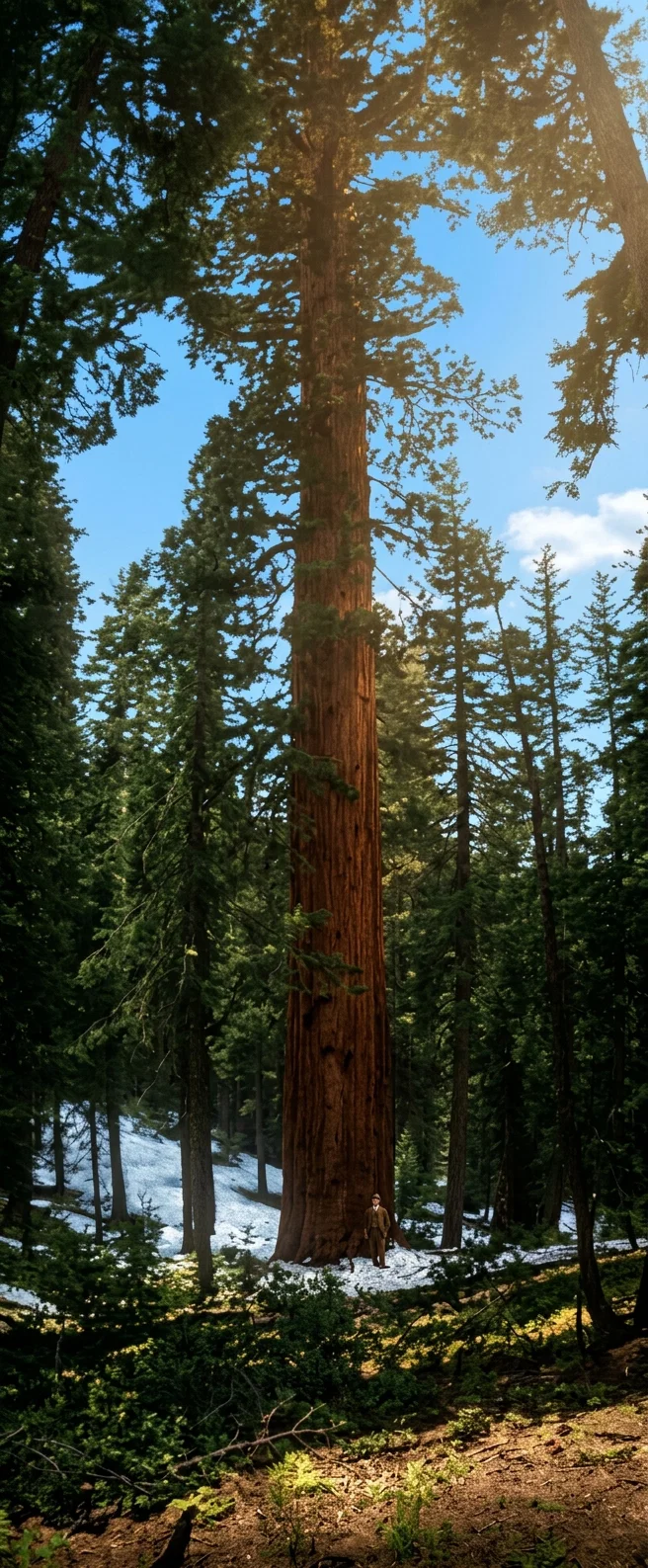
Photo by E.J. Drake. Scene in the Tuolumne “Big Tree Grove,” California. The tree in the foreground is a sequoia gigantea, 28 feet in diameter 10 feet from the ground. Compare its size with that of the man at its foot.
IN ancient times people lived under the shelter of trees, and their places of worship were the groves. When three angels in the guise of men came to visit Abraham, he entertained them under a tree in the plain of Mamre, or Hebron. Gen. 18:1–8. There is still a very large oak tree at Hebron which is called Abraham’s oak; but it is not at all likely that it was much of a tree so long ago, if, indeed, it existed at all. Deborah, a prophetess, was at one time a judge or ruler, in Israel; “and she dwelt under the palm tree of Deborah, between Ramah and Bethel in Mount Ephraim; and the children of Israel came up to her for judgment.” Such were the humble residences of one to whom was given the promise that he should be “heir of the world” (Rom. 4:13), and one whom God recognized as ruler of His people, and through whom He gave them counsel. Judges 4:4–9, 14.
WHEN Jacob returned to Canaan, after meeting his brother Esau at Peniel, the Lord told him to go to Bethel. But before going there He took the strange gods which his wives had secretly brought from Padan-aram and hid them under an oak at Shechem. Arriving at Bethel, Deborah, Leah’s nurse, died, and Jacob buried her under an oak tree. “And he called the place Allon-bachuth,” margin, “the oak of weeping.” See Gen. 35:1–8. When Joshua was about to die, he made a covenant with the people of Israel, in which he enjoined them to incline their hearts to God, and they promised to obey His voice. So “Joshua wrote these words in the book of the law of God, and took a great stone and set it up there under an oak, that was by the sanctuary of the Lord.” This stone was for a witness to the covenant. Joshua 24:22, 26, 27.
TREES were the subject of a significant parable spoken by Jotham, one of the sons of Gideon. See Judges 9. The lesson portrayed the folly of the men of Shechem in choosing as a ruler one who had caused his own brothers to be slain, and had hired “vain and light persons” to be his immediate followers. It also teaches that those who are doing the most valuable work in the Lord’s cause have no desire to be rulers over their brethren; and that an ambition to be exalted over others is evidence of utter lack of qualification for rulership.
AMONG the trees especially noted in Scriptures is the palm. Israel, after leaving their camp at Marah, where the bitter waters were healed, came to Elim, where were “twelve wells of water and threescore and ten palm trees.” On the desert the sight of palm trees was always a cause of rejoicing, because it was a sure indication of fresh water. The city of Jericho was called “the city of palm trees.” Deut. 34:3; Judges 3:13; 2 Chron. 28:15. The palm branch is a noted symbol of victory. John 12:13; Rev. 7:9. The date and coconut palms are especially valuable for their fruits.
OF the many illustrations of Solomon’s wisdom, his knowledge of trees must have been regarded as exceedingly remarkable. “He spake of trees, from the cedar tree that is in Lebanon even unto the hyssop that springeth out of the wall.” 1 Kings 4:33. Solomon was well acquainted with the cedar, altho it grew principally in the northern part of his kingdom and in Tyre and Sidon. David had built for himself a house of cedar, and half of Solomon’s reign was occupied in building himself a house and the temple of the Lord. 1 Kings 6:38; 7:1. Chapter 7 tells of his contract with Hiram, king of Tyre, for cedar timber. Solomondid also much other building in which the cedar was extensively used.
THE Lord’s people are compared to trees. The man who delights in the law of the Lord is like “a tree planted by the rivers of water, that bringeth forth his fruit in his season; his leaf also shall not wither; and whatsoever he doeth shall prosper.” Ps. 1:3. Again we are told that “the trees of the Lord are full of sap” (Ps. 104:16) which represents the Spirit of God. The sap is the blood, or life, of a tree, and from it comes the flower and fruit. So the “trees of the Lord” being filled with the Spirit (Luke 1:15; Acts 4:8; 6:3, 5; 13:9; Eph. 5:18), bring forth the “fruit of the Spirit” which is “love, joy, peace, long-suffering, gentleness, goodness, faith, meekness, temperance.” Gal. 5:22, 23. In this way they become “trees of righteousness, the planting of the Lord, that He might be glorified.” Isa. 61:3.
THE olive tree has a higher place in symbolism than any other tree. The prophet Zechariah saw in vision two olive trees that emptied their golden oil into seven lamps. On asking what they meant, an angel answered him, “These are the two anointed ones, that stand by the Lord of the whole earth.” Zech. 4:14. The oil of the olive tree stands for the Spirit of God, by which the Word of God is to be made plain. The apostle John was also shown two olive trees in vision (Rev. 11:4), which evidently symbolize the Word of God, the Old and New Testament. The olive tree also stands for the Seed of Abraham, which is Christ (as we learn in Gal. 3:16); and a wild olive tree very appropriately represents those who have not known Christ. The lesson of Romans 11 concerning the grafting of branches from the wild olive into the good olive is worthy of special study, as, indeed, are all of the various lessons from the trees which are set forth in the Word.
THE tree of life, from which man was disconnected when he chose to eat of the forbidden tree, will be at the service of the redeemed, who have chosen the part of obedience. The inspired description of the New Jerusalem tells us of the River of Life flowing out of the throne of God and of the Lamb “in the midst of the street of it, and on either side of the river was there the tree of life, which bare twelve manner of fruits, and yielded her fruit every month.” Rev. 22:1, 2. And to this grand prospect is added the encouraging promise: “Blessed are they that do His commandments, that they may have right to the tree of life, and may enter in through the gates into the city.” Verse 14. G.