When God made man and woman in Eden, He made them upright, and without doubt He made them beautiful, because the Word tells us man was made in the image of God. It was only as a result of sin that they were obliged to wear clothes. At first these were very simple; but as sin increased and man became more and more degenerate, more clothes were added, until at the present time in many cases the beautiful clothing is admired instead of the beautiful creature which God created.
True beauty must spring from within. The beautiful girl must be a healthy girl; she must have a healthy circulation of pure blood thru a sound organism. This will give color to the cheek, a smooth skin, and a well-developed body, with sound muscles, which will be able to maintain the body in proper poise.
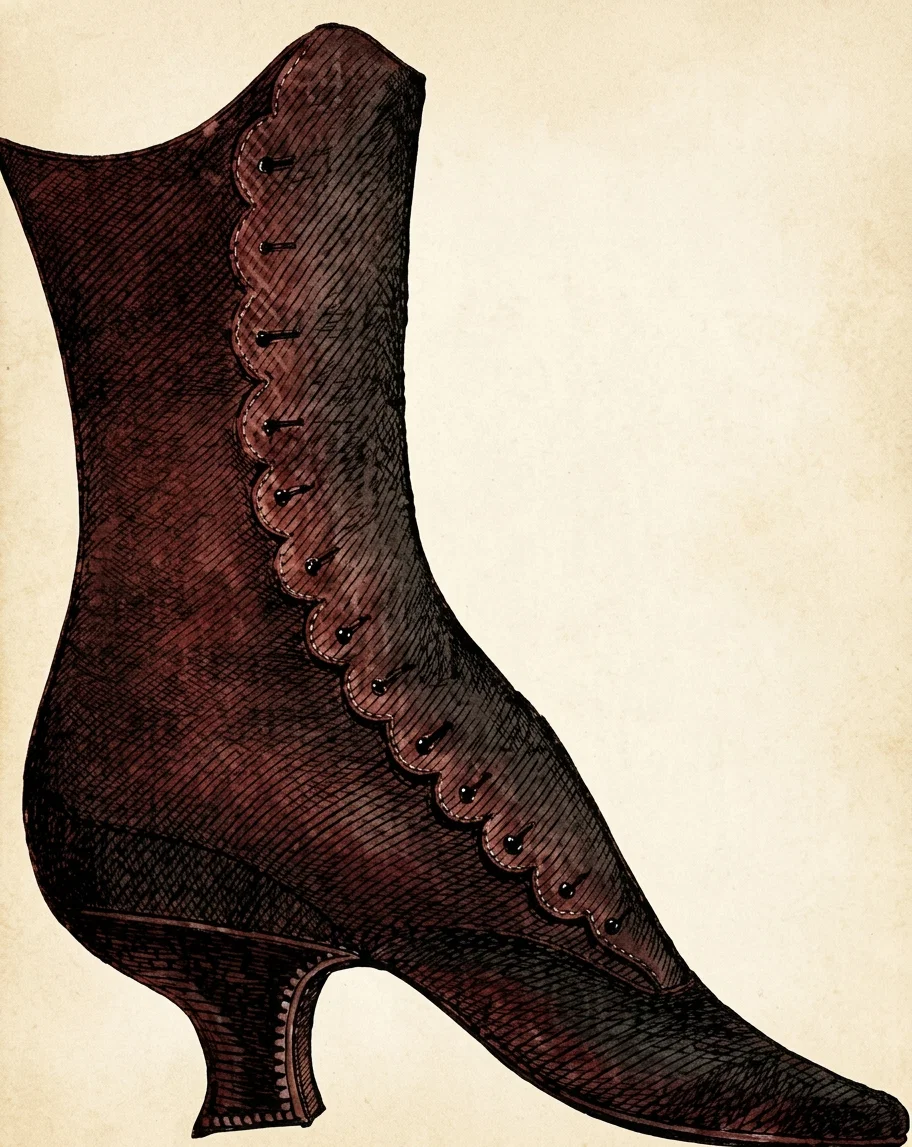
The fashionable high-heeled shoe, the connecting link between a healthy foot and the foot of a Chinese lady.
As a result of violation of the laws of health in regard to diet, exercise, and dress, we have sickly, dwarfed, and deformed bodies. We have been so long accustomed to these ill-shaped bodies, and to artificially correcting them to meet the standard of beauty in many minds, that I fear we are not in a position to appreciate the truly beautiful. So much is artificial nowadays. People spend hours and hours studying and admiring works of art, while the natural is passed by almost unappreciated.
No clothing, however rich and elegant, can make an ill-shaped, weak, distorted body look beautiful, or even comely; and, happily, no dress, however poor or humble, can make a well-proportioned healthy body look mean or insignificant.
We think more of prevailing customs than we do of our lives. Some have said they would rather die than part with their corset. In such a case custom and fashion rule, and the physical laws governing our bodies are made servants to what is sometimes cruel custom; and we begin to wonder whether there are persons left who still have a sacred regard for the human form divine.
Much effort has been put forth along lines of reform, but there is great need for more. The statement that the average body is deformed may be startling to some; but that it is so, and very commonly so, can not be questioned. These are not the deformities which have come as the results of accidents or some diseased process. They are cultivated, and we ourselves have made them.
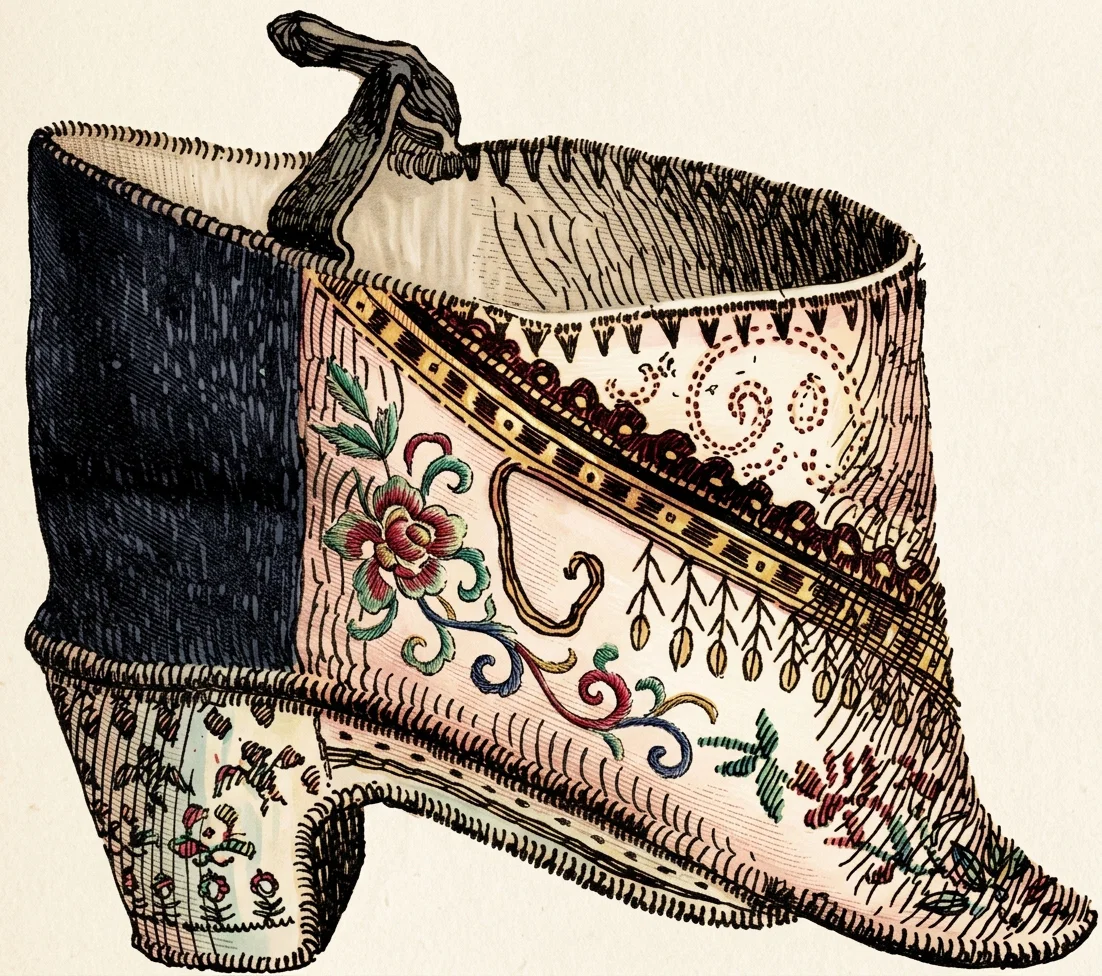
Shoe Worn by the Bound-foot Women of China, Three-fourths Actual Size.
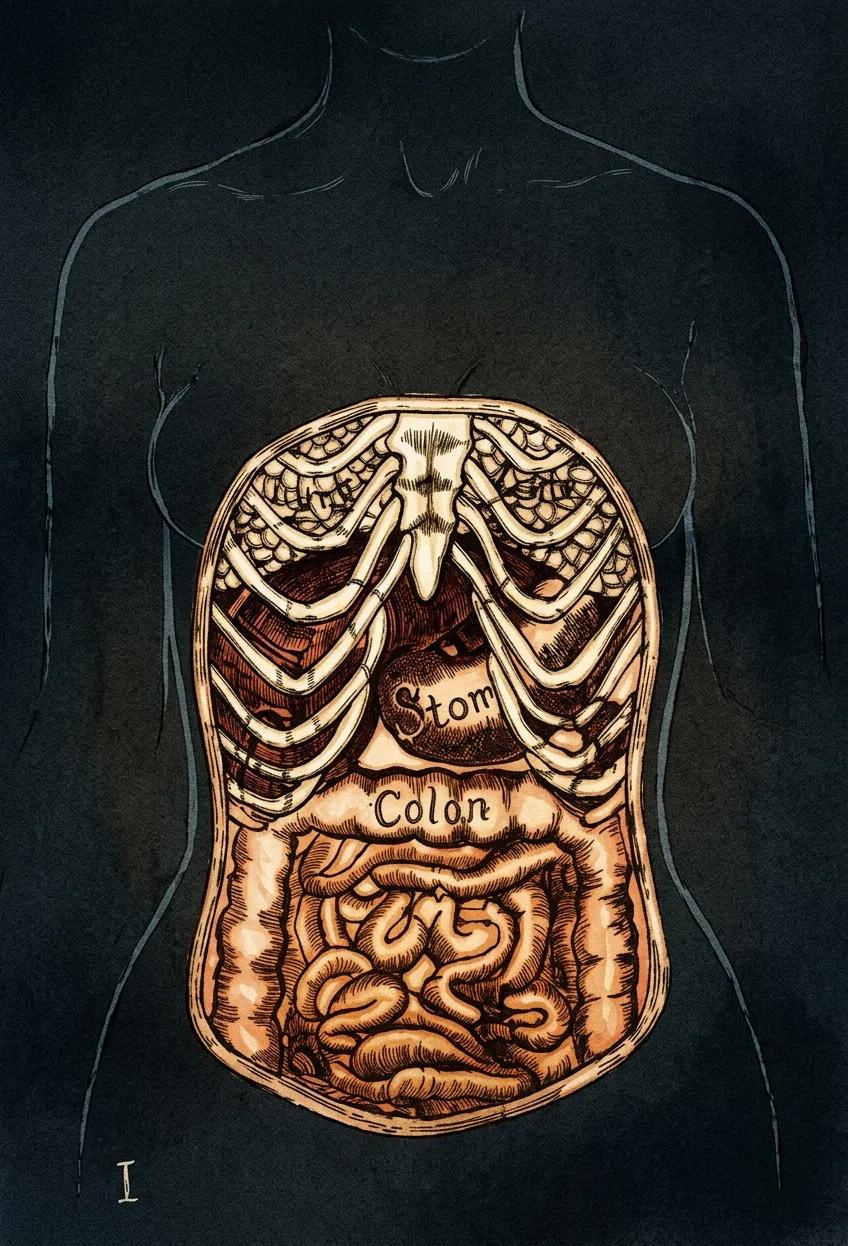
In China the feet are deformed. Among some Indian tribes the head is deformed. In our country the trunk, and especially the waist, of civilized women has been deformed by tight lacing, heavy skirts hanging on the hips, long trains, etc. To appreciate this fully, one ought to become familiar with the human anatomy. On examining the normal human body, we notice that the lungs and heart lie in the chest cavity, and just below them is the diaphragm, separating the two cavities. Below the diaphragm are packed away the stomach, liver, spleen, and kidneys; below these are the small and large intestines. It can be readily seen that at the waistline are situated at least five important and very vital organs of our bodies, upon which we must depend almost entirely for proper bodily nourishment. We are made of what we eat, but our eating apparatus must be in good order if we would be made well.
By carefully observing a perfect figure, it can be seen that the lower ribs spread far apart, so that as much room as possible is furnished for these organs. In fact, the difference between the bust and waist measure ought not to be as great as dressmakers would have us believe. Instead of ten inches difference, there should not be more than six. Daily a physician deals in his office with patients who are suffering from chronic diseases as the result of displaced internal organs. That we should insist upon sowing for sickness instead of health seems strange.
The mother thinks her duty is not fulfilled toward her daughter until she shapes her body according to the prevailing custom of dress, and so, often, at the age of twelve, when the young girl should have every possible chance to develop according to natural laws, she is made to grow into a vise. The young girl should have all the chances for development that the boy does, but instead we find the girl's trunk muscles becoming weaker and the waist decreasing in size, so that it has been found by actual measurement that the waist of the young lady is frequently smaller than when she was a girl of twelve. That this constriction does decrease the size of the waist is proved by the fact that when the corset or tight bands are removed, the waist in- creases in size. I have known this increase to be as much as five or six inches in some cases, showing how greatly the action of the organs located there must have been interfered with.
Headaches, backaches, a feeling of lassitude, inactive bowels, torpid livers, irritable nerves, and nervous prostration have become so common among women especially that it is taken for granted that these are part of our heritage, the same as the color of our eyes or the shape of the nose, and so we try to make the best of it. We find it quite impossible to change the color of the eye, but in most cases these headaches and backaches can be driven away. Why should people always be sick, when with so little effort they could be made well?
We have within our bodies two nervous systems one called the cerebral-spinal system, the other the sympathetic system. By means of the latter the viscera are connected, so that when one organ is affected another sympathizes with it, as it were.
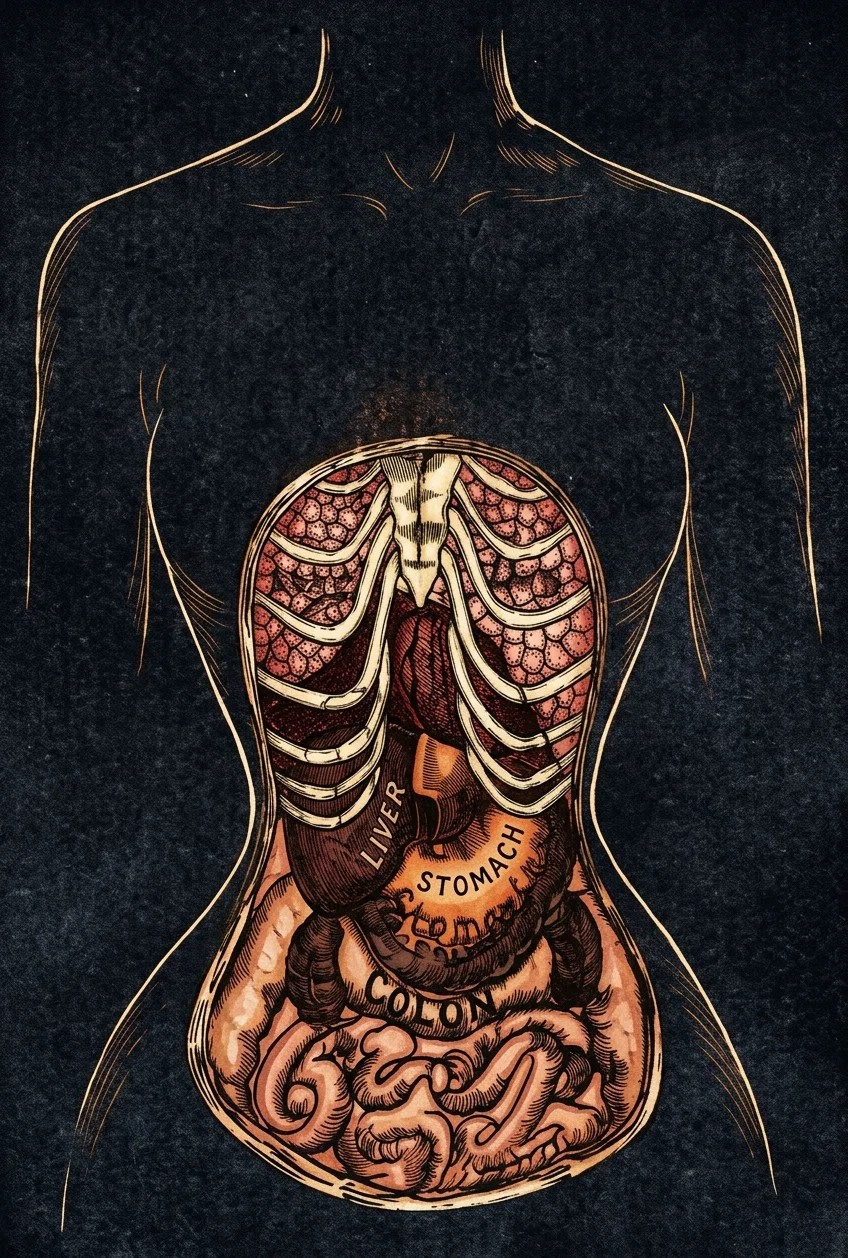
View of the bound waist, showing displacement of vital organs caused by tight lacing—a cause of weak, diseased offspring.
For instance, patients suffering with stomach trouble very frequently have at the same time palpitation of the heart. This is due to the irritation of the sympathetic nerves connecting these two organs. Perhaps we ought to mention that the centers for these nerves lie along the spine, thus accounting for the fact that so often the distressing symptoms are felt in the spine and possibly not at all in the organ which is causing the difficulty. Many of us can recall the disagreeable sensation of having our ears pulled when we were children. Such pulling continued for any length of time would have made us very irritable. It is not at all surprising, then, that when such an organ as the stomach or kidneys is prolapsed, stretching the hundreds of nerves going to it, there should be pains and aches and irritable nerves. This condition is what is accomplished by the conventional dress, prolapsing the stomach, and spleen, and kidneys. It can readily be seen that no amount of plasters or liniments of any sort, or even internal medication, is going to cure such a condition. To bring about a permanent cure the causes producing the difficulty must be removed.
Not only are these organs greatly displaced and the muscles weakened by the conventional dress, but there are other great evils which arise. The diaphragm is so situated that as it moves up and down in free respiration, it acts as a pump, forcing the blood in and out of the abdominal cavity, especially influencing the portal circulation, or the supply of blood to the liver. Conventional dress does not allow the expansion of the ribs at the sides, which would occur in free movement of the diaphragm and the other respiratory muscles, so that the circulation of the blood thru the abdominal viscera is much interfered with, and we have as a result the common torpid liver and dyspeptic stomach.
The healthy waist, showing the vital organs in their natural positions.
Another but not less important evil is the abnormal mode of respiration, which the conventional dress necessarily causes. That respiration is interfered with is shown by the readiness with which a woman tightly dressed gets out of breath. The first thing ordinarily done for a fainting woman is to cut her waistbands and corset strings, so that she may catch her breath.
In proper action of the chest there should be an expansion, not only in the upper chest, but also in11the lower. It does not seem quite right to speak of thoracic breathing only or of abdominal breathing; the two should be combined. If there are no restrictions, a difference of one and one-half to two inches should be noted in the measurement of the waist in forcible respiration, and even more than this in the upper-chest measure. This is impossible with a corset or ordinary health waist or tight-fitting waists or belts of any kind. Why not allow all the life-giving air to enter our bodies that nature has made provision for?
Another evil of the conventional dress is that of an ungraceful, unnatural carriage of body in sitting, standing, and walking. At the present time curvatures of the spine are extremely common. There is scarcely a woman found who does not have some form of spinal curvature to a greater or less degree. Reference has already been made to the fact that the constriction of the trunk muscles has much to do with this. Ask a woman to take off her corset, and she quickly tells you that she can't hold herself up without her corset, simply because she has no properly-developed muscles to hold herself up with.
The healthful dress should be one which allows perfect freedom of every organ and muscle of the body, and which equally clothes all portions of the body. To accomplish this, the limbs and feet must be well protected; thin-soled shoes should not be worn in cold weather; the arms also must be well clothed; there will be no tight elastics around the limbs, no constrictions of any kind about the waist or neck. There is a good feeling that goes with freedom that rewards one well for making the change. When this is done, then an effort must be made, by means of well-directed exercises, to strengthen the dwarfed muscles, and replace the displaced organs, and increase the chest capacity.