The journey from Jerusalem to Joppa may be made by rail or by carriage, the distance by the former being fifty-four miles and by the latter forty-one miles. Most people go by rail. There is but one train daily each way; the train leaves Jerusalem at 8 A.M. and reaches Joppa at 11:30 A.M. At the time of arrival and departure of trains many people and carriages assemble at the station, presenting a lively scene; at other times the vicinity of the station is as quiet as a country station on the Western prairies. The railway is operated by a French company; but many of the employees are natives.
JOPPA.
The first part of the route is through the rocky, barren hills of Judea; after riding twenty-three miles, we enter the rolling plain which extends north along the sea to Cæsarea, where it ends in the slopes of Mount Carmel. The same plain, extending southward to Egypt, constituted the fertile land of the Philistines. To the north it is called the plain of Sharon, which is celebrated in inspired song for its beauties and its flowers, and which, like the land of the Philistines, was noted for its great fertility.
The first station of any importance is Ramleh, a town of 8,000 inhabitants, which during the Middle Ages once had a population larger than Jerusalem. Two miles farther is Lydda, where Peter healed the paralytic who had kept his bed eight years. “And all that dwelt at Lydda and Saron saw him, and turned to the Lord.” Lydda is now but a small village. Anciently it was situated on the principal caravan route between Syria and Egypt. While Peter was at Lydda, Dorcas died at Joppa. “And forasmuch as Lydda was nigh to Joppa [ten miles], and the disciples had heard that Peter was there, they sent unto him two men, desiring him that he would not delay to come to them.”
This part of the journey is of more interest, the fields being green with verdure and the villages adorned with trees and shrubs. As we near Joppa, the number of trees increases till we reach the large orange and lemon orchards east of the town. These are quite extensive, and extremely prolific. Joppa oranges are large and sweet, and command a good price in the markets of Europe.
Just before reaching Joppa, our train passes the corner of the German Temple colony of Sarona, so called from the Bible Saron. This colony, numbering fifty-one families, has had a harder experience than any of the other Temple colonies; the soil seemed saturated with fever germs, and for many years nearly every child born in the colony soon died. But by tilling and draining the soil, the region has now become tolerably healthful. The colonists are chiefly occupied in the culture of the vine, the raising of grain, and the production of honey. The many flowers on the plain of Sharon make the district specially favorable for apiculture. The honey here has such a deliciously delicate flavor that it is difficult to make one believe that it has not been perfumed.
On reaching the station, we meet a crowd, as at the station at Jerusalem. The Arab porters here are the most impudent of any we have met since leaving Beirut; nothing but iron firmness will enable one to escape imposition. Meeting a Swiss-German hotel-keeper, I am at once at home, and, depositing my luggage, begin a stroll about town. The station is at the north end of town, but a short distance from the sea. Just back of the station is a Jewish colony, consisting of squalid huts amongst the sand banks. Between the station and the sea is an Egyptian colony, comparing quite favorably with the Jewish colony.
Joppa, being about half a mile lower than Jerusalem, is much warmer. At the present time, January 18, it is agreeably warm; most of the inhabitants are barefoot, and have but little clothing. It is now the midst of the orange harvest, and the trees are bending beneath the weight of their abundant yield. The natives are busy gathering and taking to town the fruit, and at the wharf many hands are packing and taking to the ships the oranges, which will soon be in the markets of Europe all the way from Naples to London.
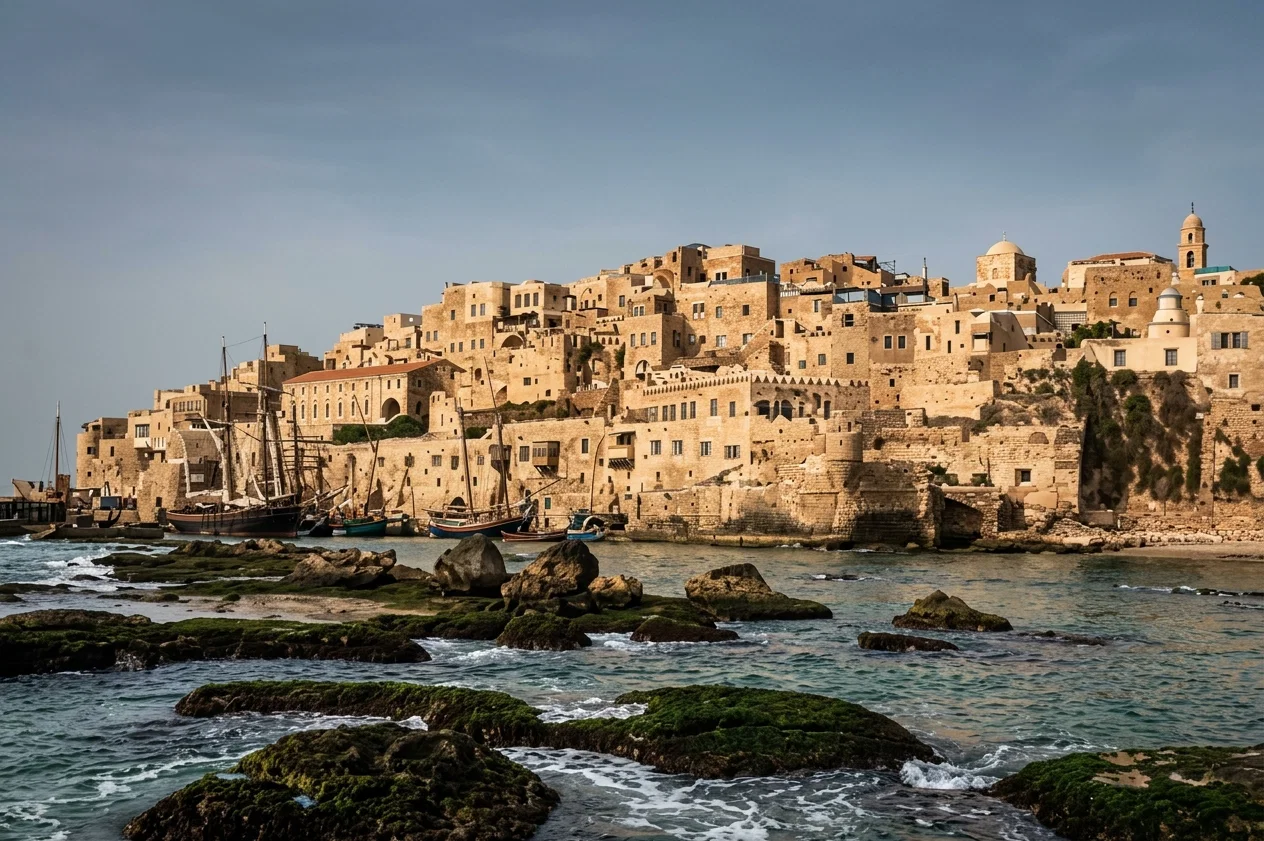
Joppa is situated on a low, rocky promontory extending but a short distance into the sea; and most of the town is situated close to the water’s edge, like the house of Simon the tanner, with whom Peter lodged. The town now has a population of 24,000, half being Mohammedan, a fourth Jews, and a fourth Christians. In the northeastern part of the town is another German Temple colony of forty families, where the principal hotels are located. Among the Germans is a baron who has developed an exceptionally fine garden with a great variety of tropical plants and trees, thus furnishing an illustration of what the land must have been when in its glory.
Joppa is mentioned at the time of the conquest of the land by Joshua; it was to Joppa that Hiram sent the cedars in floats for the temple of Solomon; it was here that Jonah embarked when fleeing from the Lord; here Peter raised Dorcas to life; and it was to this place that Cornelius sent from Cæsarea for Peter, when the Lord prepared Peter for his work among the Gentiles by the vision of the sheet let down from heaven. Tradition still locates the place where the house of Simon the tanner stood. Joppa is of a mixed character, European industries commingling with the Asiatic. Much of the trade is in the hands of Germans, several large steam flouring-mills being prominent among the buildings. As in the days of Samson, the plains of the Philistines produce much grain.
Joppa has no harbor; a reef of rocks jutting a little above the water affords some protection to row-boats; but steamers are obliged to anchor about half a mile out. As about 15,000 pilgrims land here every year, the work of bringing them to shore furnishes a lucrative trade to quite a large number of boatmen. In time of storm, passengers can not land at all; some have passed Joppa three times in succession without being able to land. In rough weather, landing is not only difficult but dangerous; two weeks before I embarked, a boat was capsized and six of the passengers drowned. When it is difficult to land, the boatmen demonstrate what they are capable of in the line of extortion, often demanding twenty times the ordinary price.
The boats usually make the run between Joppa and Port Said during the night. About 4 P.M. I boarded the steamer for Egypt, and as the sun was setting, enjoyed my last view of Palestine; Joppa was just in view to the north,10while to the east extended the broad plain of the Philistines, skirted by the blue hills of Judea; as our steamer kept near the shore, we could see the regions of Ashdod, Gath, and Ekron, the cities of the Philistines to which the ark was successively taken, as the inhabitants were smitten for their impiety. Darkness veiled the shore before we were opposite Gaza, else we could with the naked eye have seen this city, made memorable by the last exploits of Samson.
Next morning in the gray twilight we could see the dim outlines of the shores of Egypt. As the sun rose, the sky was lighted nearly to the zenith with a red, coppery, yet mellow glow, which is peculiar to the desert regions of Egypt, and which constitutes one of the scenic charms of the land of the Pharaohs, Sphinx, and Pyramids. At Port Said, in the wide mouth of the Suez Canal, a forest of masts and smoke-stacks proclaims the extensive traffic of the East and the West which threads its way through the canal. The scene forms a pleasing contrast to the dull, almost deserted regions of Palestine.
We here leave the steamer for the railway, and in a few hours are speeding through the land of Goshen, where the well-irrigated pasture fields, adorned by numerous palms, call to mind the days when the flocks of Israel fed here, and when they escaped the plagues which destroyed the cattle of all that did not heed the Word of God. As we near Cairo, the setting sun again causes the remarkable red glow, and from time to time we catch a glimpse of the Pyramids through openings between the palms which line the Nile. We are soon quartered in the busy Egyptian capital, and, while attending a meeting of the Christian Endeavorers, have the good fortune to meet Mr. Ira D. Sankey, who is visiting Egypt for the health of Mrs. Sankey, and to hear him sing some of the sweet songs of Zion.