DIFFUSION is the great principle underlying all of God’s dealings with the human family. God is the dispenser of light and knowledge, and of every spiritual and physical blessing. “Every good gift and every perfect gift is from above, and cometh down from the Father of lights.” The idea of diffusion, of giving, of spreading abroad, runs all through the teachings of the Scriptures. It lies at the base of the whole scheme of redemption, and interweaves that scheme, like a golden thread, from beginning to end. “God so loved the world, that He gave His only-begotten Son.” “Freely ye have received, freely give.” “Give, and it shall be given to you again.” “Cast thy bread upon the water.” “The GIFT of God is eternal life through Jesus Christ our Lord.” Every benefit enjoyed, every work accomplished, and every hope realized, is in consequence of some grace received from the great Giver.
Concentration is the great principle underlying the work of the enemy. In a multitude of ways is it manifested. Selfish gratification and aggrandizement, self-love and esteem, centralization of power and influence, enjoyment of spiritual or temporal blessings with little thought of others, envy at the good-fortune of others, uncharitableness, narrow-mindedness—in all these and many other ways is the principle drawn out in detail.
During the history of the last six thousand years many instances of these two opposing principles are observed. God’s plan has been that of progression and enlightenment. The policy of Satan has been to circumvent that plan. When God has ordered a forward movement, Satan has stood ready to block the wheels of progress. When God has sought to scatter light and blessing, Satan has endeavored to hedge about the carrying out of the divine purpose. But God has not lacked for resources. His purpose may have been turned aside for a little time, but it triumphed in the end, and accomplished that which He designed. Let a few illustrations suffice to impress the lesson.
In the peopling of the earth six thousand years ago, we see the principle of diffusion illustrated. To Adam was given the command, “Be fruitful, and multiply, and replenish the earth, and subdue it.” The Garden of Eden was given as a model of perfect husbandry, and in the subduing of the earth, it was no doubt designed that the whole world should be brought to the same glorious state of cultivation and production. Here was a work to engage the highest ambition of man, and a work which, if properly entered upon, would have continually led the mind to the great Creator and the Source of all blessings and joy. By the suggestion of evil, the people disregarded this commission. Associating themselves in large companies, their time was occupied with sensual gratification. Self and selfish interests were the objects of supreme service. Finally the sins of the people reached unto heaven, and God remembered their iniquities. All but Noah and his family were destroyed from off the earth.
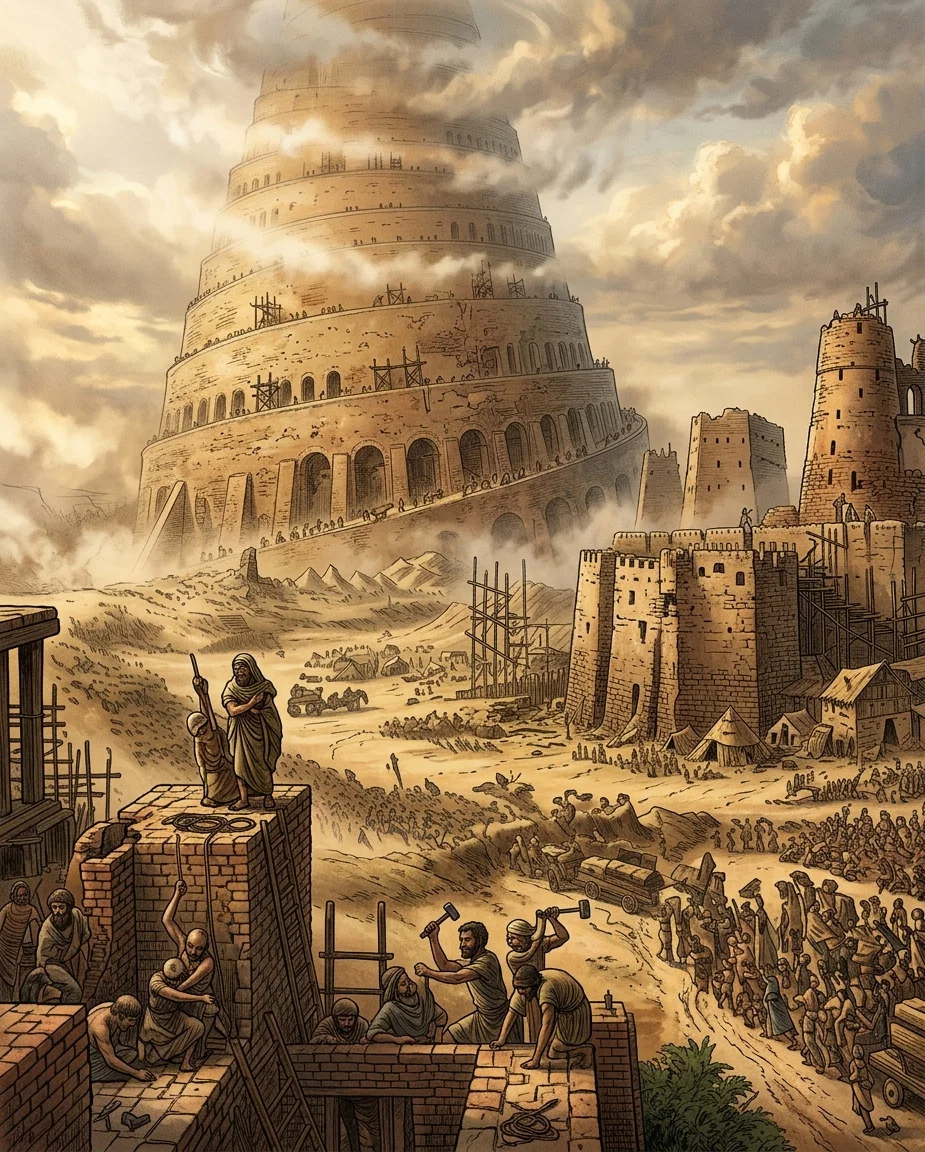
To Noah and his seed the Lord repeated the command given to our first parent, “Be fruitful, and multiply, and replenish the earth.” Again Satan sought to nullify God’s purpose. Love of ease and selfishness prompted their disregard of God’s requirements. “And they said, Go to, let us build us a city and a tower, whose top may reach unto heaven, and let us make us a name, lest we be scattered abroad upon the face of the whole earth.” Here truly was the principle of concentration exemplified. But how did God regard their devices?—“And the Lord said, Behold, the people is one, and they have all one language; and this they begin to do; and now nothing will be restrained from them, which they have imagined to do. Go to, let us go down, and there confound their language, that they may not understand one another’s speech. So the Lord scattered them abroad from thence upon the face of all the earth; and they left off to build the city.”
THE TOWER OF BABEL.
Thus, in spite of all opposition and of the spirit which Satan instilled into the minds of men, God carried out His purpose in peopling the earth.
Christ was the highest manifestation of God. He came not to do His own will but the will of the Father who sent Him. He came seeking not His own interests or His own happiness, but the happiness and interests of others. His life-work was to scatter abroad for others the blessings of which He was the Author. He gave His life a free and willing sacrifice. Contrary to the established prejudices of His own nation, He taught that the Jews were not alone the recipients of divine grace. “Other sheep I have which are not of this fold.” He was the Light which “lighteth every man that cometh into the world.” And to all the world did the influence of His mighty works extend. Before His ascension He gave to His disciples the commission to carry forward the work which He had so grandly inaugurated. “Go ye into all the world, and preach the Gospel to every creature.” “Ye shall be witnesses unto Me both in Jerusalem, and in all Judea, and in Samaria, and unto the uttermost part of the earth.”
Once more we see the efforts of the enemy of all righteousness. Too easily were the early disciples persuaded that their responsibility ceased with the witness they bore in Jerusalem. Some, it is true, heeded the command of the Saviour and carried the message to the surrounding countries, but the great majority found home comforts and the association of brethren too enjoyable to scatter abroad from Jerusalem among the outcasts of the heathen, where trials and difficulties must be met and conquered at every step. So Jerusalem became the center of a large Christian church, while many of the remote regions of the earth were left without a witness for the Gospel. But here the fruitful resources of God are again apparent.
The truth must go, and for the sake of those who should carry the light as well as those who desired to receive it, God will use other means to accomplish His purpose in the evangelization of the world. “And at that time there was a great persecution against the church which was at Jerusalem; and they were all scattered abroad throughout the regions of Judea and Samaria, except the apostles.” Thus early did God impress upon the Christian church that the principle of their evangelistic labors must be that of diffusion and not of concentration.
Not alone in the line indicated—that of scattering the people—is the principle upon which God works illustrated. In the matter of all temporal benefits bestowed, it is the same. God gives life to use for others’ good. “He that loveth his life shall lose it, and he that hateth his life in this world shall keep it unto life eternal.” To the possessors of means, God says, “Sell that ye have and give alms;” “Give to him that asketh thee, and to him that would borrow of thee, turn not thou away.” In the government of His church, He has not centered the authority and power in one individual. He has given to every man gifts severally as He will. The Lord Jesus is the Head, “and all we are brethren,” members of the one body, all sharing equally in the labors, joys, and trials of Christian ministry. But the opposite of all this is found in the great world. Life spent for others is counted spent in vain. Concentration of wealth is everywhere apparent. Hoarded millions are rusting from lack of that use which would lessen and alleviate human wo. In society and in the professed church, caste and social distinctions exist. There are lords many and gods many, popes and potentates, each centering in himself, as far as possible, power, and wealth, and influence. Thus these two opposing ideas are everywhere apparent.
In the work of the Gospel dispensation to-day there is no change in the purpose of God. The Gospel now, as in the past, is destined to go to all the world. The great commission given to the early disciples was not alone to them, but to their children and to their children’s children, and to every follower of the Lord Jesus Christ. Witnesses for God to-day must carry the Gospel message to every nation and tongue on the face of the earth. “And I saw another angel fly in the midst of heaven, having the everlasting Gospel to preach unto them that dwell on the earth, and to every nation, and kindred, and tongue, and people.” Every region, however remote, whether in the confines of darkest Africa, in the isolated islands of the sea, or the more favored parts of our own land, must hear the Gospel of God’s dear Son. “This Gospel of the kingdom must be preached in all the world for a witness unto all nations.” All the commands to diffuse the light, to preach the Gospel, and to make disciples among the nations of men, are doubly and trebly emphasized to the people of this generation.
What relation do we sustain to the great commission? Are we carrying out its provisions, or are we, like the builders of the tower of Babel, making for ourselves in this world a name so that we may not be scattered abroad upon the face of the earth? Has love of ease and of pleasant associations taken possession of our minds to-day as it did the minds of the early disciples, thus deterring us from giving to others the glorious light which we have received? What principle lies at the bottom of our life-work? Is it the principle of concentration or the principle of diffusion? The former will be manifested in the hoarded wealth, in4the selfish enjoyment of home comforts, and in the association of brethren, with little thought for those deprived of such privileges. The principle of diffusion will lead to an opposite course. It may require us to leave home, to separate our connection with large companies of believers, and go into the unenlightened regions of earth and labor for the salvation of others who have not the light we enjoy. Let each individual inquire, Am I assisting in the fulfilment of the great commission? Have I a part in giving the Gospel message? The profession of Christianity, or a union with the visible church, is no evidence or indication in itself alone that the individual is assisting in the proclamation. The one who gives of his means to sustain the work of God, and who by his own personal efforts engages in labor for others, is the only one to whom the great commission has come with true appreciation.
Concentration in wealth, in population, in authority, or in the blessings bestowed by the beneficent Giver, is contrary to God’s design. When thus used, stagnation will result, and inactivity and death be the final outcome. “Go ye into all the world,” is the command to-day. “Preach the Gospel to every creature;” this shows the breadth of the great commission. God exhorts us to “arise and shine.” Our thoughts should be no longer of self, but of others. Souls are perishing, and God asks us to search them out and give them the light of truth which we enjoy. “Behold, I will send for many fishers, saith the Lord, and they shall fish them; and after will I send for many hunters, and they shall hunt them from every mountain, and from every hill, and out of the holes of the rocks.” What principle actuates our labors to-day? Is it that of concentration, or that of diffusion? F. M. W.