The Two Covenants

9%

Seventh-day Adventist Publishing Association · Battle Creek, Mich. · Nov 8, 1881

FromReview and Herald, Vol. 58, No. 19.

Read the full edition

The Two Covenants.

In Hebrews 8:8 we find this statement: “For finding fault with them [the Hebrews], he [God] saith, Behold, the days come, saith the Lord, when I will make a new covenant with the house of Israel and with the house of Judah.” The new covenant, which is the subject of this text, is called in the preceding verse the second covenant. This implies that going before this there was a first covenant, which by parity of reasoning is called the old covenant. These two covenants are singled out from the many covenants mentioned in the Scriptures, as first and second, old and new, because they relate particularly to the great work of the redemption of a lost race, and embody the two grand divisions of that work.
This subject is one in which every person has reason to feel the most lively interest; for it embraces the whole question of our relation to God in this world, and of all our hope for the future. The condition of those who do not place themselves within the provisions of the covenants, is set forth by Paul as wretched in the extreme. Read Eph. 2:11, 12. It is the condition of every unconverted person: no God, no Christ, no hope! It becomes, then, not merely a question of interest, but one of great spiritual importance, to ascertain what constituted the old covenant and what constitutes the new, what change took place between the two, and what the conditions are upon which the promises of the covenant are suspended, that we may know how to comply with them and secure the blessings.
A covenant is defined to mean a mutual agreement between two or more parties based upon mutual conditions and promises. The first covenant, we are expressly told, was made with the Israelites when they came out of Egypt. In the history of that most remarkable of all migrations we find an explicit account of the agreement which God made with them, the only transaction between them which could be called a covenant. The story begins in Ex. 19:3, and continues to chapter 24:8. The condition on God’s part was that the people should obey his voice; and that voice was shortly heard from the summit of Sinai, declaring the ten commandments. His promise was that they should then be a peculiar treasure to him above all people. The condition on the part of the people was, that the Lord should own them as his peculiar treasure; and their promise was, that they would then obey all that he had said. The ten commandments, being the basis of the covenant on God’s part, are in that sense called a covenant; but the sacred writer is careful to put in the qualifying word “his,” referring to God, to mark the distinction. He declared unto you “his covenant,” even ten commandments. And so God speaks of them as “my covenant,” since they are the basis of all his covenants, whether with individuals or nations, and the condition upon which all his blessings are suspended. Whenever the word “covenant” is applied to the ten commandments, it is in this sense. But they are not that which is called the first covenant; for that covenant was dedicated with blood, Heb. 9:19, 20, and the first covenant was thus ratified before the tables of the commandments were put into the hands of Moses. Ex. 24:7, 8. After the covenant had been dedicated with blood, the tables of the decalogue were delivered to Moses. Verse 12. The ten commandments were never sprinkled with blood.
Restored with AI
The time allotted to the old covenant at length expired. Over six hundred years before this, the Lord had announced by the prophet Jeremiah that a new covenant should in due time be made. Read carefully the language in which that promise was given in Jer. 31:31–34. The new covenant was to be made with Israel and Judah. It was not to be according to the covenant made with their fathers. The chief points of difference named were that God’s law was, under this new covenant, to be written in the hearts of his people, and the complete removal of their sins was to be secured through its more gracious provisions.
Christ at length appeared to confirm this covenant. He made it, not with Gentiles, but with those who represented both the house of Israel and the house of Judah. (No outside ten lost tribes to come in afterward.) His blood was the blood of the new testament, or covenant. This covenant had better provisions than the former, having the blood of Christ instead of the blood of beasts. It was established upon better promises, inasmuch as it promised to take away sins in fact, which were taken away under the first only in figure. What was the basis of this covenant?—The same exactly that formed the basis of the first. Then it was God’s law; and now, says God, I will write my law in their hearts; no one can doubt what God called his law in the days of Jeremiah, when this promise was given.
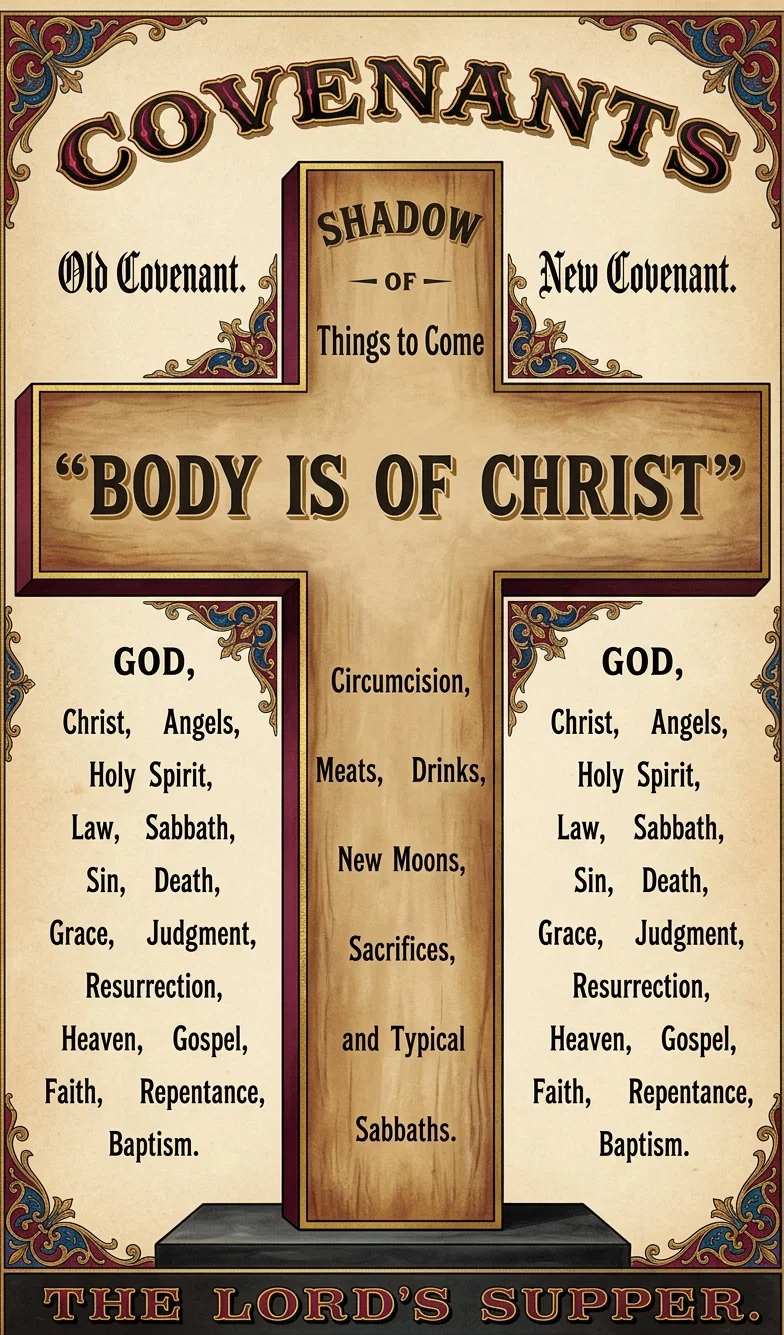
With these remarks the way is prepared to particularize more fully in regard to the difference between the two covenants. This difference is shown at a glance by the accompanying diagram. The cross standing in the center marks the dividing line between the two. On the cross the blood was shed which brought the old to an end, and ratified the new. We have simply to inquire, then, What did the people of God have before the cross which they have not had this side the cross? And, What have we this side the cross which the people of God did not possess before? And, What features belong in common to both periods?
Paul says that the worship of the former dispensation, the old covenant, was a shadow of things to come, but that the body is of Christ. Since Christ, we have had to do with the substance instead of the shadow, the antitype instead of the type. But what was done away in Christ? What was nailed to the cross? Answer: Circumcision, meats, drinks, new moons, sacrifices, and typical sabbaths. This Paul expressly teaches. And what remains? Answer: God, Christ, angels, Holy Spirit, law, Sabbath, sin, death, grace, judgment, resurrection, Heaven, gospel, faith, repentance and baptism. But all these the children of God had before the cross the same as after. We have the same God now as then, the same Christ and angels, the same Holy Spirit, the same law and Sabbath; for, as already noticed, the law (the same that in the days of Jeremiah was acknowledged to be the law of God) was under the new covenant to be enshrined in the very hearts of Christ’s disciples; and this law Christ magnified and made honorable, according to the declaration of the prophet, Isa. 42:21, by his perfect obedience to it, his instructions concerning it, and his sacrifice of his own life to its claims. And this law had a Sabbath, which continues with it,—the primeval, Edenic, God-ordained and God-sanctified rest-day. And this day Christ recognized, observed, and earnestly labored to set upon its true basis by stripping from it the burdensome load of Pharisaic glosses and rabbinical traditions, by teaching the people what could be done in accordance with the Sabbath law. But the most rigid Sundaytarian must admit that previous to the cross, where the new covenant was completed, ratified, and sealed with the blood of Christ, the testator, not a step was taken toward the introduction of the first day of the week as the Sabbath in place of the original seventh day. Then it cannot come in at all; for Paul declares that after the death of the testator nothing can be taken from or added to the testament, or covenant. Gal. 3:15; Heb. 9:17. This is one among the many considerations equally conclusive, each of which forever settles the Sunday-Sabbath question.
The other objects named in the diagram—sin, death, grace, judgment, etc.—existed before the cross, and exist equally since that time. And in place of that which was nailed to the cross, which pointed forward to Christ, we now have the Lord’s supper pointing back to him.
It becomes, therefore, the easiest thing imaginable to determine what change occurred in the transition from the old covenant to the new. All that was shadowy, typical, and ceremonial ceased at the cross. All else remains under the new covenant. And they who are teaching that the ten commandments were the old covenant and have consequently been done away, are doing a work in which the measure of their success is simply the measure of the condemnation which will rest upon their souls at last.