72.—THE GENEALOGY OF CHRIST.
Please reconcile the lineage of Jesus in Matt. 1:16 with Luke 3:23. J. W. L.
Ans. In modern times, infidels have made considerable capital out of the seeming discrepancy between the genealogy of Christ as given by Matthew and Luke. It is a remarkable fact, however, that, according to the statement of Adam Clarke, the infidels of the first century never sought to invalidate these genealogies, though they were, no doubt, just as sharp in making points against the Christians as are their brethren of the present time. The explanation of this difference is found in the circumstance that they, living near the time of Christ’s birth, knew very well that the accuracy of these genealogies could not be successfully disputed.
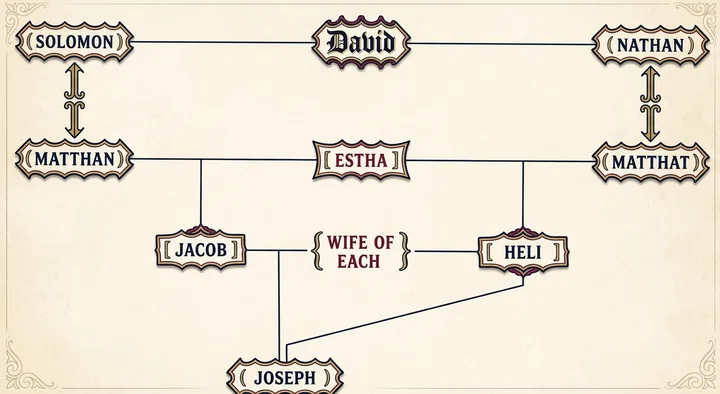
A glance at the two lines will show that they differ so widely in the numbers of the persons mentioned by each, that the two writers could not have attempted to follow one and the same line. Matthew, for example, has forty names between Joseph and David; whereas, Luke has only twenty-five names between Joseph and David. Again, in running up the two lines, Matthew begins the ascent as follows: Joseph, Jacob, Matthan; while Luke has it: Joseph, Heli, Matthat. Once more: Matthew ends his line with Solomon and David, while Luke ends his with Nathan and David; i. e., running up from Joseph, both terminate with David; but one passes through Solomon the son of David; the other, through Nathan, another son of David. Now we have a clue to the matter. It is possible, nay, probable, that one ascended to David through the line of Nathan’s posterity, and the other through that of Solomon’s posterity. The only difficulty in the way is found in the fact that Matthew says that Jacob begat Joseph, while Luke says that Joseph was the son of Heli. But let us be patient in our investigation. It is not best to throw away the whole Bible before we have first manfully grappled with the difficulties which are in the way of our accepting it as authentic. To begin with, then, we suggest that among the Jews a son by marriage was spoken of at times as a son in reality. Recollecting this fact, Albert Barnes will furnish a way of escape out of the whole trouble. He says, Joseph was the natural son of Jacob, and at the same time the legal son of Heli; also that Matthew traced his genealogy down through Jacob to Joseph, from David, while Luke, on the contrary, traced his up through Heli to David; i. e., through another line of the same family, legally speaking. This question is so important, and is handled so largely by skeptics, that we give below some remarks from Mr. Barnes on the subject, together with a diagram which may be found in his notes on Matt. 1: “Joseph was the legal son and heir of Heli, though the real son of Jacob, and thus the two lines terminated in him. This was the ancient explanation of most of the Fathers, and on the whole is the most satisfactory. It was a law of the Jews that if a man died without children, his brother should marry his widow. According to this solution, which was first presented by Africanus, Matthan descended from Solomon, married Estha, of whom was born Jacob. After Matthan’s death, Matthat, being of the same tribe but of another family, married his widow, and of this marriage Heli was born. Jacob and Heli were therefore children of the same mother. Heli dying without children, his brother married his wife, and begat Joseph, who was the legal son of Heli. This is agreeable to the account of the two evangelists. Matthew says that Jacob begat Joseph; Luke says that Joseph was the son of Heli; i. e., was his legal heir, or, reckoning according to law, his son.”},{