AN IMAGINARY CONVERSATION ON A VERY IMPORTANT THEME.
BY ELD. W. H. LITTLEJOHN.
Mr. Biblist.—“Maud, answer the doorbell, if you please; it seems that we are to have a call this evening.”
Miss Maud.—“Father, this is Mr. Thoughtful.”
Mr. B.—“Good evening, Mr. Thoughtful. Are you well, sir?”
Mr. T.—“I am quite well, I thank you, physically speaking; but I confess to a little embarrassment of mind on account of the nature of my mission. As I approached your door, I queried whether you would not smile when you learned the character of the errand which has brought me to your house on this dark night.”
Mr. B.—“Well, neighbor Thoughtful, of course I do not know to what I am indebted for this call, but I presume that you have come for some good purpose, and I confess that your remarks have excited in me a curiosity to know just what your errand is; so you will please divulge the secret immediately.”
“Mr. T.—Well, to be frank with you, I have been reading, of late, the five books of Moses, and for some reason which I cannot explain my mind has been particularly impressed with the account given therein of the tabernacle and its service. It struck me as being very remarkable that such a building should be reared up under such circumstances, and that the Lord should have given such minute directions for the construction of even its most unimportant parts. Why! the pins, the taches, the sockets, the loops, the needlework, and indeed everything connected with the building, is described as minutely as though the fate of the whole people depended upon their being made on just such a plan.”
“Now, to be brief, I have thought this matter over until I have become satisfied that there was a significance in the tabernacle and its service that I have never understood; and knowing your acquaintance with the Scriptures, I have called this evening to see if you can give me any light upon this subject.”
Mr. B.—“Well, neighbor Thoughtful, I am glad that you have called this evening on the errand that has brought you here. Some years ago I had an experience somewhat similar to your own. For months my mind was occupied, more or less, by thoughts very much like those you have just expressed. It occurred to me, as it did to you, that the tabernacle and the temple which succeeded it must have been designed to answer a purpose much higher than that of merely furnishing a place where victims could be offered. I do not know that I ever should have obtained any special light on the subject had it not been for an event that I have ever since looked upon as a providential occurrence.”
“While walking through the town of C. one day, my attention was attracted by a large tent that had just been pitched upon the commons. My first impression was that it was connected with some circus. I soon discovered my mistake, however. On a streamer that was flying from the top of the center pole, I read these words, ‘What Is Truth?’ In a moment I discovered that the occupants of the tent must be religionists of some sort. My curiosity was aroused, and I immediately entered the tent, that it might be satisfied. There was but one person therein. He was a youngp. 467 man of fair intelligence, and as he seemed disposed to be quite communicative, I began to inquire into the nature of his mission. He frankly told me that he was a Seventh-day Adventist, and that he was seeking to propagate their faith. I had heard considerable about that people, and was so far prejudiced against them that I was about to turn upon my heel and leave the tent in disgust, when my attention was attracted by a prophetic chart that was suspended behind the desk. My curiosity was aroused a second time, and I thought that I would at least approach near enough to it to get a better view of the hideous-looking creatures that were portrayed thereupon. The young man seemed to read the exercises of my mind, and wishing to hold on to me for further conversation invited me to enter the desk and examine the chart at my leisure. This I did, glancing over the representations of beasts and angels, till at last my eye rested upon a diagram purporting to present a ground plan of the tabernacle of Moses. By the way, Maud, I think I have a fac-simile of it in the book-case yonder; look it up, if you please.”
Maud.—“Yes, father, I know just where it is. This is it, is it not?”
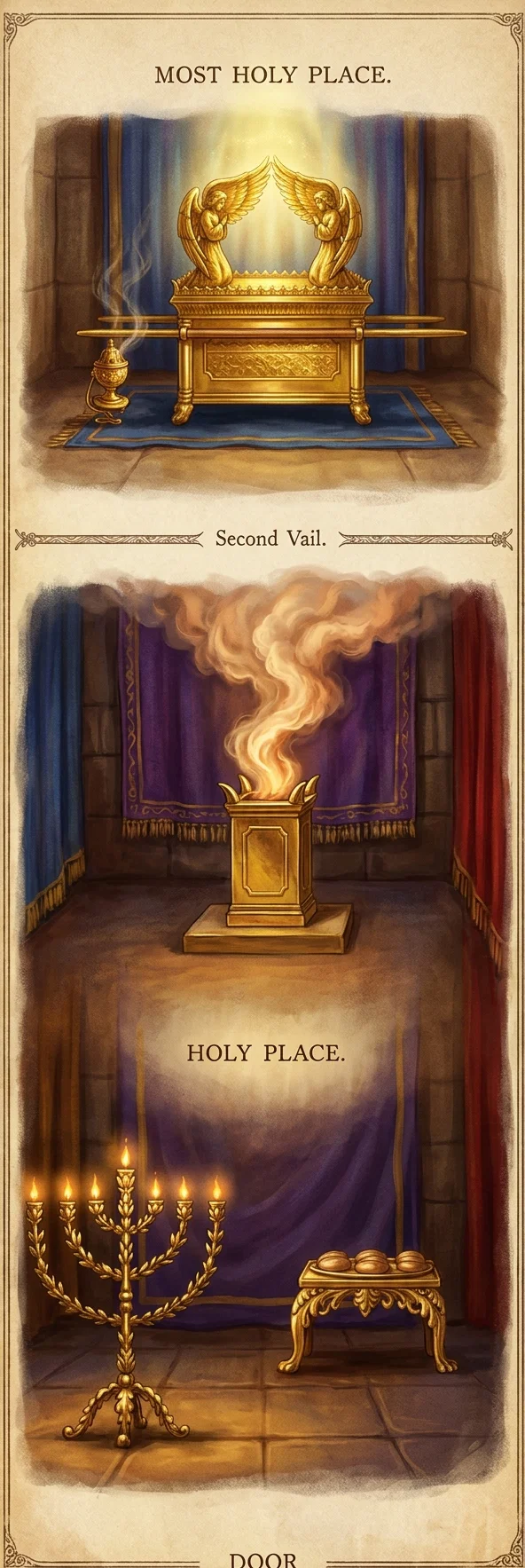
Mr. B.—“Yes, this is the one. Now, Mr. T., if you have studied the book of the law carefully, you will perceive that this diagram, which we will place on the table before us, presents a view of the plan of the inside of the tabernacle according to the description given therein. There is the dividing wall that separates it into two apartments, which are called respectively the holy and the most holy place. You will observe that the most holy place is exactly square, and occupies one-third of the tabernacle. In it you will notice the following articles: 1. The golden censer; 2. The ark of the covenant, overlaid with gold, and containing the tables of the law of ten commandments, and the pot of manna, and Aaron’s rod that budded; 3. On the ark you will see that the cherubim are placed and are represented as overshadowing the mercy-seat, or cover of the ark, with their wings.”
“Passing now to the first apartment, you will discover that the only articles that it contains are the candlestick,—or more properly the lamp-stand with seven lamps,—the table of shewbread, and the golden altar of incense. By carefully comparing this diagram with the accounts given of the tabernacle in Exodus, chapters 25–27, you will find that it correctly outlines the building in question, and properly locates every article of furniture that it contained.”
Mr. T.—“Very good, Mr. B.; but I do not see that this diagram relieves my difficulty in the least. I have studied the question so long and so earnestly that I could have sketched the tabernacle and its furniture just as you see it there, without making a single mistake. The point which I cannot fathom is this: Granting that the tabernacle contained just what is found in the diagram, why did it contain these things rather than something else?”
Maud.—“Yes, Father, that is the very thing that I too would like to understand. I am not much of a Bible student, I confess; but the same queries which have troubled Mr. T. have suggested themselves to my mind heretofore.”
Mr. B.—“Well, I see that I have critics to deal with, and I am not averse to your questioning me at the proper time; but permit me to suggest that if you had not interrupted me in my story, I should have reached your difficulty ere long. Let me resume my account, therefore. In the meantime, you will remember that I was in just the position you now occupy; I could not comprehend the reason why the tabernacle was made just as it was made.”
“Well, as I was saying, my eye lit upon the diagram in question, and it immediately occurred to me that it was not impossible that the young preacher might be able to throw some light on the question that had perplexed my mind so long. Pointing to the diagram, I said, ‘What is this that you have here, sir?’ ‘That,’ said he, ‘is a diagram that we employ in our lectures when we wish to illustrate the sanctuary question.’ ‘But,’ I replied, ‘what do you mean by the sanctuary question?’ ‘Well,’ he remarked, ‘it would take some time to make you comprehend the sanctuary question in its full scope. If, however, you will attend my lectures regularly, and listen candidly to all I may have to say on that topic, I assure you that—little as it is understood at the present time—I will prove that it presents one of the most important themes found in all the Scriptures.’”
“Impatient at the proposed delay, and anxious to get his views of the subject, I replied, ‘I do not object particularly to listening to your lectures, sir, provided they shall be interesting and profitable; but, to tell the truth, I am so anxious to get the facts in regard to the sanctuary question that I cannot bear the thought of listening to a whole course of lectures before reaching them. Could you not by conversation, or in some other direct method, impart to me the information that I desire?’ To this the preacher replied, ‘I will tell you what I will do. You attend the lectures each evening, bringing your friends with you, and I will grant you the liberty to come to the tent each day during the forenoon, and we will spend several hours together in canvassing this subject from the Bible standpoint.’”
“I immediately accepted his proposition, and the next day we entered upon our task. The result was that I soon became convinced that he had light upon the subject in advance of anything that I had ever received. It would be impossible to even give an outline of his theory to-night, as it is already past nine o’clock; so I will make this suggestion: You return to-morrow evening, Mr. T., to this room, and I will give you some of his ideas respecting the design of the sanctuary, or the tabernacle; for these are but two terms for the same thing.”
Mr. T.—“Very good, Mr. B., I gladly accept your proposition, and as my interest in the subject is very deep, you may look for me to-morrow evening at a very early hour. Good night, Mr. B. Good night, Miss Maud.”
Mr. B.—“Good night, Mr. T.”
Maud.—“Good night, Mr. T.”
Mr. B.—“Maud, did I understand you to say that you do not comprehend the sanctuary question?”
Maud.—“No doubt you did, father; for that is what I stated.”
Mr. B.—“I am surprised that the daughter of a Seventh-day Adventist should not be posted on a topic so much discussed by our people. But never mind, my daughter, it is not too late for you to get an understanding of this subject. Be sure to be present hereafter at the interviews between Mr. B. and myself, and I think that I shall be able to make the question so plain that you cannot fail to comprehend it fully.”