THE CLOSE OF THE VOLUME

4%

Seventh-day Adventist Publishing Association · Battle Creek, Mich. · Tuesday, December 23, 1884

FromThe Advent Review and Sabbath Herald, Vol. 61, No. 51

Read the full edition

THE CLOSE OF THE VOLUME.

We give this week the index of volume sixty-one, to which these words from the epistle to the Hebrews may well be applied: “Of the things which we have spoken, this is the sum.” It will well repay the reader to look it over to remind himself of the many good things which have been served out to him during the past year, the multitude of which, as they have come to him gradually from week to week, he may not have realized.
THE FIRST GREAT LIE.
ITS ORIGIN AND FRUITS.
(Read from Bottom to Top.)
THE FIRST GREAT LIE. ITS ORIGIN AND FRUITS. (Read from Bottom to Top.)
He will find that a great variety of subjects has been presented. The main features of our faith,—law, gospel, and prophecy,—have been fully canvassed. Matters theoretical and practical, historical and experimental, pertaining to the signs of the times, the progress of our cause, the fulfillments of prophecy, and the course of events in the world in general, have been presented in one unceasing panorama upon its pages. Those who have read them must have had their faith strengthened, their spirits revived, and their hope and courage greatly increased.
There has never been a more encouraging period in the history of our cause than that covered by the past volume; and the Review has been the depository in which the record of all the encouraging items, facts, incidents, and movements has been gathered. The two thousand nine hundred and eighty-four conversions which have been reported, the good accomplished by the tent-meetings, the success of the long series of camp-meetings, the blessing which has attended the labors of Sr. White at these meetings, the fifty-seven millions of pages of books which have been printed, the two and a quarter million copies of periodicals which have been issued, the sixty-three thousand dollars’ worth of books sold, the eight new papers started, the older foreign missions enlarged and new ones opened, the city missions established, the growth of the tract and missionary work, the liberal donations of funds to sustain this latter work, domestic and foreign, and the earnest endeavors in many places on the part of both ministers and people to reach a higher state of practical godliness and devotion to the work—all these features have been calculated to inspire every heart with good cheer, fresh courage, and gratitude to God.
And the outlook for the future is no less encouraging. For the evidence is daily accumulating that these truths which constitute the specialty of the work of Seventh-day Adventists, are the crowning truths of God’s providence and revelation in the world. If so, the hand of Heaven is in this message, and the full design of the Lord in its promulgation, will be accomplished.
The testimony of the faithful and true Witness is that he has set before this work “an open door and no man can shut it.” The temple in heaven has been opened, and there is seen therein the ark of his testament. Rev. 11:19. This view is not to be obscured. Men cannot hide the heavenly temple nor cover the ark from view. This cause has come to stay, and this truth is to be promulgated, till that supreme moment is reached when we pass the dividing line between the dispensations, and the glories of the heavenly state shall burst upon our vision.
Then strengthen the feeble knees, and lift up the hands that hang down. Who can lose heart in sight of the prize? And as the angels said to Lot on the eve of Sodom’s destruction, “Hast thou here any besides?” so the question may now be asked of every believer, Hast thou here any besides? Have you friends or neighbors to whom a knowledge of these things should come? Call their attention to the REVIEW. Secure their subscription for it. Induce them to read.
As the times and the work become more and more interesting, so the REVIEW will become a more and more important factor in the work. It will seek to be a true reflection of this cause, to warn sinners, arouse the careless, and strengthen believers. It is such a paper as should go everywhere. No pains will be spared to make the coming volume more valuable than any of its predecessors. And we ask the co-operation of all its friends.

MAN’S NATURE AND DESTINY.

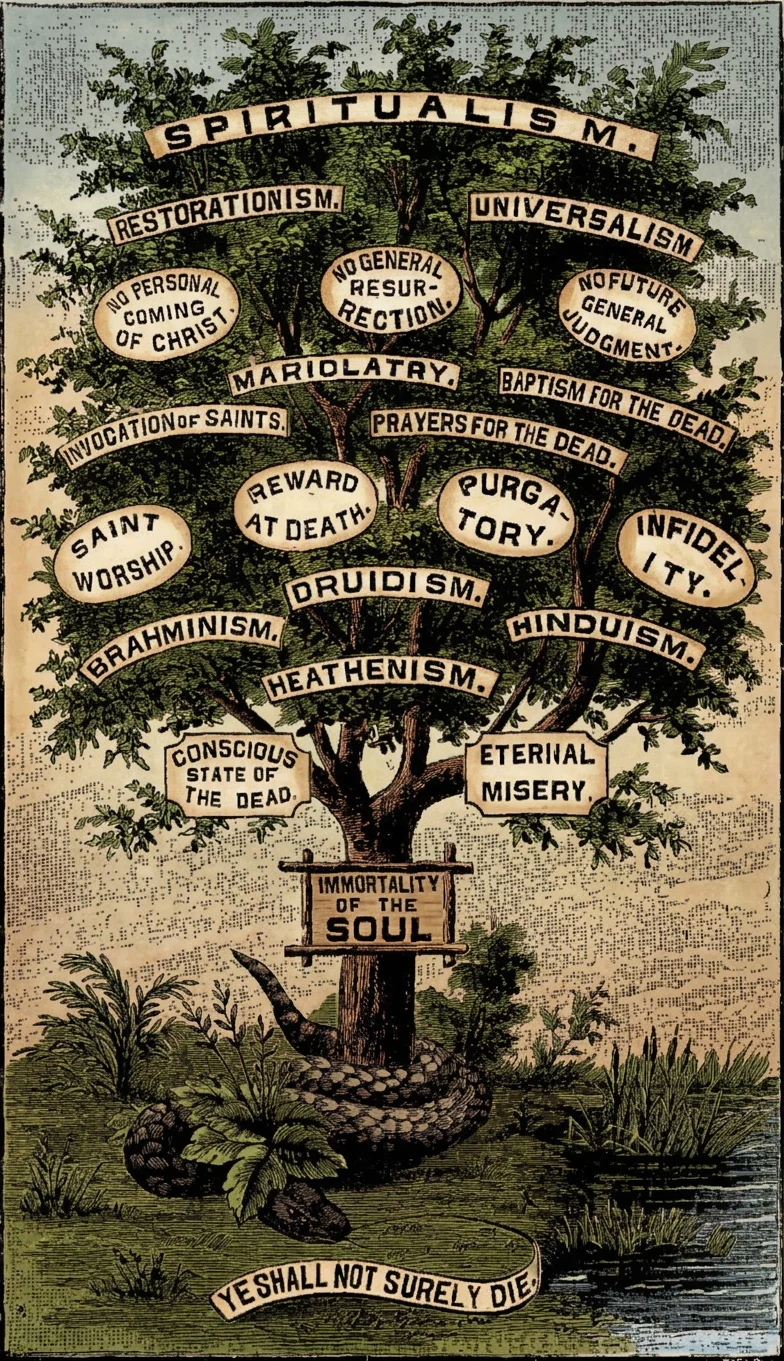
The foregoing illustration has been designed and prepared expressly for the new edition of the work “Man’s Nature and Destiny,” and is printed as the frontispiece in that book. As the reader will perceive at a glance, it contains a sermon in itself. It presents, as in a nutshell, the whole hideous outgrowth from that first falsehood uttered by the serpent in Eden, “Ye shall not surely die.” The great foresight and the deep-seated malignity of the tempter is shown in the fact that no sentence could have been uttered which would have produced such a baleful outgrowth of superstition and error as this. Like the ostrich which imagines if he can get his head under a leaf that his whole body is hidden, so the serpent peers out slyly from under the bush, as if he would keep himself in the background, and conceal his presence
as much as possible. But there is not enough of it to hide his form, which is plainly discernible.
From the announcement then so insinuatingly made, “Ye shall not surely die,” in opposition to the express denunciation of God, “In the day thou eatest thereof thou shalt surely die,” has grown up among men a doctrine comprehensively expressed by the terms “Immortality of the Soul.” This is therefore affixed to the body of the tree growing up from the coils of the serpent. The tempter’s words were the first enunciation of that doctrine, and the foundation upon which it rests.
Two fundamental conclusions at once spring from this doctrine. For if the soul is immortal, the dead are conscious, and an unending state of conscious suffering awaits the incorrigibly impenitent. On the two main branches of the tree we therefore have “Conscious State of the Dead,” and “Eternal Misery.”
Over the central body of the tree we have “Heathenism,” as the doctrine of the immortality of the soul is the source of most of the darkness and superstition of all the pagan world. But out of the manifold forms of error there existing, three distinct systems are specified, one of which, the bloody system of “Druidism,” has happily passed away, but two of which “Brahminism” and “Hinduism” are still current, and all of which were expressly founded upon the doctrine of the immortality of the soul. (See the recent work entitled “Error’s Chains, how Forged and Broken,” by Frank S. Dobbins, of Japan.)
Ascending the tree we come to fruit which this doctrine has borne in the Christian world,—“Saint Worship, Reward at Death, Purgatory, and Infidelity.” Of these the first three could not exist a moment aside from the doctrine of the immortality of the soul. And the latter, “Infidelity,” is placed as one of the fruits of this doctrine; for it is largely owing to this. This is placed on the “eternal misery” side of the tree; for this latter doctrine, so contrary to every conception of justice, and the common emotions of humanity, has probably made more infidels than any other doctrine whatever.
We next have the “Invocation of Saints” and the “Mariolatry” (worship of Mary) of the Papal Church, and the “Prayers for the Dead,” and “Baptism for the Dead,” of the Mormons and some other sects, none of which could exist were it not for the doctrine of the immortality of the soul.
Three great contradictions of Bible subjects next appear as the fruit of this doctrine; namely, “No Personal Coming of Christ,” “No General Resurrection,” and “No Future General Judgment.” For if men are judged individually, as they die, as they must be if they are conscious in death and enter at that time upon their rewards and punishments, there is no necessity for a future general Judgment when all will be judged together; and there is no possibility of such a scene. It is a libel upon God to suppose it. This is probably what led a prominent clergyman in Battle Creek to exclaim in his pulpit last summer, “No one will ever see any worse day of Judgment than this beautiful June day.” Yet if the Bible teaches any doctrines whatever, one of them is a future general Judgment; hence that doctrine that contradicts it is a dangerous error. Again, if all the dead are alive in the spirit world, there is no need of a general resurrection, as the Bible teaches. Hence that doctrine has largely fallen out of the creeds of Christendom. And then, if men are already judged, and, being alive, do not need to be raised from the dead, what need is there of any personal second coming of Christ, since the Bible represents that coming to be for the express purpose
of raising the dead and giving immortality to his people? There would be no necessity of it, and hence this doctrine is spiritualized away in almost every orthodox pulpit in the land. Oh that men would candidly and conscientiously consider the many and grievous errors that grow out of the anti-scriptural dogma of the immortality of the soul!
As a Christian revolt from the doctrine of eternal misery, there have sprung up the two forms of belief which next appear as “Restorationism” and “Universalism,”—forms of error which could present no claims for adoption, if the doctrine of the immortality of the soul were taken out of the way.
And finally the tree tops out with “Spiritualism,” Satan’s last crowning imposition upon the credulity of men,—a system in which spirits of evil palm themselves off as invisible embodiments of our dead friends, conscious and active and anxious to communicate with us, whereas they are all unconscious, quietly resting in the grave till the resurrection. This whole system of deception rests solely on the doctrine of the immortality of the soul. To strike that down is to demolish at one blow the whole superstructure.
Thus we have at one view the origin of this evil tree, and the baleful fruit it bears; and at one glance the relation is seen which the doctrine of the immortality of the soul sustains to the dark devices of heathenism, and the errors and superstitions of Christian lands. What a libel is it upon the word of God to charge upon it the teaching of such a doctrine! and how zealously ought we to labor to disabuse the minds of men of so gross an error.
This work, “Man’s Nature and Destiny,” claims to be a more comprehensive examination of this question from the specific standpoint of the Scriptures than any other work now before the public. Every text usually appealed to in controversies on this point is examined. In the new edition recently issued, two new chapters entire are added, besides many additions in other parts of the work, swelling the volume to 444 pages. The pages are of a pleasing size and form, the type new, open, and easily read, and the stock of fine quality. It is nicely bound in muslin, stamped in gilt and black, with as unique and striking a gilt side title as was probably ever designed for a book. It is sure to attract attention.
The world is ripe for the agitation of this question, and multitudes are ready to embrace the truth upon it. Some of our canvassers, judging from remarks which they frequently hear, conclude they could do well with it as a subscription book, and wish to make an effort in that direction. For this purpose prospectuses have been prepared, and vigorous efforts to circulate it in this way will doubtless meet with good success, and accomplish great good.