(Continued.)
THE SETTLEMENT OF PITCAIRN ISLAND.
As the “Bounty” cleared Matavia Bay, she took a northerly course. But this was only intended to deceive those who remained at Tahita, as Christian intended from the first to sail in a southeasterly direction, in search of an islet described in one of his books as having been sighted by a young man named Pitcairn. The book described the “lone isle of the ocean” as a beautiful place,—
“Where over the reef the surge rolls free, Like a circlet of pearls round an emerald stone.”
And as the place was described to be uninhabited, Christian determined to make it his place of abode, if possible. To reach that point would be to secure a place of refuge for himself and others whom his rash act had made outcasts and outlaws.
He felt sure that search would be made for him, and knowing that the first place a vessel would naturally touch in search of the fugitives would be at Tahita, he resolved to put them off the track of himself at that point, by sailing northward until out of sight of that island. He then directed his course for Pitcairn, as it was located in the book in his possession.
For several weeks the search for the place was kept up, until the wanderers began to fear they would not find it. But toward the end of October, a distant rock was seen to lift itself from the ocean. Coming near to it, they found its sides everywhere precipitous, and a depth of water surrounding it that would forbid ships’ anchoring there. They now sailed round the island to find a landing-place. Twice, however, they compassed it before discovering a slight indenture in the coast where there seemed a possibility of landing. Into this the vessel was taken, and stripped of everything, even to her planks, copper, nails, bolts, etc., when the hull was set on fire. The guns she carried, and what remained of the hull after being burned to the water’s edge, were sunk in the ocean, and so all traces of the vessel were destroyed.
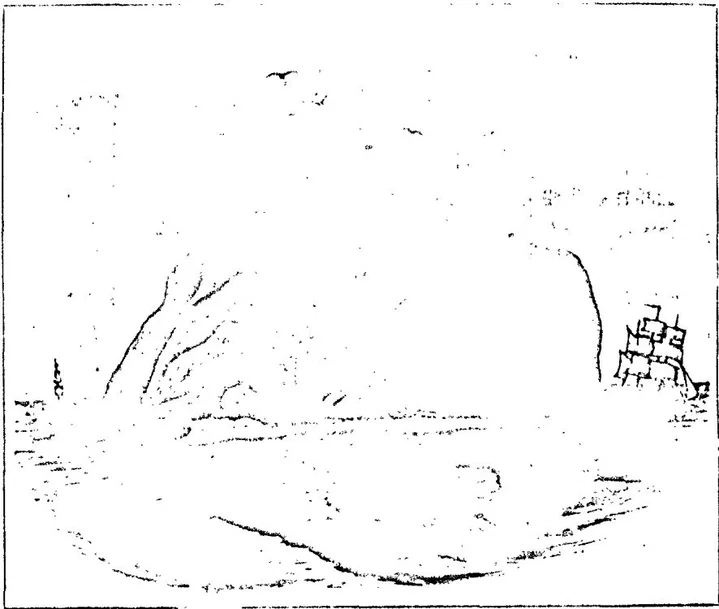
The small indenture in the island, where the refugees effected their landing, has ever since borne the name of Bounty Bay. From this point, the party, consisting of the mutineers, three men brought from Tooloonai, three Tahitian men, one child, and thirteen women, found their way up the steep ascent to the plateau 400 feet above the ocean, only to be surprised at what they saw. Here they found already growing, cocoa-nut trees, bananas, plantains, and bread-fruit trees, which crowned the ridges of the island. As they pushed toward the center of the little spot, they were impressed by the beauty of the scene. Forests of fig-trees and palms grow on the steep hill sides, and charming vines filled the valleys, forming “endless canopies of sylvan net-work.”
But it was impossible for peace to be secured, even in that lovely place, so long as the distinct races there represented should be recognized. Although the white men had taken wives of the Tahitian women, they evinced a superiority over the other representatives of the island races among them, that was not relished by the latter. A plot was formed by the colored men to murder all the English, but was exposed by the wives of the latter. Another was quickly hatched, which was fatal to Christian. Four others, also, fell victims to the hatred of the natives, after which the blacks fell into a quarrel among themselves, and all but one of them were killed by the widows of the murdered white men. The remaining survivor of the Tahitian men was afterward killed by one of the white men.
At the end of three years from the time of landing on Pitcairn, only four of the “Bounty’s” mutineers were living. These were Young, Adams, McCoy, and Quintall. Two of these were shortly after destroyed through strong drink, which they had discovered the means of distilling from a plant called the “ti” root. Only Young and Adams remained at the end of ten years.
Adams, though a man of humble origin, had been able to pick up a little learning while a waterman in London. After the crimes that had so decimated the first settlers on the island, he was frequently seen meditating in some place of solitude. One day while under this peculiar state of mind, he was looking over the articles that had been taken from the “Bounty,” when he came upon two dusty books that had been cast aside as worthless. They were a Bible, and a prayer-book of the English Church. Opening the Bible, he read some of the precious promises it contains, and his heart was touched. Tears began to flow, and soon the “wicked sailor” became a “new creature.” Immediately a scene of new duties arose in his mind. He saw a number of children growing up around him with nothing before them but European vices united to heathen degradation. Feeling that he was in a measure responsible for the situation, he determined to do his utmost to teach them the value of the books he had so long neglected.
He prayed for himself and them three times a day. One morning as he sat under a tree reading his Bible, two of the youths came to him to receive orders, as usual. He directed them to dig up a piece of ground, and plant it with yams, at the same time telling them he would reward them for their labor. One of them said: “You promise a reward; may we be permitted to choose what it shall be?” The answer being in the affirmative, the boy replied: “You read that book very much, and talk of the good that is in it; will you teach us to read it too?”
To Adams, this request seemed an answer to his prayers, and in a few days not only the two boys, but all the community were learning to read. The Bible was the only lesson book they had, and the thirst for knowledge became so great that he could scarcely do anything but answer questions.
But what a sudden transformation was wrought by those daily exercises. Where nothing had been seen but the grossest wickedness, were now established “all the blessings of civilization.” Order and cleanliness became the characteristic of all; dwellings were improved, and the land was cultivated. Public worship was established according to the forms of the English Church, and a most happy, blissful condition of society was created.
What an argument in favor of the Bible! Let infidels scoff at that blessed book and those who believe in it, the fact still remains that nothing else in the world was ever found so potent in the work of civilization as the sentiments contained in that book. And even among those who have the reputation of being civilized, where is the antidote for evils and a bad conscience, so effectual as that presented in the word of God? Let those answer who can.
Shortly after the awakening just mentioned, Mr. Young died, leaving Mr. Adams the only man upon the island. He, however, continued to prosecute the good work he had commenced, until the island was visited by an American trading vessel, in 1808. Captain Folger, of the “Topaz” went on shore, and in 1814 he made known to an English navy officer the fact of his having found a survivor of the “Bounty’s” mutineers, on Pitcairn Island. No notice was taken of this intelligence, however, and nothing definite was published until the English frigate “Briton” visited the island near the close of the year 1814. The captain of that vessel then informed his government of the discovery of the colony, and gave a description of the island. It was at this visit that John Adams disclosed to Captain Stains all the circumstances during and since the mutiny on the “Bounty.”
J. O. COULISS.