As late as the opening of the present century, New Zealand was inhabited only by cannibals,—an olive skinned race, yet in intellect highly superior to the natives of Australia and Tasmania. When first known to Europeans, they numbered nearly 100,000. Then they knew little of disease, and lived to a great age, unless killed in war. When not inflamed by the spirit of war, they were hospitable and generous, but they were vindictive and cruel when aroused to revenge. They were divided into nations, tribes, and families, all under chiefs of various grades. They had a code of honor, forms of etiquette, and rules of conduct. Although democratic in their civil relations, they were, nevertheless, aristocratic in their pride of birth.
Such was the race among whom European missionaries began their operations seventy-five years ago. Many things at first conspired against their civilization. Habits they had never known were introduced among them by unprincipled sailors, causing disease and degradation. Their confidence was often repaid with treachery, which, in turn, was resented with deadly venom. Such things as these rankled in the hearts of the dusky natives, engendering hatred toward all missionaries, which ripened into acts of murder and rapine. Even after long years of weary toil, because of some affront, either fancied or real, the mission house would be plundered and burned, and the gospel adherents either killed or driven away.
But by the persevering efforts of missionaries, and the extended settlement of the country by Europeans, New Zealand is now one of the fairest and finest countries in the world. Instead of traveling on horseback, as in the early days, along the sea-shore, or up the rugged mountain, plunging frequently into the deep forest, then emerging upon the plain, and crossing the rapid streams as best one might, roads of the finest kind now abound in most parts of the colony, with substantial bridges spanning the rivers, inviting the traveler to seasons of comfort and pleasure, while riding in coach or private carriage. Nearly 2,000 miles of railway are in full operation, connecting all the principal cities. These contain from 10,000 to 65,000 inhabitants each, have well-paved streets, are lighted with gas, and adorned with stately buildings that would do credit to the finest city of America.
There is a social freedom in New Zealand, that is not known in England, and is not surpassed by any other Australasian colony. No man loses caste there because he has the good sense to accept such employment as presents itself to him, provided he does not compromise his character. On the other hand, a mechanic or laborer, if industrious and of good morals, may find his way into the best circles of society. Add to this the fact that this island colony has been endowed by nature with the most beautiful scenery in the world, a magnificent climate, and a soil of wonderful fertility, and it becomes to the imagination just such a place as one would most desire for an earthly dwelling-place.
The largest town of the North Island is Auckland, with something over 50,000 inhabitants. Passing from the wharf, up Queen St., the principal avenue of the city, one finds a well-paved thoroughfare, crowded much of the time with carriages, express carts, drays, etc. The sidewalks are generally thronged with footmen, eagerly bent on business, or simply strolling along, viewing the shop windows, which are decorated after the most improved fashion.
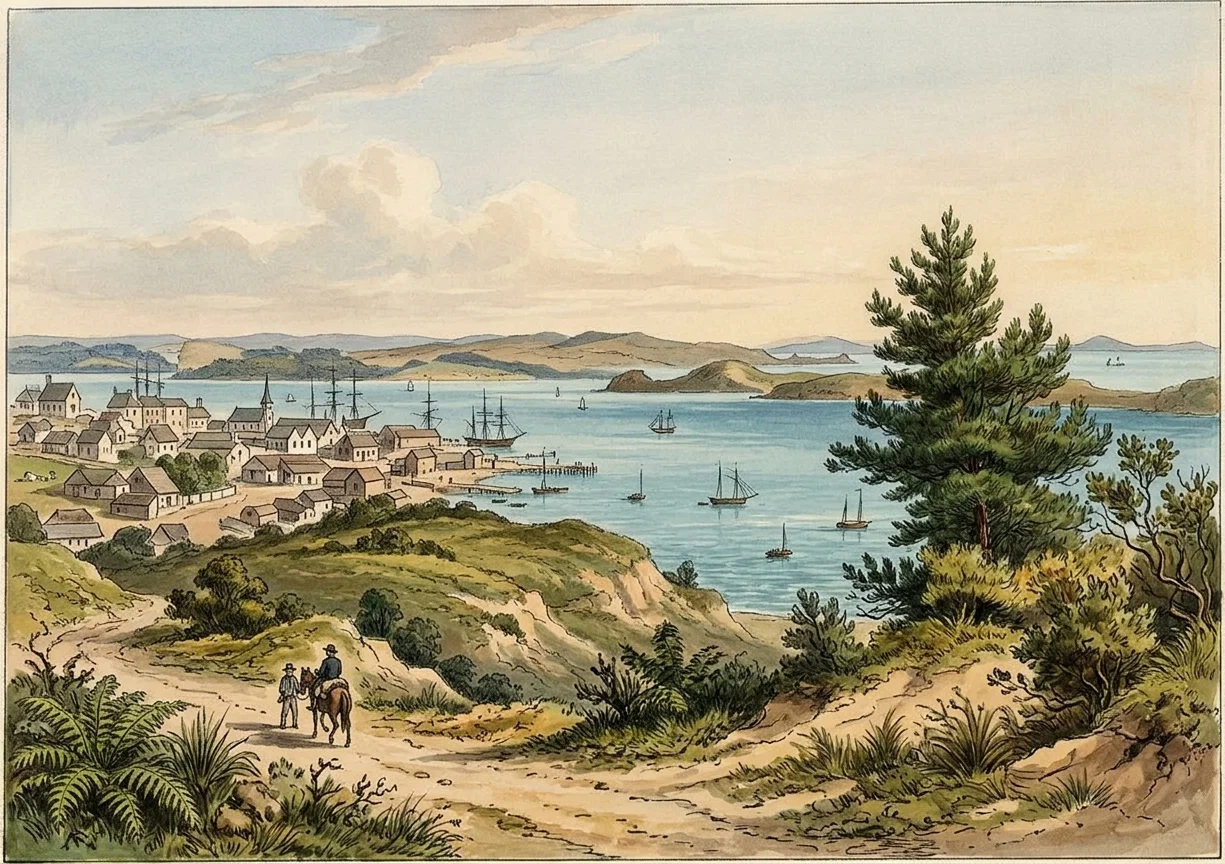
As one passes along the street, he ascends the hill upon the side of which a good part of the city is built. Toiling up the ascent of one of the pretty crescent avenues, one arrives at a point from which he may obtain a fair view of the city beneath, and the extensive land-locked harbor beyond, where many large vessels may ride safely at anchor during all seasons of the year. On the opposite shore, in the distance, are suburban towns, accessible by ferry at regular intervals of a few minutes, during the entire day, and a large part of the night.
Restored with AI
THE CITY AND HARBOR OF AUCKLAND, NEW ZEALAND.
Before the visit of Eld. Haskell to this city, in October, 1885, we had become acquainted with a former resident of Auckland, then living in one of the suburbs of Melbourne. This gentleman recommended Bro. H. to find a stopping place while in Auckland, with a friend of his, by the name of Edward Hare. Through his influence Eld. H. was invited to speak at one of the assemblies of the congregation of which Mr. Hare was a member. A discussion of the Sabbath question with the minister followed, which resulted in favor of the truth; for, as it was in Melbourne, the discussion introduced Eld. H. into families to which he would in no other way have gained access. He improved the opportunity for a few weeks, of doing personal labor among them, and Mr. Hare and wife and two or three others embraced the Sabbath.
Bro. Hare's father and a host of relatives, lived north of Auckland about 100 miles. No sooner had he embraced the Sabbath, than he determined that his people should hear it, as well. Accordingly, he and Eld. H. started for Kaeo, and were accorded a hearing. A few weeks in that place sufficed to convince the entire Hare family (eighteen or twenty in number) of the truth. But at this juncture Eld. H. felt that duty urged his return to Melbourne, and with a few parting admonitions to faithfulness, he left these new converts, and returned to Auckland on his way to Melbourne, where he arrived Jan. 7, 1886.
During the time our New Zealand friends were left without ministerial help, they went to work for themselves. They were not of that make-up which settles back as dead weight, because no one of experience in the truth is at hand to lead them along. They commenced missionary operations in good earnest. The Bible Echo, which had just made its appearance as a necessity of the field, was put into the hands of all who would read, and the canvassing work was pushed with vigor. Every day was a march, in which all were so deeply engaged, that no time was found to call a halt. Opposition was rife on every hand, but it availed nothing. Like an army in solid phalanx, the truth cut its way through the ranks of the enemy.
The following March Eld. H., on his way to America, again visited the friends of truth in Maoriland. At this time he organized a small church at Kaeo, administering the ordinance of baptism the first time it was ever witnessed in that vicinity. After celebrating the ordinances of the Lord's house with the newly organized church, he again left them, to resume his passage across the Pacific.
And now the struggle was to commence. In faith they must take up the work, where it was obliged to be left by him who had brought it to them, trusting that some time, not a great way in the future, the proper help would be given them. But their hearts were fully set in the truth, and after patiently waiting for seven months, they were made glad at the arrival of Eld. A. G. Daniells and wife from America, who landed in Auckland, Nov. 14, 1886. Bro. Daniells carried with him a fifty-foot circular tent which, after visiting a short time with the Kaeo church for their edification, he erected in the city of Auckland, and held nightly meetings in it, with good audiences, until the following April. As the result, sixty or more embraced the truth, and a church was formed.
Since that, a comfortable house of worship, the first owned by our people in the Southern Hemisphere, has been erected on an eligible site, and by continued and persistent effort the membership has been swollen to nearly a hundred members. And yet hardly a beginning has been made among the half million people of that colony. Not a blow has been struck in all the South Island, except that the city of Christchurch has been canvassed for “Thoughts on Daniel and the Revelation.” There are other cities, like Dunedin, Wellington, Invercargill, Oamaru, Timaru, and others, with their teeming thousands, which stand ready for the canvassers, colporters, and ministers. Besides these larger commercial cities, there are a host of smaller places, located in the midst of fertile districts, covered with flocks and herds, and fields of wheat, capable of sustaining ten times their present population. There is no country where more good can be accomplished by faithful canvassers. In the North Island, hundreds of “Great Controversy” have been sold with little effort. There is no reason why there may not be thousands of them placed in the cities and towns of the South Island. The resources of these districts are boundless, and offer to the active canvasser and colporter, not only remunerative fields for present necessities, but opportunities for gleaning sheaves that will confer eternal riches. The fields of that country are indeed white unto harvest, but the laborers are few. There are yet many souls to be won for Christ in that far off land, and “he that winneth souls is wise.”