To say that the area of South Australia is 914,730 square miles, does not, at first thought, convey to the reader an idea of the extent of the country. If every coast State of our country on the eastern sea-board, from Maine to Texas, were spread out over that colony, there would yet remain 24,000 square miles, or a territory twice as large as both Vermont and Rhode Island, unoccupied. Considering, that the entire colony has hardly more inhabitants than the city of Boston, one of two conclusions is readily formed; that the country is very sparsely settled, or that the entire population must be largely found in one locality.
The last of these conclusions would be true. Only a small portion of the territory, and that principally in the extreme south-eastern part, has been settled. The interior is entirely undeveloped, and is still the haunt of the black aboriginal. In the extreme north of the colony, bordering on Torres Strait, are a few settlements formed by those who have been drawn thither through mining excitement. The climate in that section is not the most favorable to the health of the average white man, because of the proximity of that locality to the equator, though some do live there, and thrive. The greater part of the population, however, is made up of Chinese, who do not seem to mind the high temperature, so long as they are successful in mining.
That part of the country about Spencer Gulf and the Gulf of St. Vincent, and on the ocean coast southeast of those bodies of water, has been fully settled, and proved to be very fertile. It seemed most natural to occupy this territory first, on account of its superior advantages in the way of water; but when new-comers can no longer be accommodated in these older parts, they will, of necessity, push on into the interior, where, with the assistance of artesian wells, they will cause the wilderness to blossom as a rose.
Considering that the first settlement in this colony was not made until 1836, and that the country has had to suffer almost continuously during its early history, through the greed of speculators and unprincipled adventurers, there is no question but that it has prospered as well as could be expected. At the time mentioned, the city of Adelaide was known only on paper; now it has, with its suburbs, fully 100,000 inhabitants. Three hundred thousand more are comfortably situated at easy distances from the capital city, all of whom are fairly intelligent, and easy to approach.
Some matters in this colony are regulated in a different way than they are in Victoria. In the latter colony, children not only receive the benefits of the State school free, but are compelled by law to be in school a certain number of days in every month. In South Australia, while the compulsory law exists, obliging each child under a certain age to attend school, a tuition fee of sixpence (twelve cents) per week is demanded of all. Should any parent be absolutely unable to pay the required amount, and go before the proper officer, with satisfactory proof of the same, the State then furnishes the amount demanded.
Until 1876 Victoria furnished State aid for religion, providing annually £50,000 ($242,000) for building houses of worship, and for the maintenance of the clergy. This created, as it could not fail to do, an unfair discrimination between the sects, giving to some, marked advantages over others. In South Australia this state of affairs never existed. On the other hand, no discrimination between sects was ever made in that colony. From the first, all have stood on an equal footing, as to the privileges of propagating their religious opinions; and the result is seen, not only in the more even distribution of professors among the various organizations, but in the greater simplicity and devotion of the church members in general, as well as in the display of less bigotry on the part of members of one order against those of others.
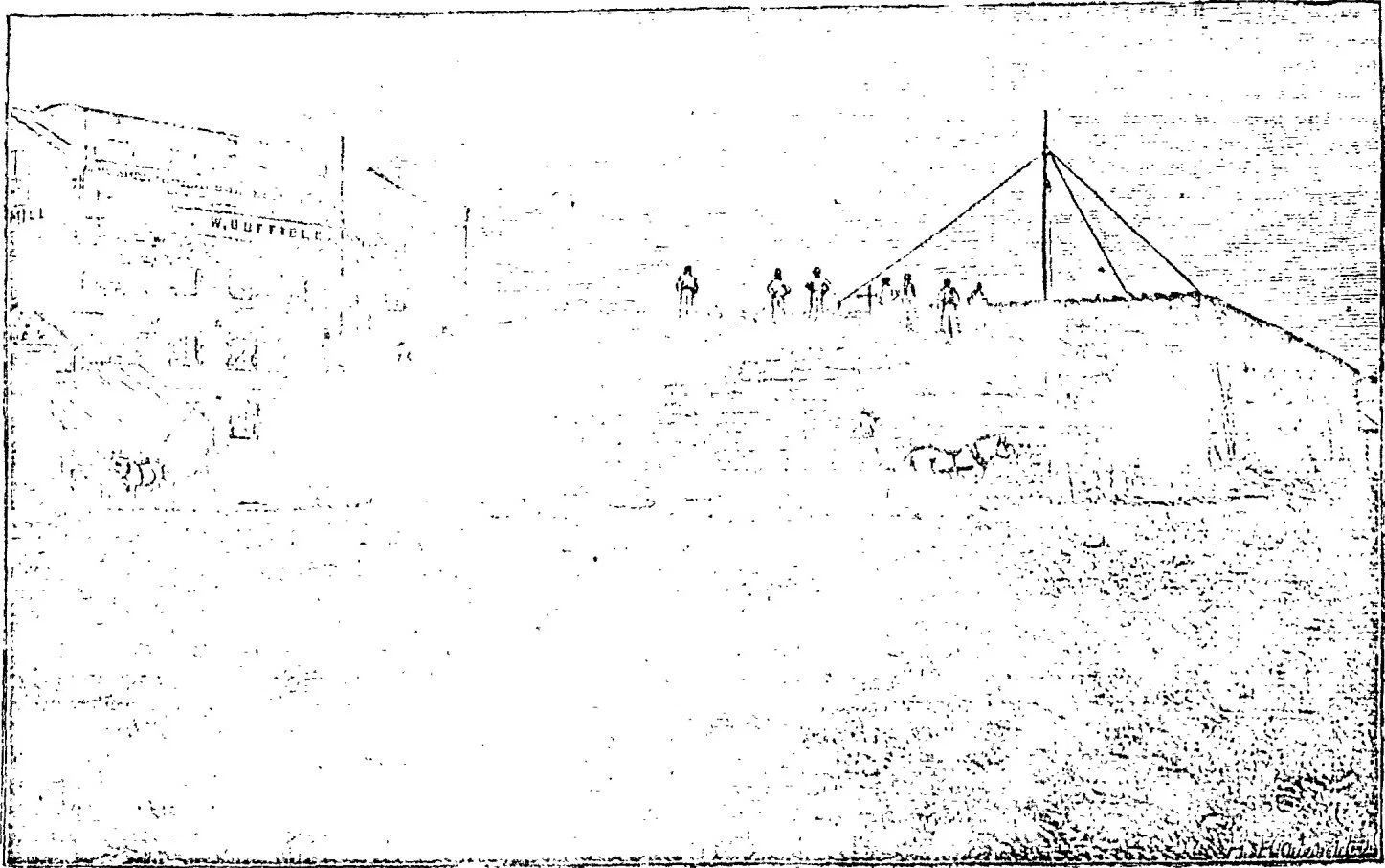
THE VICTORIA MILL, GAWLER, SOUTH AUSTRALIA.
This latter consideration makes that colony, in some respects, an easier field in which to present a new truth, than some of the other colonies. And yet the law regarding Sunday work is very rigid in all the colonies. One may go to the public baths, to the seaside, or on steamboat excursions on Sunday, without incurring the penalty of the law; but let him be found at some useful occupation on that day, and he is not looked upon with much favor. An observer of the seventh day, is, therefore, not popular among Sunday professors, because he does not reverence the day they observe. He is not popular among the employers of labor, because he will not work on Saturday, and therefore dull times become extremely dull to him; because at such times there are so many who are not only anxious to fill his place, but clamor for it.
There is nothing an English employer dislikes more than to be bound to one on whom he cannot depend. In fact, he cannot endure such a thing. And although on Saturday in the colonies a half-holiday is allowed, among high and low, yet for a laborer to be absent from work two half-days (Saturday forenoon) in succession, causes an unrest on the part of the employer; and no matter how great has been his esteem and attachment in the past for his laborer, he immediately sets about finding another to fill his place. If the workman retains his position under these circumstances, he may know that his employer has not been able to find any one to take his place. Every one in Australia who attempts to observe the Sabbath, expects the worst; and if it does not come, he is agreeably disappointed. And if one loses a situation in this way, he finds it hard to secure another, for the same reason that he lost the first; as an employer in that country will seldom hire one who he knows intends to remain away from his work on Saturday forenoon. He may, it is true, get employment for a week, if he says nothing of his custom of Sabbath-keeping, and simply stays away from work on that day; but that is of little satisfaction, when he knows he will be obliged to look for another job at the beginning of the following week. Altogether, it is a much greater sacrifice to keep the Sabbath in Australia than in America.
Some, when thrown out of employment, go to the mines on their own account, but these are not satisfactory places for a Christian to live. It is generally the rougher classes that labor in the mines, and there are scenes of recklessness constantly going on among them, which it is not pleasant to witness. One of the most prominent gold fields of South Australia is at Echunga, north of Adelaide. In this vicinity, too, have been found diamonds, and other precious stones. In other parts of the colony have been gathered amethyst, agate, beryl, bloodstone, cornelian, chalcedony, emerald, garnet, onyx, spinel, ruby, sapphire, topaz, and other very fine gems. In the southeast, bordering on a bight of the coast called the Coorong, is found on the surface a substance something like India rubber. Many tons of it lie scattered on the ground, in layers, varying from that of a sheet of coarse brown paper to an inch in thickness. Upon experimenting with it in Adelaide, a brilliant illuminating oil was obtained, which was thought to be superior to the best kerosene oil of American product.
Wheat is grown in great quantities in the colony. Near Gawler, may be seen thousands of acres devoted to this crop alone. To look over one of these vast fields of ripened grain in time of harvest is a goodly sight. Scattered here and there, are more than a score of harvesting machines, each drawn by four horses. These machines are so arranged as to clip off the heads of wheat, and to thresh and winnow the grain, ready to put into sacks. It is then drawn to the mill and tiered up, as shown in the cut, to be ground into flour for home and foreign consumption.
The wool clip of the country is simply enormous. The finest grades of wool grown in the world are produced in these parts. During the months of November, many vessels are freighted with compressed bales of wool for the English market. Comparatively little of the product reaches this country, on account of the heavy duties required by the United States Government for landing it here.
There are some pests in Australia, which are unknown in the United States. One of these is what is called the white ant. It is, however, yellow in color, and is always seen covered with a shield of glutinous earth. It uses this covering to protect itself from the attacks of the small black ants, its deadly enemies. The white ant eats whatever happens in its way—leather, wood, soap, books, clothes—it will not even refuse tobacco. Ordinarily, nothing short of sheet-iron or tin, will stop its ravages. There are, however, some kinds of wood, such as iron-bark, blood-wood, and a few519others, or the jarrah of Western Australia, capable of withstanding their attacks.
The ant-hills throughout the interior are exceedingly large, some of them being from six to ten feet in diameter, and twenty to twenty-five feet in height. The larger ones have the appearance of great age, and are capable of resisting the pressure of the heavy tropical rains which prevail in that country. The ravages of the white ants, in eating through wooden buildings, have been so great that the government voted to have all public structures built of stone, with floors of Portland cement.
Another curious yet destructive insect is one about the size of a large fly, and known as the borer. It is not found near the coast, but leads an active existence in the interior, where its chief business seems to be, to see how many holes it can bore in a single tree. Neither is it satisfied with the amount of damage it can do by daylight; on a still night the noise of their operations may be distinctly heard, as they diligently pursue their avocations. On the head of this insect is a kind of augur, which it drives with considerable force into the wood. The augur being inserted, the body performs a series of rapid revolutions; and in an incredibly short time, it has bored a hole into the timber, as perfectly as could have been done by a carpenter's augur bit.
The native products of the interior are not adapted to sustain civilized life, although they afford sufficient to support the aboriginal population. And yet for hundreds of miles inland, the country plentifully yields trees, plants, and herbage, of different kinds, and in most cases of luxuriant growth. It has already been demonstrated that these unsettled lands are well adapted to stock-raising; and since the most delicious fruits, such as the banana, cocoa-nut, custard-apple, pine-apple, and tamarind, thrive near the coast, there is no doubt that, with proper cultivation, these could be produced abundantly in the jungles and swamps of this vast unoccupied territory, where are found the advantages of a genial tropical climate.