As seen from the ocean, much of the coast of West Australia is anything but inviting. From that stand-point one sees in the south of the colony but a monotonous plain, bounded in the distance by a chain of bleak hills. Farther north, however, the shores are strewn with enormous masses of rock, extending, in some cases, a long distance from the beach. The eye is relieved by the ap- pearance of an occasional eminence among them, covered with the richest vegetation, and a few fertile plains present themselves, in marked contrast to the general barrenness of the coast.
A glance at the map will show the interior of this colony to be entirely unsettled. Indeed, until quite recently it was a great, unknown land. The discovery of the Kimberly gold-fields has, however, encouraged exploration, until now the exact nature of the country is well known. Arrangements are now being made for the construction of railways on an extensive scale, to be partially paid for on the land grant system, so that, ere long, much of the country will be opened up to settlers.
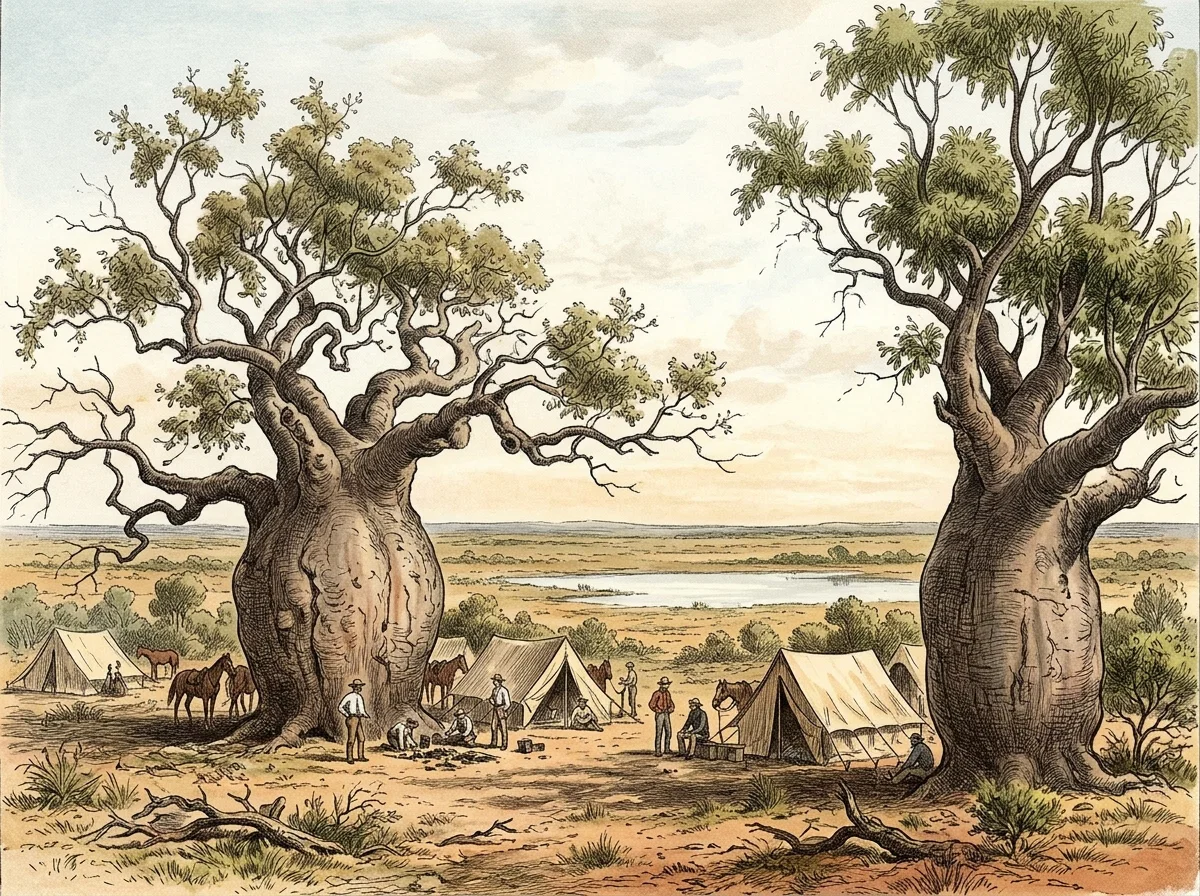
We present this week a characteristic scene of the interior of the country, taken on the spot. In the distance is seen an extensive flat, broken only by a sheet of stagnant water, the plain beyond being bounded by the horizon. In the foreground are some herders' tents, erected under two singular-looking trees, the bodies of which, as will be seen from the size of the tents, and the men standing about, grow to an enormous size.
This species of growth is known as the baobab tree, which in some cases sends up narrow, compressed trunks to a great height, and have only a crown of sharp pointed leaves, while others seem to exhaust themselves in foliage, having only enfeebled stems. Then there are others still, like those seen in the picture, which grow to such a giant size as to admit a large party within the hollow of the trunk.
This tree flourishes mostly in low, swampy ground, and seems to concentrate its strength in its huge bottle-shaped trunk. It will be seen that those herewith shown are stunted in height, and have but few branches. But even these, when in leaf, afford a welcome shelter to the shepherd or wayfarer. It is sometimes called the bottle-tree, not only because of the shape of its trunk, but also because it contains small supplies of water, which may be secured by piercing the bark. When young, the bulbby stem of the tree is edible, and the wood of the full-grown trees is so soft that the trunk of one can be easily scooped out. This quality, taken in connection with its convenient shape, renders it peculiarly suitable for making canoes. These trees are found in Northern Queensland, as well as in West Australia, and by a singular co-incidence, in the same latitude in Africa.
The gold-fields of this colony are proving to be very rich. Already many are there, engaged in working claims, and large nuggets are frequently found. The country in the regions of the gold-fields is of a slate formation, with numerous hills, gullies, and creeks. The gold-bearing stone taken out so far, is described as very fine, and only slightly stained with iron.
Land can be taken up in this colony on liberal terms of deferred payment, or can be rented at a cheap rate. At present, over 130,000,000 acres are held by the Government for rental purposes, 100,000 acres being under actual cultivation. Within what is called the settled districts, there is good land enough to satisfy all demands for fifty years, were time to continue so long. When the value of the country is more fully known, there will be thousands of immigrants to that desirable part of Australia.
Restored with AI
THE BOABAB TREE OF WEST AUSTRALIA.
Sheep-raising is not so great an industry in West Australia as in older colonies, not because it is not so profitable there as in other parts, but because there are not the number of people there to engage in it. But it is, nevertheless, quite a thriving business there, considering the circumstances. In the clipping-season large bands of men go from one “run” to another to shear the sheep. They become very expert at the business, and some realize handsome sums of money at the close of the season. By investing the money earned, in flocks, they soon become possessors of large establishments of their own, as the usual annual increase is seventy-five per cent. A professional shearer will often clip one hundred sheep in a day of ten hours, for which he is paid five dollars. Some work over hours, and thus receive extra pay. Board is always included while thus engaged.
Pearl-fishing has for some years been one of the leading industries on the north coast off Port Darwin, Torres Strait, and other parts of Northern Queensland. But it is only lately that this enterprise has engaged much attention along the coast of Western Australia. Some rich firms of London have had boats in the business, and have successfully introduced the diving-dress in which to descend in search of the valuable commodity. The natives, however, do nearly as well without any dress, on account of being so well accustomed to the water.
They stay down for a full minute, in which time they generally succeed in loading a small vessel with the oyster-shells. The way this is done seems surprising to one not acquainted with the habits of the people. Their great toes can be moved out from their feet apparently as easily as a white man moves his thumb, and in this way they pick up the shells in sight. It seems natural for them to pick up small objects with their toes, and they often do so to save themselves the trouble of stooping. A diver's life is a very trying one, on account of the constant pressure of water upon him while engaged at his task. Quite frequently, too, sharks appear on the scene, to dispute the title of the diver's life, when his is rarely a long career.
The business of getting the pearls from their shells is not the most pleasant. The oysters, on being first taken from the water, are thrown into a vessel and there left to die, when the shells open of their own accord. The shells are then removed, but the oysters are still in buckets till they become decomposed, when the mass is well stirred. In the last operation the pearls sink to the bottom, and the filthy mass is poured off. In most cases the pearl business is very nearly like gold prospecting—much hard work for meager returns.
The pearl is said to be formed through accident. Some foreign substance, as a grain of sand, or some sort of parasite, becomes lodged between the oyster and its shell, when the creature, in self-defense against the intruder, begins to deposit on it a coating of the same material as that of which the shell is composed. In some cases the process continues till the pearl has grown large enough to kill the oyster. When this happens, the shell opens, and the pearl is soon lost, being washed away by the action of the waves.
When a pearl is found buried in the soft substance of the oyster, it is round, or pear-shaped. If it be found with one side adhering to the shell, it is then called a “button pearl.” Sometimes a parasite bores its way into the shell of the oyster, when the bivalve, feeling the pressure, immediately deposits a layer of pearly matter on the shell itself, at the point of attack. These are called pearl blisters, and are found in all shapes, but are of no value only as curiosities. The exports in shells and pearls now reach the handsome sum of $700,000 a year.
The resources of this country are so numerous and rich, that when the fairy touch of a sufficient population shall be given them, they will give an impetus to the colony quite unparalleled in that part of the world. It has doubtless a brilliant future before it, commercially, and it is reasonable to hope for a corresponding progress for the truth of the third angel's message there also, if it can only become planted in the hearts of its people. Nothing direct has been done there yet, and it is the only colony of the group, of which this can be said. And yet, the sound of the truth has been wafted there. Some who embraced it under the labors of the writer while in Australia, sent papers and tracts to that country; yet with what result, I have not learned. But there is no reason why that important colony should not soon be entered, and the truth firmly planted there. We hope it may be soon, and that, when the work closes, there may be many precious souls found there, as well as in other parts of the Southern Land, who will be prepared to welcome the Saviour when he comes. J. O. CORLISS.