HOW IT STARTED IN TASMANIA.
The Island of Tasmania was discovered in 1642, by a Dutch navigator named Abel Janz Tasman, and for two centuries or more, was known as Van Dieman's Land. It is separated from Australia on the south by Bass Strait, which is 180 miles in width. It comprises an area of 26,215 square miles, or a trifle less territory than New Hampshire, Vermont, and Massachusetts combined. The island is mostly surrounded with a steep, rocky coast, indented with numerous bays, some of which afford good harbor for vessels. Mountain ranges traverse the country, presenting some very high peaks, but the face of the country is generally of a rolling character, well watered, with bountiful forests.
The soil is quite fertile, yet owing to the climate, which is similar to that of the south of England, or Western Oregon, no tropical fruits flourish there. But such fruits and plants as are indigenous to the central portion of the United States grow in great abundance. The country is also favorable to agriculture, and cattle-raising is carried on with success. The mountains abound in coal, and iron and copper ore. Emus and kangaroos were once numerous, but through the ruthlessness of hunters, have now become extinct.
Among the principal towns of the island are New Norfolk, Campbell Town, Launceston, and Hobart Town, the latter of which is the capital of the colony. It is located on the west bank of the Derwent River, about seventeen miles from the ocean, and not far from the base of Mount Wellington, the summit of which is covered with snow a great portion of the year. The city and its neighborhood is a popular summer resort for Australian tourists, who seek a cooler climate than that afforded in the more northern cities of their own colonies.
Ascending the river to its source, one is greeted at every turn with the most charming scenery. The stream takes its rise near the center of the island, and flows in a south-easterly direction. Its banks are lined with a wealth of vegetation, which extends, in some places, to the water's edge. In other parts, the meadows of green gradually rise from the lip of the water, and are lost in the distant ranges, which stand out in irregular piles against a background of clear ether. All along, may be seen the mansions of the wealthy, nestling among the rich foliage, or the comfortable home of the toiling farmer, surrounded with its well-kept garden of vegetables, fruits, and flowers.
The city of Hobart was founded in 1804, by Colonel Collins, the first governor of the colony. It is now a place of nearly 30,000 inhabitants. The Government buildings are located there, the most of which are near together, in the same street. Until 1824, Tasmania was under the New South Wales Government, but since that time, it has been an independent colony, having its own governor and parliament.
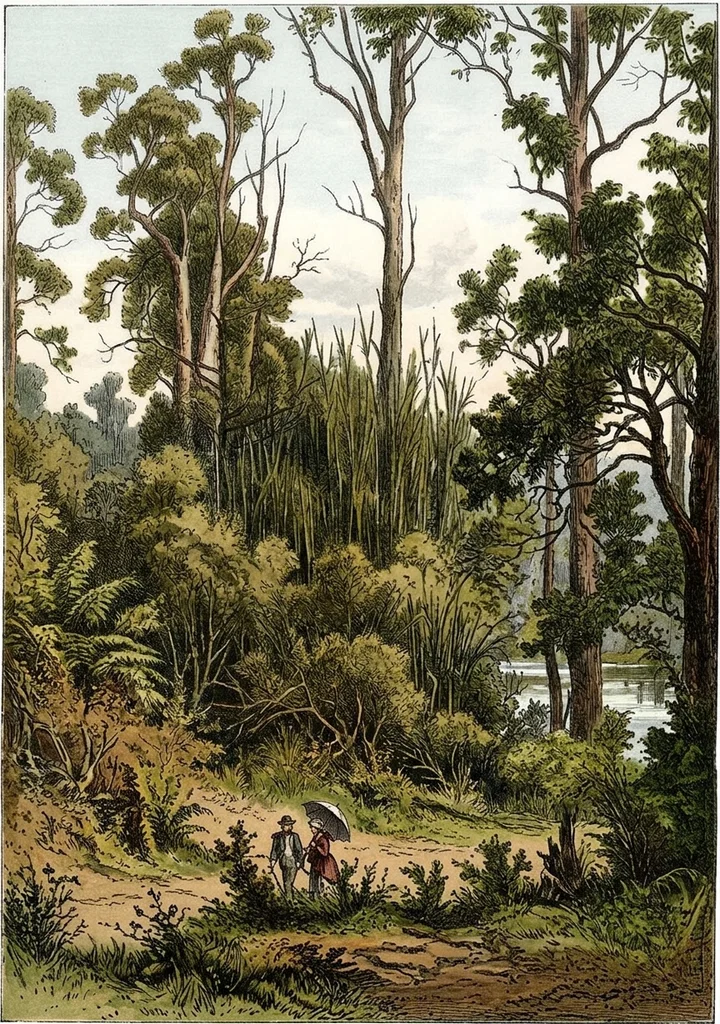
The sketch we present this week is a forest scene on the Huon River. This stream is formed from the melting snows on the mountain-top, the water of which leaps down the steep declivities, forcing a passage among huge boulders, eddying through the fertile valleys, and connecting with other streams going toward the sea, and thus forming one grand sheet of water. While, in the distance, the unsightly forms of the Huon pine, stripped of their foliage, appear to a disadvantage in the view, it will be seen at a glance that the ferns and other vegetation which form the principal undergrowth, add a charm to the place. Those ferns are of almost endless variety, from the coarse, heavy leaves of the largest kind, to the bridal-veil texture of the most delicate plant. Interspersed among these are acacias, known in that country as the wattle tree, around which cling the clematis, or white virgin's bower, which have rope-like stems, varying in size from that of a quill to a man's arm, and presenting such a profusion of beautiful, clear blossoms, as to have the appearance, at a little distance, of a snow-white cloth covering the tops of the trees. These, with the great quantity of wild flowering shrubs that present themselves, give the place a most romantic appearance. The Huon pine is a beautiful white wood, with fine grain, and susceptible of a very high polish. Its botanical name is derived from dakru, a tear, because the gummy exudations drop like tears from the tips of its branches. Suites of furniture made from it, command the highest prices in the furniture marts of Australian cities.
The development of Tasmania was greatly hindered at first, by its being made a dumping-place for the English convicts. As late as 1842, there were 20,000 of these vile creatures kept there. In those days, the people of the rural districts lived in almost constant fear of those who, having broken away from their keepers, hid in the bush, and prowled about by night, seeking occasion to steal and murder. Add to this the frequent scarcity of food, the hardships, privations, and conflicts with the natives, and life in the Van Dieman's Land of early days was not the most pleasant. In 1812, the population of the country did not exceed 1,500, and the habitations were of the most wretched description. There were no fences, very few cattle; and scarcely anything worthy the name of agriculture had been attempted. Very few of the people were free, and all the others being convicts, had lost nothing of their lawlessness by being transported to that island prison. Many of them associated with the native blacks, who at first were gentle and inoffensive, but by the example of their white associates were rendered the most intractable and remorseless of foes.
Matters became so bad that it was necessary to begin a work of extermination, which, in time, reduced lawlessness to a minimum. The hand of disease was constantly thinning out the aboriginals, until none are now to be found in the island. These great difficulties overcome, the prosperity of the island has been steady, and a finer place of residence is not known in all Australasia.
When the writer began a series of tent-meetings in South Yarra, Victoria, about the middle of February, 1886, a Mr. Foster attended very regularly at first, and it was noticed that he appeared very much interested in the subjects presented. He bought “Thoughts on Daniel and the Revelation,” and a few smaller works, but as the testing-points began to appear, he stopped coming to the meetings. He having labored some as a public speaker, I thought perhaps he would embrace the truth, and, with some training, become of service in the cause. It was therefore quite a disappointment when he suddenly ceased attending the tent services.
For a long time I did not know what had become of him. At length Brn. Wm. Arnold and W. E. Wainman met him while canvassing Hobart for “Thoughts on Daniel and the Revelation.” They learned who he was, after hearing him speak publicly on the abolition of the law. Seeking an interview with him, they began to reason together upon the subject, when he invited them to his house. During the conversation, he told them he had spoken several times against the law, since making his home in Hobart. But before the brethren left him, they all united in a Bible reading, followed with prayer. He appeared much softened, and asked them to call again. Shortly afterward he wrote to me, telling of his interview, and asking light on some law points in the New Testament. Being ill at the time, and unable to attend personally to the matter, I left directions for the secretary to send certain reading matter to his address.
Not long after, I received a letter from him, in which he expressed joy for the light of the truth, and declared his intention to walk in it forever. The next letter from him announced that he had succeeded in getting a few others to embrace the truth, and that he had established regular Sabbath meetings at his home. He then began to appeal for help, to further propagate the third angel's message, but received very little encouragement, until the opening of the last tent season. At that time Eld. M. C. Israel, accompanied by Bro. W. L. H. Baker and wife, began a series of tent-meetings in Hobart, continuing their effort until the latter part of April, at which time they reported twenty-five keeping the Sabbath, including the families of those who were observers of it when they went there.
This colony is really as good a field for a laborer in the truth as any one of the others, and far better than some of them. Lying south of Australia, it is off the great lines of steamship travel, and consequently has less bustle than those colonies which have direct communication with Europe and America. The people are of a rather retiring nature, yet affable and hospitable. It is true that only a beginning has been made there, but the truth moves more rapidly in that country than in Europe, and we look for faithful laborers to be raised up there, who will carry the news of the third angel's message to the remotest corners of that island, where such great darkness so recently reigned.
J. O. COLLINS.