VICTORIA, AUSTRALIA.
Believers in the third angel’s message have never been obliged to defend themselves against the charge of setting time for the Lord to come, and for a good reason. They have believed that before the second advent could take place, according to the prophecy, a message notifying the world that such an event is near, must be heralded to earth’s remotest parts. They have therefore taught the Lord’s coming near conformably as they have seen the fulfillment of prophecy in the spread of the present truth among the various nationalities.
What is termed “present truth” by this people, is the message of Rev. 14:9–12, which warns the world against the worship of the beast and his image, or the reception of his mark, and presents for a relief from that, the commandments of God and the faith of Jesus.
The advocacy of this message began in much feebleness, something over forty years ago, with only two or three persons devoted to its promulgation. It made no great stir at the beginning, and the majority of those who first embraced it, were not widely known. The light, however, was kept constantly burning, and was lifted on high until men of thought were finally attracted toward it.
Reverses were met at almost every step, and many of those who were watching the movement, predicted its early burial. But those who carried the heaviest burdens in the matter were sanguine of success, and confidently affirmed that at no distant day the message would find adherents and champions in all the nations of the world. Some of those who were foremost in the work were called to rest from their labors before the fulfillment of their anticipations; but an unseen power upheld the work, and guided its counsellors in wisdom, until the time came when God, in his providence, would have the nations afar off, listen to the news of his soon-coming kingdom.
But before this could well be brought about, publishing houses must be established, from which the truth could issue in printed form, and silently find its way to men of influence, and stir them up to call for the living teacher. Schools must be established, where men and women could be educated for special lines of work, such as canvassing, colportage work, etc., which would be necessary to be done in starting the work in new fields. There must also be a force of true, devoted souls who would furnish the means to support the missionaries while planting the truth in those far-off countries.
All of these things must needs have been brought about, before introducing the truth in other lands, in order that such work might be a success. Were it undertaken before these preparations had been made, the laborer would soon give up his work for lack of support, which it would not be possible for him to provide while engaged in labor in those fields. Those who think that this work has been a long time in reaching its present state of progress among the various nations, should stop to consider these things, and then ask themselves whether they have done all they might to help push it along farther and faster.
Even now, there seem to be some who do not appreciate the situation. They talk about waiting for the Lord to come, and yet do little or nothing to help spread the message, in order to hasten the event for which they profess to be so anxiously looking. These think more of their own comfort than of the sacrificing toil of the messengers of truth. They have no real anxiety about the condition of the teeming millions who do not know the truth. As it was with Israel of old, when going toward the promised land, so it will be in this work,—the antitype of that—all the half-hearted, complaining ones will drop out by the way.
In order that our people may know more of the countries to which the truth has penetrated, it has been thought best to furnish a series of illustrated articles, giving a description of some of the most important parts of those countries. This will be done, hoping that it will cause our people everywhere to take a deeper interest in the work going on in those fields, and that they will not only pray for the laborers there, but do what they can in a substantial way to help along the work.
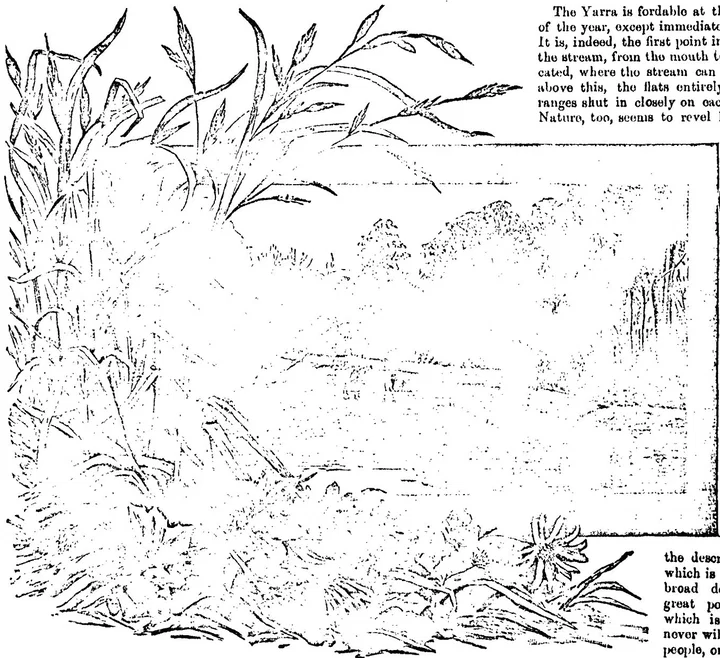
The accompanying picture presents a view on the Yarra River, in Victoria, Australia. This river takes its rise in the Hume range of mountains, nearly fifty miles northeast of Melbourne, and flows between very steep banks the most of the way to where it discharges its waters into Hobson’s Bay, eight miles south of Melbourne City. That part of the river which flows through the city and its suburbs, has rather an unenviable notoriety, on account of the stench it bears along its course. It is especially so concerning the last eight miles of the stream, after having absorbed the filth of the metropolis, on its way to the sea. But while this is true of the Lower Yarra, it may be said of its higher waters, that they are as free from contamination as almost any other stream of its size. The view presented in the accompanying sketch, is of a point twelve miles above the village of Lilydale, one of the remotest suburbs eastward of the city of Melbourne. At this point, the river runs through a low-lying, flat country, of rich alluvial soil, lightly timbered with gum trees and wattles, the last, a species of what is known in California as acacia trees. This tree produces an amber, liquid gum which the natives call korong. This is prepared for food, by soaking the gum in water until it becomes assimilated with it.
The Yarra is fordable at this place at all times of the year, except immediately after a heavy rain. It is, indeed, the first point in the entire length of the stream, from the mouth to the place here indicated, where the stream can be forded. A little above this, the flats entirely disappear, and the ranges shut in closely on each side of the stream. Nature, too, seems to revel here in a wealth and variety of vegetation which is beyond description. In some parts, however, the ranges present a park-like appearance, where game is found plentifully.
Already numerous villas have been erected in this sylvan-like place, by those who seek a quiet retreat from the noise and dust of a great city; and it will not be long, before the suburbs of Melbourne will include this, one of the most beautiful spots in Victoria. But one cannot judge of all the country by the description of this part, which is like an oasis in the broad desert. There is a great portion of Australia, which is not, and probably never will be, settled by white people, on account of its sterility. Very little of Victoria, however, is of this character.
The colony of Victoria comprises 86,831 square miles, yet it is only about one thirty-fourth part of the entire continent. It is a trifle larger than the two Carolinas, and has a population a little in excess of 1,000,000. More than one third of these reside in Melbourne and its suburbs, constituting it the largest city in the Southern Hemisphere. There are several reasons why so many choose to remain at this point, but space forbids the mention of more than two or three.
First, the laws of the country are not so liberal as those of America in granting a homestead to all who will settle on and improve a tract of land. On the other hand, the government holds on to the most of its land, saying it will not do to part with its capital. It will lease to a man a certain amount of land at so much an acre, provided he improves it each year to a certain extent. But when his lease expires, he must leave the land greatly improved; and if he wishes to continue in the business of farming, must again rent land under the same conditions as before. Under these circumstances, there is not much ambition to settle on new farms.
Then, in the interior it is very dry during the summer months, and one is not always sure of a crop, though he sows and plants. There are veryp. 439 few streams in the country that survive the extreme droughts, consequently irrigation is out of the question. At times, water for household purposes must, in some parts, be brought for miles, and the stock must be driven to and fro each day, to supply their demands. This is very discouraging to the farmer there, as it would be to the farmer in America. The question of procuring water from wells for drinking purposes, is not always a practicable one, as in most parts, at least in Victoria, water thus procured is usually more or less brackish.
Again, very much of the country is better adapted to sheep and cattle raising than to the production of crops. But to engage in this business successfully requires more capital than most men can command. In the city there is more or less work to be obtained by the hour or day, and many prefer to labor where there will be no risks in the way of dry weather, and the loss of stock or crops.
The supply of water for Melbourne is brought by pipes from Yan Yean (a native word meaning boy) Lake, which lies about ten or twelve miles north of the city. It is furnished by the general government, and therefore, if one owns a house on any street along which the water pipes are laid, he must pay his water tax, whether he wishes to use the water or not. This is on the supposition that the house owner will supply himself from his neighbor’s hydrant, if he does not have one of his own, and so use government water anyway.
Every work of any importance in that country is under the control of the government. By this system there is no competition. If one is dissatisfied with the charges, it makes no difference. He can walk, if he chooses, but he can get no reduction in the fare. More than this; if a deficit appears at the end of the year, on account of the railway’s having been managed on a political instead of a commercial basis, the lack must be met by taxation. All railway officials are government officers. Public schools are all controlled by the general government. One who becomes a public school teacher has no choice of the school he prefers to teach. Should he be teaching a school in a pleasant locality, he is liable to be sent to fill a vacancy in some mining or remote district at any time. Should he object to going, the matter is settled by his resignation as a teacher being accepted, and his retirement from the service.
If one wishes to publish a paper regularly, whether a daily, a weekly, or a monthly, the law requires him to furnish two bondsmen, who are property holders, and who become responsible for the publisher, to the amount of $1,500 each. With these, the intending publisher must go before the judge of the district, make affidavit regarding the name and object of his intended publication, and where it is to be published. The paper is then registered, when he receives permission from the court to issue it. This is done to protect the government against treasonable sentiments, and also to provide for recompense in case of actual libel against private individuals. The law goes still further. One cannot even own a printing-press of any description, without notifying the authorities and stating the street and number where it is located, and the purpose to which it is to be put. By violating this provision one lays himself liable to a heavy fine. Then, too, any poster or circular printed and sent out, must bear the imprint of the place from which it was issued. In this way all printed matter is traceable to its origin; and if forbidden sentiments are found, the guilty one is easily located.
To many, these laws may seem quite strange and unnecessary. But still they have a good effect upon the people in some respects. They are led to be more careful in their ways, and more thorough in what they do. There is also noticeable an agreeable absence from the public prints, of sensational headlines, and extravagant statements for the purpose of catching the eye. Everything moves off more soberly in that country than in America; but after one has become accustomed to the ways of the people there, he sees many things that recommend themselves to his judgment.
J. O. Corliss.