It may not be generally known that Queensland extends northward to within about 600 miles of the equator. Not only, however, is this true, but also the fact that nearly the entire colony lies in the torrid zone. It covers 680,000 square miles, being eleven times larger than England and Wales, or nearly ten and one half times larger than all New England. Like New South Wales and Victoria, its eastern portion is very mountainous, the ranges traversing the country from north to south nearly parallel with the Pacific, and at a distance of from fifty to seventy miles from the coast. West of the main range, numerous smaller ones run in all directions, stretching away for hundreds of miles, and not only diversifying and beautifying the country, but forming fertile valleys of valuable pasturage for the extensive flocks and herds of the squatter.
Out of these valleys flow numerous streams which unite to form several good-sized rivers, and thus furnish a water supply to the country. Passing on, the country spreads out into rolling plains, thinly timbered, but covered with an abundance of rich feed for cattle and horses. On the eastern slope of the mountains, looking toward the ocean, much of the country is broken and hilly. Here is found heavy timber and plenty of grass, and nearly all the land is fit for cultivation.
Brisbane, the capital of the colony, is beautifully situated in the extreme southeast, on an elbow of a river of the same name, about twenty miles from its entrance into Moreton Bay. This bay is about sixty miles long and twenty wide. It is well dotted with islands, a few of which are of high land and capable of improvement. One of these is called St. Helena, from the fact that a black man who had received the name of Napoleon, was placed upon it as a punishment for some crime.
The climate of Queensland, is, of course, quite warm, though it is said by those who have long lived there, to be healthful, and conducive to long life. The heat in the extreme north of the country is not so oppressive as its latitude would seem to indicate. It is said to be warmer at times in Sydney, Adelaide, or even Melbourne, in summer, than in this district. This is owing to a prevailing trade-wind from the southeast, which brings cooling draughts from the ocean, over the country. The soil varies from a light, quick loam to that composed of the richest vegetable mold. Its range of products is great. On the same farm are sometimes grown corn, peas, potatoes, oats, coffee, sugar-cane, flax, cotton, peaches, oranges, apricots, figs, grapes, pine apples, and bananas.
From Wide Bay, a little over 100 miles north of Brisbane, to the northernmost extremity of the continent, extends a great coral reef, which renders the navigation of the coast extremely dangerous. These reefs are so high that no vessel can cross them, except at intervals where nature has seemed designedly to leave narrow passages for that purpose. Coasting vessels generally keep between these reefs and the shore, as that is considered safer than to attempt a passage outside the great barrier. Inside the reefs, the water is always comparatively calm, which is considered an advantage in navigating that part of the coast.
From Sydney to Brisbane the distance is about 600 miles, and by steamer is nearly a two days' passage. While one may go overland by train from Adelaide to Melbourne, and from there to Sydney, I believe that no railway trains have yet been run from Sydney to Brisbane, though such a service has been contemplated for some years. But should such an enterprise be carried out, it would be hard to choose between routes; for while one might dread the sickness of a sea voyage, and for this reason prefer to journey by land, he would find few comforts for a long journey, on the railways of Australia.
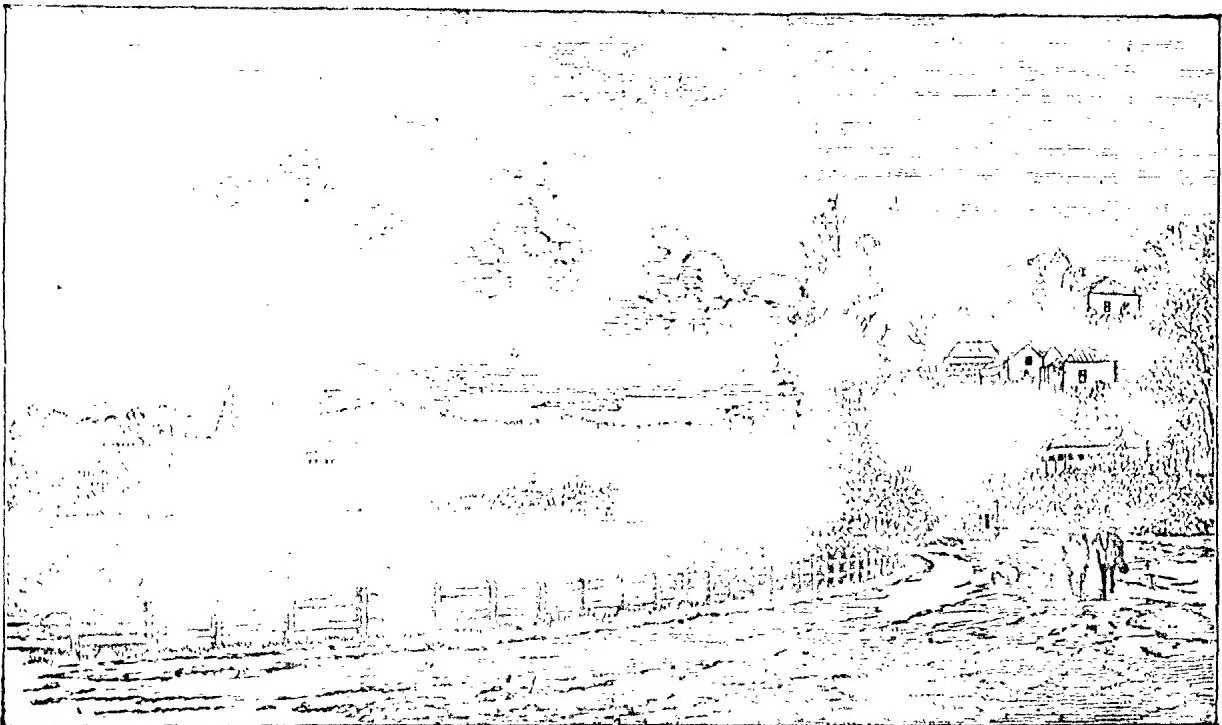
VIEW IN BRISBANE, AUSTRALIA.
The cars there are, according to the English custom, divided up into little compartments, running from one side to the other, and only wide enough for two seats facing each other. You enter these from a side door, and are shut away from every other part of the car, without even a bell-rope passing through the apartment, for you to pull, in case of accident, or disturbance by drunken fellow-passengers. Before the train starts, the “guard” collects the fares, and you are then shut up to your own musings, or to the study of the physiognomy and clothing of your opposite neighbor, whose knees touch your own.
One may be annoyed by indecent language or the fumes of whisky and tobacco, or in danger of being robbed if alone in the apartment with some ruffian, but no assistance is to be obtained. No water-tank is provided, nor any of the other conveniences always found on American cars. Then, again, one must look after his own baggage. No checks are given for it, but the owner must see to its being put on the train, and be present on its arrival at its destination, to remove it, or it will be taken to some general store-house as lost baggage, and sold, unless called for within a certain time.
The sugar plantations are worked by the natives of the tropical islands. For a small sum, they are induced to go there in large numbers, where they often remain for years. On some of the plantations, it is said, there are employed as many as 600 of these Kanaka laborers. Three years ago, it was estimated that there were 32,000 of them employed in different parts of Australia.
While the interior of Queensland is but an arid desert, there seem to be, underneath the soil, hidden rivers and lakes, which if properly utilized, would convert the entire country into a rich and fruitful region. Within a year or two, the idea of having artesian wells in that section has been agitated, and some experiments have been made that may finally solve a knotty problem, which has troubled many minds. Between 700 and 800 miles northwest of Brisbane are the Barcaldine Downs, where thousands of sheep and cattle have perished from drought.
That part of the country is exceedingly rich, and the absence of water has been its principal drawback. Last November, the Government closed a contract with a party, to bore for water. The work was immediately begun, and a depth of over 100 feet was reached at the end of the first twenty-four hours. After this the boring was more difficult, and four weeks were required to reach the depth of 650 feet. At this point, water was struck, which spouted up with irresistible force. At last accounts, it was found impossible to control the supply; and the order of things in that hitherto dry district has been materially changed. Now creeks flow steadily through the low-lying country, furnishing an inexhaustible supply of the needed moisture for purposes of agriculture.
It is evident that a great subterranean reservoir exists, which it was only necessary to tap, in order to set at liberty a copious supply of water. The experiment will prove a new era in the resources of that country; for one attempt having proved successful, the matter will not be dropped until a vast system of irrigation from artesian wells shall have been brought into use. If a proper estimate has been placed upon the supply of water thus discovered, Central Australia will prove to be one of the richest countries in the world. It is stated that each gallon of water per day thus provided is equal in value to an additional sheep. One station has already demonstrated the matter, by providing a well which flows 40,000 gallons per day, thereby enabling the proprietor to keep 40,000 more sheep than his ranch could before sustain.
Of course, this new water supply will so change the condition of the country that it will become an inviting place for many an honest toiler, and this in turn, will make it an enterprising field in which to introduce the truth. Every one of this vast army of shepherds ought to have the truth, either from the mouth of the living preacher or at the hands of the canvasser. The city of Brisbane, with its 50,000 inhabitants, has been canvassed for “Thoughts on Daniel and the Revelation,” but that is only a beginning in the colony. There are thousands of Germans in colonies located in that rich and prosperous country, who ought to have the truth. The hardest question now to be settled, is, who will be found to fill the almost innumerable openings that present themselves? May God help our people to see the needs of the cause, and lead numbers to fit themselves to step into some of these places which so urgently invite our labors.