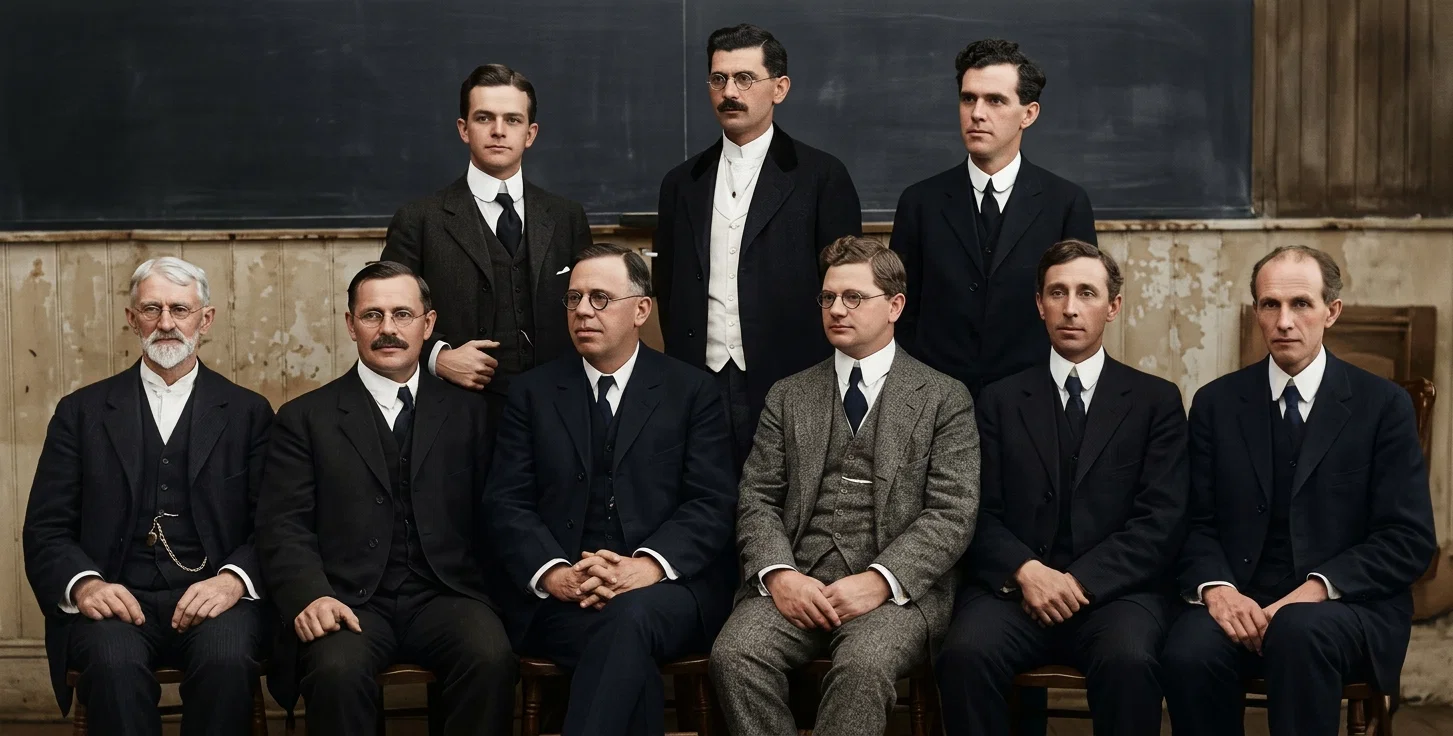
Top: W. H. Williams, H. Meyer, H. U. Stevens. Bottom: J. W. Westphal, F. W. Spies, Charles Thompson, O. Montgomery, J. L. Shaw, W. E. Howell
THE South American Division Conference was organized in February, 1916, at La Plata, Argentina, at the time of the biennial session of what was then known as the South American Union Conference, with delegates present from the Brazilian and Inca fields. Elders W. W. Prescott and N. Z. Town made a tour of the entire field at that time and directed in the organization of this division conference.
In territory this division embraces all of the South American continent excepting Colombia, Venezuela, and the Guianas; it also includes the Falkland Islands. There are eight republics in this field, having an area of 6,183,680 square miles, with a population of 51,698,936.
At the time of the organization of the division there was included in this field the South American Union Conference, the Brazilian Union Conference, and the Inca Union Mission, which embraces Ecuador, Peru, and Bolivia. Up till that time, what is now known as the Inca Union Mission was a part of the South American Union field, and was operated by it. At that session this territory was separated from the South American Union Conference and organized into a union mission, taking the name of the Inca Union Mission; and the name of the South American Union Conference was changed to the Austral Union Conference. I think it was in May of the same year that the Lake Titicaca Indian work was separated from the Peruvian Mission and was given the name of the Lake Titicaca Indian Mission. Its territory embraces those portions of Peru and Bolivia which border upon Lake Titicaca.
The constitution of the South American Division Conference provided that the first session of the conference after its organization should be held in 1918. However, inasmuch as the General Conference session was held that year, the executive committee, in counsel with the General Conference Committee, advised the postponement of this session until 1919, with the expectation that Elder A. G. Daniells would be able to be with us. The conditions thrust upon the world by the Great War, and the unusual burdens that came to Elder Daniells following the General Conference session, made it impossible for him to visit South America at that time, and so the session was again postponed, until the beginning of 1920. Thus we find that four years have passed without holding either a division or a union session in this field. While the European situation has made it impossible for Elders Daniells and Knox to meet with us at this time, yet we rejoice that special effort has been made by the Home Board to send to us a strong delegation of able men, to whom we are most happy to extend a cordial welcome to South America.
At the time of the General Conference held in San Francisco, Calif., in April, 1918, resolutions were adopted affecting the future policies of the denomination throughout the world. In order to preserve the unity and develop to a larger degree the resources of the denomination, both in finances and in man-power, and create closer co-operation between the General Conference and all parts of the world field, and bring every union organization and outlying mission directly in touch with the General Conference, it was recommended that the organizations known as division conferences be discontinued, and that the General Conference operate in the different divisional sections of the world field through its vice-presidents and the members of the General Conference Committee in these fields.
This entire question as it relates to the South American Division Conference, with the recommendations of the General Conference covering the same, and the future policies of the work in this field as they are affected thereby, will all be laid before you for your careful consideration and study in the form of recommendations.
A brief glance over the field, noting the encouraging evidences of progress and growth, will be inspiring, I feel sure. The secretary-treasurer will present financial and statistical reports, which will help you to appreciate more fully what has been accomplished in this field since its organization four years ago. The secretaries of the departments will also have some good things to present to you, as well as the presidents of the different unions.
In harmony with the advice of the officers of the General Conference, the organization of this division conference was a simple one, the only officers being the president and secretary-treasurer. Brother W. H. Williams, the secretary-treasurer, did not reach the field, however, until July, 1916. For two years we struggled along without any further help, but it was apparent from the very first that there was an urgent need of divisional departmental men to foster the general interests and to build up and unify the work of the different departments throughout the field.
At the time of the San Francisco General Conference in 1918, this need of the field was favorably considered, and in harmony with the new plan of organization, Elder J. H. McEachern was elected General Conference assistant secretary of the publishing and home missionary departments for South America; and he, with his family, came to the field with us upon our return from the United States in September, 1918. Prof. H. U. Stevens was at the same time elected General Conference assistant secretary of the educational and Missionary Volunteer departments for South America, but as he was still carrying the principalship of the union training school, he was not able to enter upon the duties of his office until the beginning of 1920.
North Brazil Union Mission
Steps were taken four years ago at the La Plata meeting for the forming of a new union mission in the northern part of Brazil, to be known as the North Brazil Union Mission. In the 1917 budget, an appropriation was allowed by the Mission Board for this purpose, but it was not until the beginning of last year that we were able to man this field and carry the plan into effect. In January, 1919, at the time of the Brazilian Union committee meeting, the executive board appointed Elder Henry Meyer superintendent and Brother W. A. Ernenputsch secretary-treasurer of the this new union. A redivision of the Brazilian field was made at that time, giving to the North Brazil Union Mission the state of Rio de Janeiro, Espírito Santo, and the east half of the state of Minas Geraes, which is known as the East Minas Mission. The addition of these fields gives to this union a part of the best territory of Brazil, which serves as a strong constituent and financial support. This new union started off very auspiciously, which is truly encouraging.
Thus the present territory of the division is composed of four unions: The Austral and Brazilian Union Conferences, and the Inca and North Brazil Union Mission fields.
Recruits
The hands of those in the field have been greatly strengthened by the new recruits who have come during the quadrennial period. Thirty-one new workers have joined our forces. We gratefully acknowledge the help given this field by the General Conference in the splendid staff of workers they have been sending from year to year, as well as their liberality in the appropriations made to us. From the viewpoint of our work18and the attitude of the Home Board toward the needs of South America, we certainly no longer have reason to feel that this is the “Neglected Continent.” We have been made sad to lose from our field, because of broken health, several excellent workers, in all numbering thirteen who returned to the United States during this period.
Membership
At the time of the organization of this division conference there was a total membership of 4,903. During the four years just closing there have been 4,313 baptisms. The net gain in membership, however, has been 3,500, giving us at the present time a total membership of 8,403. Giving the total number of workers on the pay roll in the field credit for all baptisms, we find the average for the period to be 10.07 converts for each worker. As the baptisms relate to the membership, it has taken an average of 5.6 members to win one soul each year. The large increase, as you know, has been in the Lake Titicaca field, where the growth in membership has been phenomenal. In 1919 there were 718 baptisms in that field. These are evidences of progress that are encouraging.
Tithes and Offerings
Notwithstanding the terrible effects of the World War, which were strongly felt in South America and had a very marked influence upon the financial conditions in this part of the world, we are glad to know that the tithes and offerings of this field have shown a splendid increase, the year 1919 far eclipsing anything in the past. The total tithe for 1916 amounted to $44,309.30; the total for 1919 was $82,927.93, an increase of $38,618.63. For the full period the total tithe was $244,559.43, a yearly average of $9.05 per capita.
The first goal for mission offerings in this field was placed at 5 cents for the year 1916. We lacked only one mill a week per member of reaching this goal. The goal was the same for 1917, and we succeeded in just passing it. For 1918 the goal was raised to 8 cents, but we did not reach it. During 1919, however, we passed the goal by 2.4 cents. Catching the spirit of the Boulder Fall Council, our executive board has stepped out by faith and has advanced the 1920 goal 50 per cent above that for 1919. The mission goals for 1919 were based upon about 45 per cent of the tithe income of the field, which will compare quite favorably with other parts of the world field. For 1920 it is about 43.71 per cent of the tithe income for 1919.
We are clear in our conviction that as leaders and workers we should put forth strong effort, and improve every opportunity, to educate our churches to see and appreciate the needs of the great world mission fields, and what it will mean for us to do our full part in carrying this blessed message to the regions beyond. We should help them to get their eyes outside of South America. We believe that the people of South America will gladly do their full part, and will manifest as great a spirit of liberality, according to their means and their earning power, as any other people, when they fully appreciate their responsibility. During the last few months it has cheered our hearts to see how they are responding to the calls that have been made in behalf of the regions beyond.
Our Ministry
Of the most vital importance is the gospel ministry. This has always been and still is the most important and successful way to win men to Christ. The development and training of a strong, Spirit-filled ministry should receive the careful consideration of every leader in this field. Union and local conference presidents must realize that it is a part of their administrative work to help every minister, licentiate, and Bible worker to become more successful in soul-winning. Higher educational standards, better methods, more efficient service, should be the constant aim of every worker. God has chosen that by the preaching of his word men shall be saved. Never was there a time in the history of our work when Holy Ghost power was more greatly needed in the ministry. The influence of such a ministry would be felt and reflected at once by our churches; for our churches are the “pressure gauge” of the gospel ministry, reflecting quickly and truly the spiritual fervor, the consecrated zeal, and the missionary activity manifested by that body. The church is strong or weak as the ministry is strong or weak. Spiritual, missionary, and disciplinary standards must be lifted in all our churches; a strong educational campaign is needed throughout the field. When we realize that we lost during the first two years of the quadrennial period a little more than one half as many souls as our net increase, or in other words, that 55.5 per cent of all our accessions were swallowed up by our losses, it will emphasize what I have said. However, during the last two years of the period, the showing is much different. For 1918 the difference between the number baptized and the net gain was only 30, which means a loss of only 2 per cent; and for 1919 the difference was 141. For the two years it means that our losses amounted to only 6.5 per cent of our net gain.
Our Large Cities
A few years ago there came to this people through the spirit of prophecy most stirring messages, calling attention to the masses gathered in the large cities. Without doubt those messages apply to the cities of this continent as well as to those of the United States. We believe it is high time that the large cities of South America should be provided with a strong, successful corps of workers. A little is being done in these large centers, but we have scarcely touched them with the tips of our fingers, and the little that is being done in some of the cities is only a suburban effort and among the poorer classes. It is time for us to get into the very heart of our cities with a message that will appeal to the educated and the wealthy. We believe that many of the better classes in this country will accept the truth if they are properly approached.
Unentered Territory
Outside of the cities there are doors opening in every direction. There are large sections of South America that have never been entered by any representative of this message,—great stretches of country in Argentina including state after state, where we are doing nothing as yet. The western portion of the republic, from the Bolivian border to the Straits of Magellan, has scarcely been touched. Considerably more than one half of the entire republic of Brazil has never been touched by the third angel’s message. Think of the great Amazon region! This vast unentered territory stands wide open, waiting for the message. The mighty Amazon, one of the greatest thoroughfares of the continent, with its tributaries, opens the way for us to penetrate into the very heart of the continent and reach the millions that are groping in darkness. From Pará, at the mouth of the Amazon, to the city of Iquitos in the northeastern part of Peru, there is an excellent steamship service by ocean-going vessels, while smaller steamers traverse its many branches for thousands of miles. These will bring our missionary colporteurs and workers in touch with every city and small town along the great highway of commerce. What a pity that we have waited so long to enter this field! Through the influence of a few tracts and papers that have found their way up into this section, we have a few believers waiting for the living preacher. In the city of Manáos, about one thousand miles from the mouth of the Amazon, some are keeping the Sabbath. We are definitely planning to send a company of missionary colporteurs into this Amazon region early in 1921. But there should be a minister, with at least one other helper, if not two, stationed at the most advantageous points in that great territory. We are earnestly hoping that this plan may be put into operation at an early date.
Then, in the interior is Matto Grosso, which is very accessible from the south by the Paraguay River, and from the east by railway from São Paulo. There should be a work established in that part of the field. We are glad that the Brazilian brethren have their eyes turned in that direction.
We have a good work established in the republic of Paraguay, yet there are many sections in that country that have not yet been touched. There are also large sections of unentered territory in many parts of Chile. The same is true of Peru, Ecuador, and Bolivia. These two last-named fields are calling loudly for more help. Then there are the Falkland Islands, with their English-speaking population, for whom nothing has been done since 1893, about twenty-seven years ago, when Brother Nowlin sold $1,350 worth of books there. Surely a man should be sent to the Falklands.
Then, returning again to the Inca Union, where we have such a marvelous demonstration of what God is willing to do for the Indians of South America through consecrated efforts, think of the thousands upon thousands of Indians in the eastern part of Bolivia, Peru, and Ecuador who are groping in the most dense darkness! Surely, if we are to reach all these outlying districts and take all this great continent for God, we must greatly increase our force of workers and lay definite plans for strong, aggressive moves.
As an indication of what may be done in the way of bringing some of our19fields to the self-supporting basis, the success of the São Paulo Mission during last year is a good illustration. At the beginning of 1919 this mission was placed upon a self-supporting basis. Some of the brethren were fearful that the plan would not succeed, but we have greatly rejoiced over the proved fact that the tithe was not only sufficient to carry the entire expense of the field, including the war bonus, but that it increased sufficiently to enable them to put on an extra man. And in their mission offerings they have far exceeded their goal, raising on the average 20.1 cents a week per member. There are other fields that can be quickly brought to the self-supporting basis if we will only give them a little more help for a year or two to enable them to get a good start. We believe Espirito Santo is one of these, and that it should be placed on this list in the near future.
Restored with AI
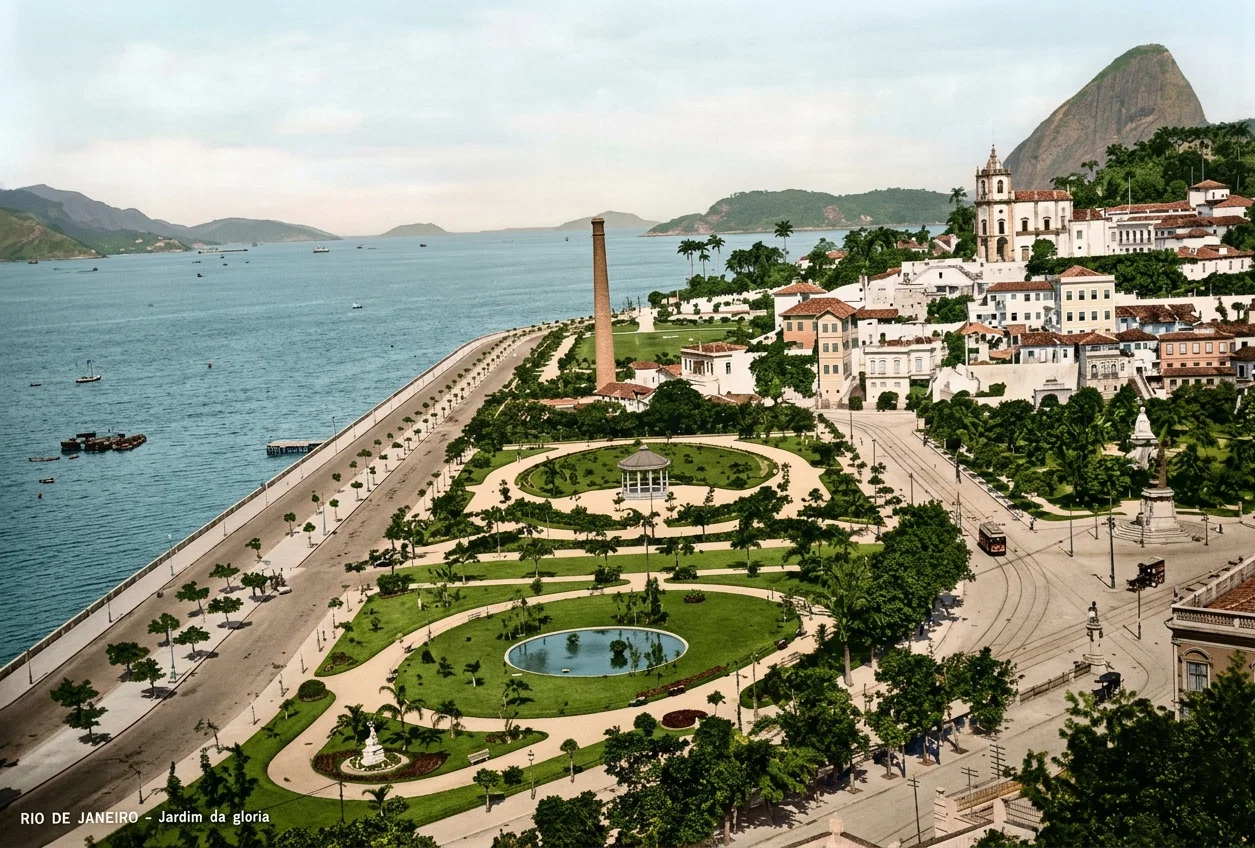
THE HARBOR OF RIO DE JANEIRO
Missionary Volunteer and Educational Departments
Excellent advancement has been made in the educational and young people’s work throughout the field during the quadrennial period. These departments have been very greatly strengthened by the addition to the different fields of several strong experienced workers. In Brazil Brother M. Rohde was asked to carry the young people’s work, which he did until the arrival of Brother W. E. Murray a few months ago. In 1918 Prof. T. W. Steen reached the field to take charge of the Brazilian Union training school, and his leadership has greatly added to the strength of that institution. With an experienced head and a good corps of assistants, and with the new buildings that have been added during the last year and the facilities provided, the Brazilian Seminary is fast becoming a very strong factor in the shaping of our work in Brazil.
Under Prof. C. P. Crager’s guidance, the young people’s and the educational departments in the Austral Union have taken the lead in the South American field. And now, with Brother J. S. Marshall connecting with the Camarero school as director, which has released Prof. H. U. Stevens to take division departmental work, another advance step has been made which we feel confident will greatly strengthen the work throughout the division.
About the middle of 1918 Brother H. B. Lundquist reached Lima, Peru, to connect with the staff of workers in the Inca Union Mission and to establish a school for that union field. This school was started a year ago. While the enterprise is a small one, yet it has had a successful year, and the prospects for the new year are very bright. Although Brother Lundquist was obliged to drop out of the work for several months because of typhoid fever, yet we are glad that Brother J. M. Howell was there in the field to carry successfully the burden of the school through to the end of the year.
With such favorable prospects in the three unions, and with the Chile school, under the directorship of Brother W. W. Wheeler, making such good advancement, we feel that we have every reason to believe that the work of these departments is placed on a good, solid, progressive basis, one that will result in success and that will mean untold good to the young people of this field.
A long-felt need in the young people’s department was a youth’s paper, which has now been started, and which is meeting with a most cordial welcome throughout the field. Departmental literature has also been provided and has given the secretaries something with which to work. Much more needs to be done in this direction, but we are glad that a beginning has been made. We believe that we cannot emphasize too strongly the importance of safeguarding the interests of our youth and bringing within their reach the educational advantages which will fit them to bear the responsibilities in their native field. The young people who have been trained in our own schools, and who have been sent from Argentina to the Lake Titicaca Mission, as well as those who are laboring in other parts of our home field, are a demonstration of this.
Publishing Department
From the first the colporteur has pioneered the work in this continent. Wherever we find this blessed message planted, there we find the fruit of his sowing.
In every part of this division field the printed page has been an entering wedge, and is still the strong arm of our cause. The production and circulation of our literature in the language of the people is next in importance to the living preacher in the proclamation of this message. We cannot estimate too highly the influence of our literature upon the minds and hearts of those in whose hands it is placed. Up until the present time the Spanish fields of South America have depended upon European and North American publishing houses for all the large books used in them. The demoralization of traffic, the tearing down of mail service, and the perplexities brought about by labor troubles are an unquestionable demonstration to our minds of the necessity of taking immediate steps in the production of our subscription books here on20the ground in our own publishing houses. The sooner this can be brought about, the better it will be for the publishing interests of our field.
In Brazil our brethren have from the first been the publishers of their own literature in the Portuguese language. More and more it is becoming apparent that the need of that field is a few larger books. Both of our publishing houses have been materially strengthened, the Florida house by the coming of Brother Everett Everest as manager, and the São Paulo house by Brother A. Pages’ being relieved of the union secretary-treasurer’s work so that he can devote his whole time to publishing house interests. It has been necessary throughout the field to revise prices in harmony with the advance costs of operation. Recently both La Revista and El Atalaya have been enlarged, La Revista becoming a biweekly paper. El Monitor, a paper especially devoted to the interests of the young people, has been started in the Spanish, and an excellent missionary magazine in the Portuguese, Signaes dos Tempos, has been started in Brazil. All these features greatly add to the strengthening and building up of the publishing work throughout the field. Excellent progress is being made; book sales eclipse anything that has ever been known in the past. We have a fine staff of colporteurs, all of good courage, and we feel that this important branch of our work should have the fullest co-operation and help of our people.
Restored with AI
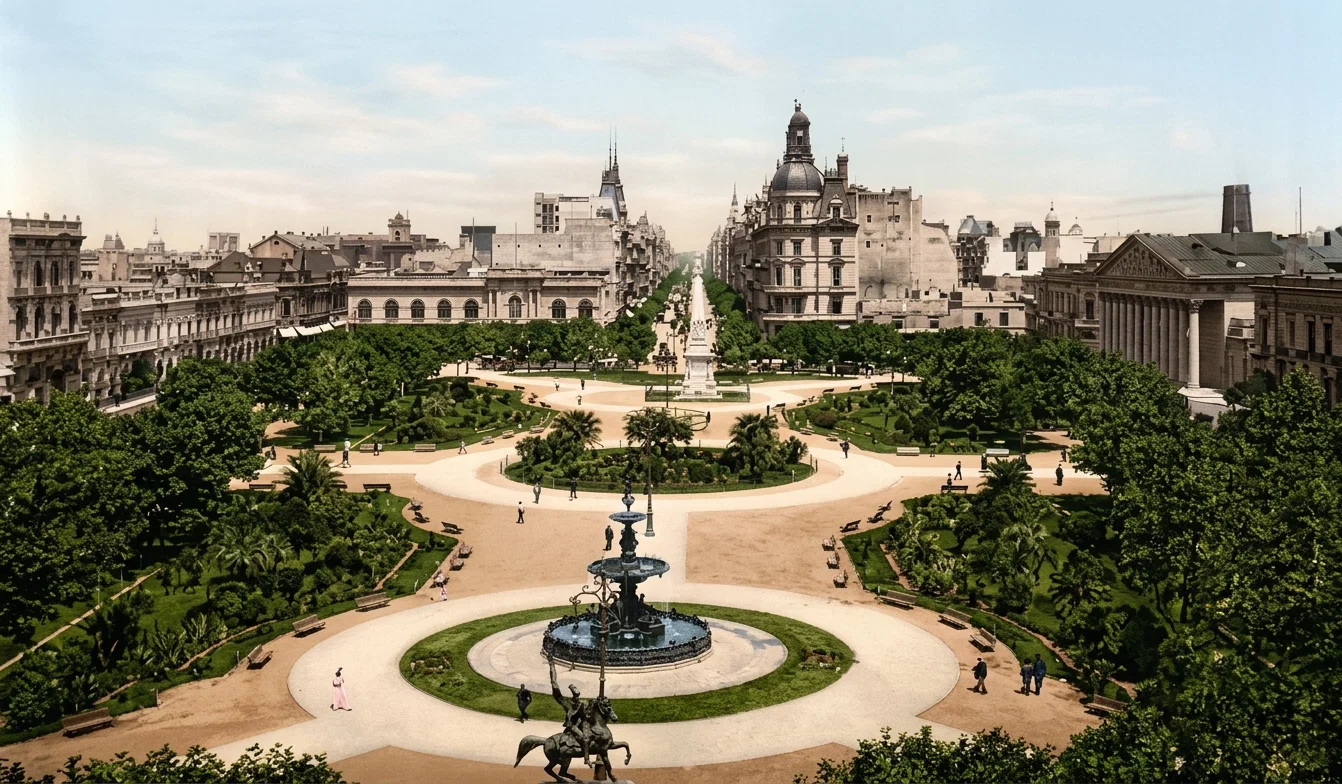
PLAZA DE MAYO, BUENOS AIRES
Home Missionary Department
We believe that the finishing of the work of God in the earth depends upon arousing the laity to service. How to make the home missionary work more effective in soul-winning is the vital question. Missionary work which is effective in saving men and women from sin, and bringing them as humble supplicants to the Lord Jesus, who only is able to save, is the kind of work that needs to be done throughout the entire field. Our greatest need in our home missionary endeavor is to bring our people to the place in their own experience where their whole effort will be actuated by a deep fervent love for souls and a desire to see men saved from sin. We cannot emphasize too strongly the importance of the work of this department. We are glad to report that very definite progress has been made in this branch of the work during the last few years. The home missionary work has been greatly strengthened in the division, and in the Austral, Brazilian, and Inca Union fields, by the earnest efforts of Brethren J. H. McEachern, A. A. Cone, M. Rohde, and E. H. Wilcox.
We stand today on the great divide, viewing the past and looking into the future. We are profoundly impressed by the way God has wrought for us hitherto. To his holy name be the praise, the glory, the honor. The future is big with promise. The Author of our salvation, whose ultimatum we herald, will be our shield and our rearward as we press on to the farthest reaches of this great continent. He will give us clear vision. He will enlarge our hearts. He will strengthen our hands. He will inspire us with courage. Saved by his grace, filled with his power, led by his Spirit, we shall claim victory and success in his name.