Leaving La Paz Sunday, June 6, we made our way that night by steamship across the deep and placid waters of Lake Titicaca. What a marvelous body of water, 12,500 feet above the sea, surrounded by an elevated plateau, rising into mountain tops on every side! Its length is 130 miles.
The next morning when our boat reached Puno, where a workers’ institute had been arranged for, we were met by Brother F. A. Stahl and other workers. The meetings, which began next day, were attended by practically all the workers around Lake Titicaca. The foreign workers present were O. Montgomery, E. F. Peterson, F. A. Stahl, H. U. Stevens, E. H. Wilcox, Charles Thompson, W. E. Howell, J. L. Shaw, Orley Ford, Jose Replogle, Dr. Johnston, J. S. Hindbaugh, A. C. Ford, David Dalinger, Archie Field, and Pedro Kalbermatter. With these were gathered more than sixty native workers, most of whom were teachers in charge of native schools. Around Lake Titicaca there are forty schools, with fifty-six teachers. The enrolment of these schools is very large.
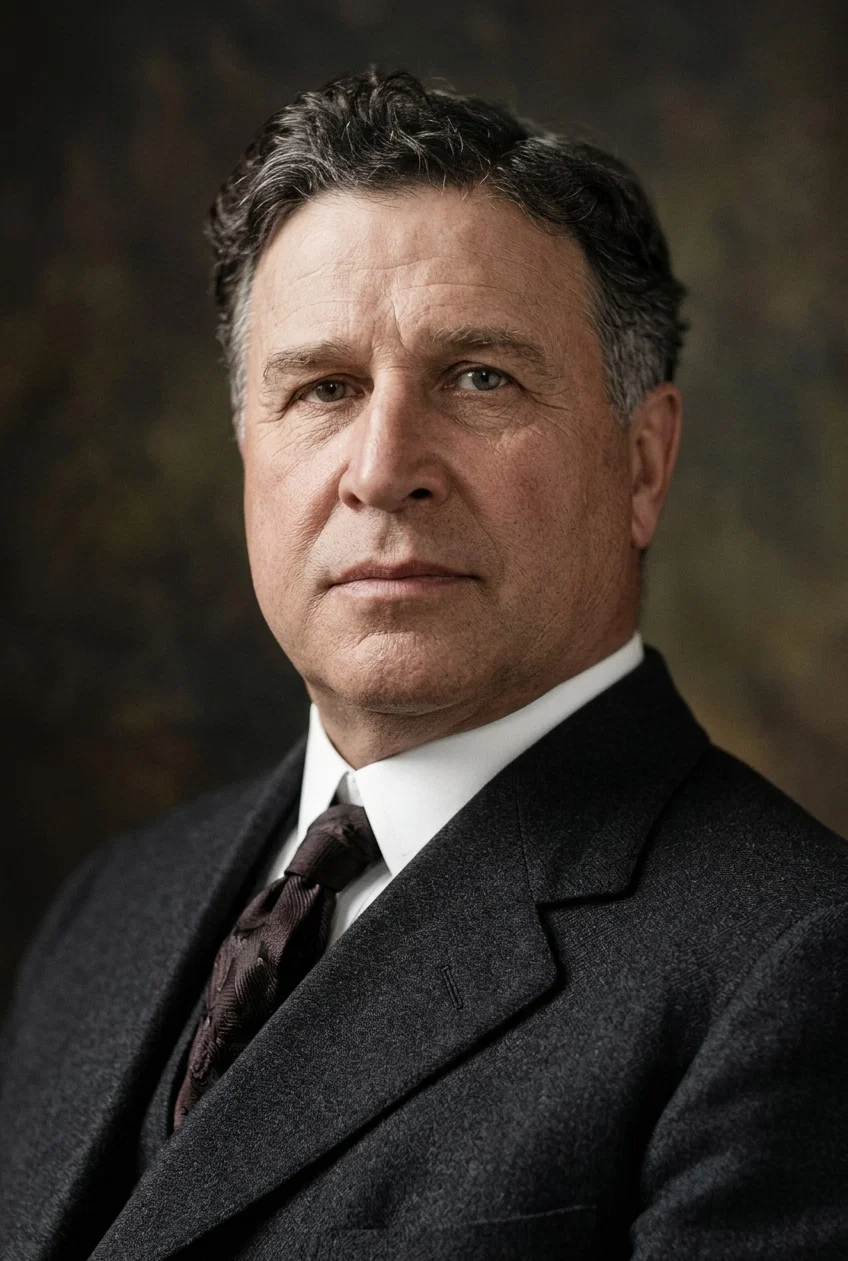
Restored with AI
F. A. STAHL
Superintendent Lake Titicaca Indian Mission
The purpose of the institute was to emphasize in a simple way some of the essential features of our message and work. The instruction given was translated first by an interpreter into Spanish, and then by another interpreter from the Spanish into Aymara, and frequently also into the Quichua. Though we questioned at first whether the messages given would reach the ears of the Indian workers and be understood, we were again and again encouraged by their manner of response. It was a real pleasure to meet these Indian workers, shake their hands, and hear from their own lips their experiences and victories in Christ. There were present those who had hazarded their lives for the faith, and many who had been delivered from the curse of alcohol and the use of the coco leaf, with all their attendant evils.
We met Brother Comacho, the first Indian convert. Having received a copy of the Spanish Signs, he wrote for more light. Brother Stahl visited him, and afterward lived in his house when first beginning work among the Indians. We also met Brother Juane Juane, who was struck by the Indians and suffered imprisonment. He is now a successful evangelist. We met Brother Luciano Chambi, who, after living five years in the house of Brother Stahl, has proved his ability as a soul-winner and is now in charge of a mission station; and also Romaldo Ordonus, who from his house at the snow line, 18,000 feet above the sea, had come seven days’ journey to attend the meeting. He came with two requests; one was that a teacher be sent to his mountain retreat to conduct a school, and the other that a minister come and baptize11candidates desiring baptism. When the needs of foreign missions were presented, he gave freely of his small store. We were also glad to grip the hand of a converted thief, once a source of fear to those who knew him, but now a quiet, earnest, successful teacher in one of the mission schools.
A Visit to the South Side Stations
After this meeting closed, the leading brethren divided into companies: Brethren O. Montgomery, Charles Thompson, E. F. Peterson, E. H. Wilcox to visit the mission stations on the north side of the lake; Brethren W. E. Howell, F. A. Stahl, Dr. Johnston, H. U. Stevens, J. S. Hindbaugh, and the writer to visit stations on the south side. In this way we were able to come into personal touch with a large majority of the 2,000 Indian brethren about the lake, and to see our missionaries at their work in the different mission stations.
Leaving Puno by boat, we went to Pomata, the farthest station on the south side, about eighty miles from Puno. On reaching the shore, the school band, with flags and horses, greeted us, shouting their cheers and playing their notes of welcome as they ran before our horses on the way back to the mission station, five miles distant.
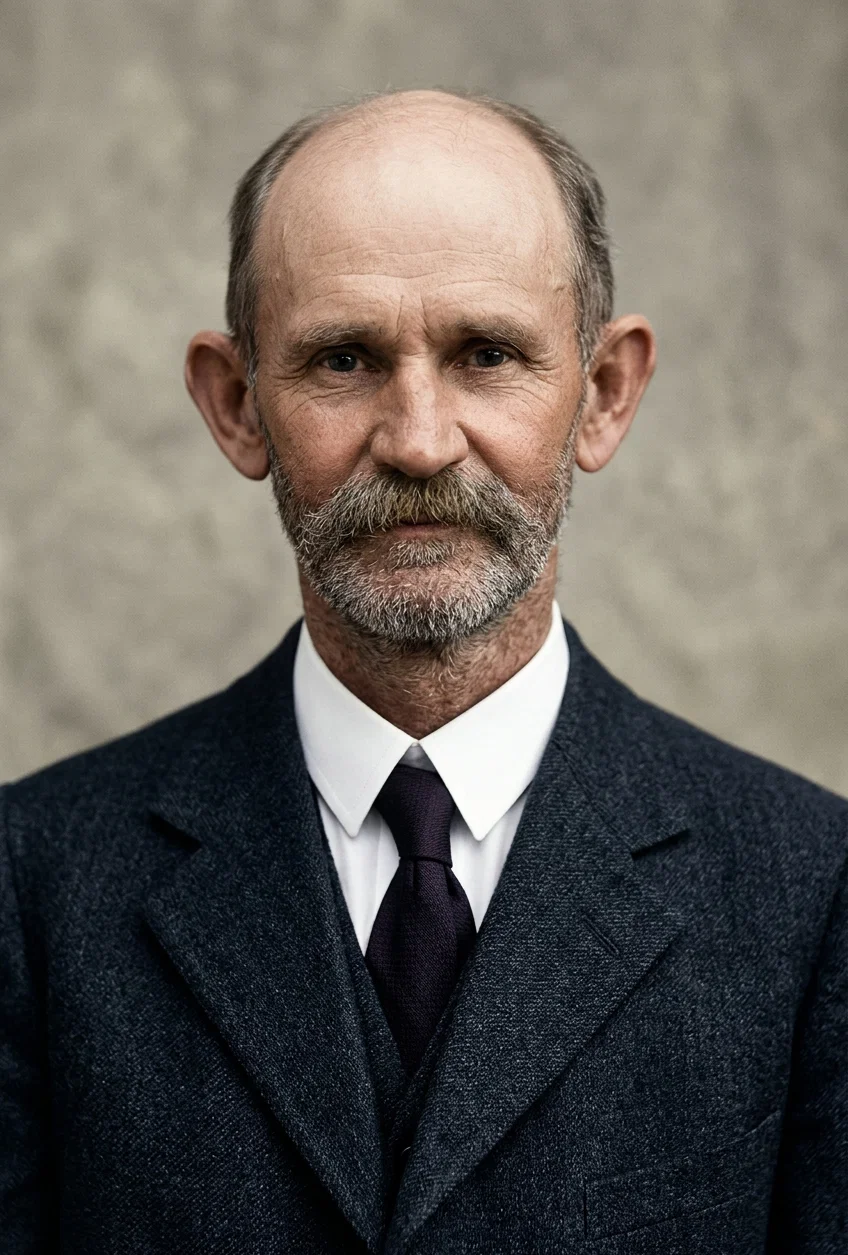
Restored with AI
DR. R. H. HABENICHT
Medical Superintendent River Plate Sanitarium
Brother and Sister Orley Ford are in charge of the Pomata station. The mission buildings are well situated on the hillside, commanding a good view of the pampa stretching away in the distance, dotted here and there with Indian houses and flocks of llamas, alpacas, sheep, and cattle eating mountain grass. The mission property consists of a church building, a small dispensary, a stable, and other small buildings, the entire cost of which was about $1,500. Though the station has been in operation only three years, there are between two and three hundred church members and seven outschools.
Announcements had been sent out that the recently completed church would be dedicated while we were there, so people gathered in from the surrounding country. The men sat around the wall on a bench made of earth, while the women sat on the floor in the center. The church, made of sun-dried brick and covered with thatch and floored with boards from packing cases, is large enough to accommodate four hundred persons. Soon it will not be large enough, for many are seeking the truth. A large baptismal class was then under instruction.
Between services the little, well-arranged dispensary was freely patronized. So many were seeking medicines it was only with difficulty that we made our way in. The interest our missionaries about the lake have taken in the sick and suffering, and the manner in which they have cared for them, have won the hearts of the people and given them their confidence. In all their needs they turn to the missionaries. They look to them as their teachers, for they have no schools; as their medical helpers and advisers, for they have no doctors; as their protectors from robbers and government officers and others who take their property, for they have been denied their rights for many generations. We rejoice in the good work going forward at Pomata. In a painstaking, thorough manner Brother and Sister Ford are building up the various interests of the station. Though working single-handed and often beyond their strength, the Lord is blessing their efforts, and many souls who have been sitting in darkness have seen a great light. Another couple is needed at Pomata, to help these faithful workers in the good work to which they have set their hands.
Our Trip to Ilave Pampa
On the morning of the third day, after the horses had been well fed on sheaves of barley, and Brother Ford, turning blacksmith, had put new shoes on them, we were ready for our journey from Pomata to Ilave Pampa. Brother Stahl leading the way on his faithful black mule, we went over pampa and hill and mountain, sometimes following trail and sometimes not. We had gone only a few miles when we were met by a delegation who earnestly requested us to turn aside from our journey and visit their brethren in a nearby village. They wished us to send a teacher for their school. For miles they ran in front of our horses, thus wishing us God-speed on our way, as we could not stop. Finally we halted. Brother Stahl made a short speech and prayer was offered; the Indians were then urged not to go farther from their houses, so they turned back. We passed many dwellings, and saw the Indians at their various tasks,—cutting and threshing barley, making chuñas, and tending their herds of llamas, alpacas, sheep, and cattle. The Indians here, both men and women, are an industrious, hard-working people. The women, weighted down with many clothes, hurry barefooted along the roads, often spinning wool as they go.
As we journeyed we saw relics of the Inca days, when the Indians of the highlands, and in fact of all Ecuador and Peru, reaching far down into Chile, were under the rulership of their own kings. Though worshipers of the sun, these ancient people developed a civilization surpassing anything of its day in either North or South America. We passed chulpas, or high pedestals of stone, underneath which are still to be found the bones of bodies buried hundreds of years ago, clay, pottery, and other relics. We passed a seat cut in solid stone, with stairs ascending to it, supposed to be the throne upon which the Inca or Indian ruler sat when in that part of his extended domain.
Miles before we reached the mission station of Ilave Pampa, we were met by one delegation after another, some on horseback, others on foot, blowing horns and waving flags, all desiring to shake our hands and bid us a warm welcome. Soon we reached a broad river, the water reaching above the horses’ girths. There was nothing for these Indian brethren to do but to take off their clothing, put it on the tops of their heads, and wade the deep, cold river.12
Shortly after we forded the river, the mission buildings came in sight. Soon, in company with more than twenty men on horses and about fifty or more on foot, with the native bands lustily cheering, we entered the grounds of the Ilave Mission. Brother and Sister Jose Replogle are in charge. These workers received their training in Argentina at the school and sanitarium in Camarero, and therefore have the advantage of being able to speak and converse freely in the Spanish. Ilave Pampa is one of the newer stations. The buildings are not yet completed. Brother and Sister Replogle welcomed us into their little adobe house of one room. What promises to be a comfortable house is not yet completed. We began to wonder how a party of six hungry, weary men should be fed and housed in such small quarters. A trip of thirty miles on horseback for the first day in our itinerary was sufficient to make every bone and muscle long for rest. But we found our hostess equal to the occasion. Soon we were seated at a well-laden table in the little cabin. Already we had been convinced, while at Puno and Pomata, that the missionaries about Lake Titicaca need not suffer hunger. They can have as needed, bread, potatoes, milk, eggs, butter, frequently green vegetables, and some fruit. There is still one place at least where eggs and milk can be purchased in abundance at reasonable prices. In some places the price of eggs is as low as ten cents a dozen. We also discovered that the Titicaca missions have a number of excellent cooks. These sisters know both how to prepare and how to serve food. Though isolated, with only Indians about them, they keep their homes neat, tidy, and restful. And still more, these faithful women stand loyally by their husbands, doing their part to bring the Word to Indian hearts.
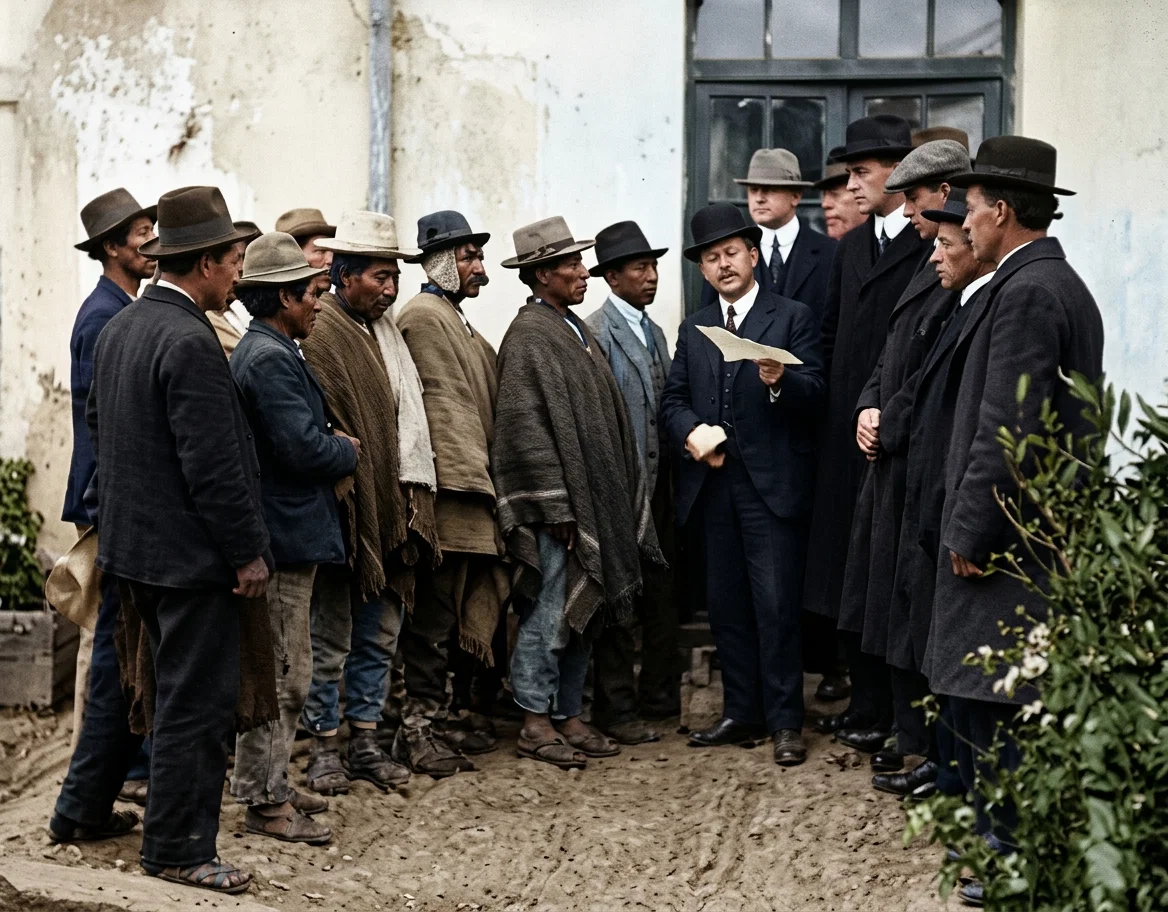
Restored with AI
Indian Chiefs in La Paz Asking for Schools
The Ilave Pampa Mission lies on a great pampa. From ten to fifteen thousand people live within ten miles of the mission. The soil is productive. Barley and potatoes are the chief products. Sheep, cattle, llamas, and alpacas are raised in large numbers. Already there are 200 church members, 40 persons are awaiting baptism, and 300 more are interested. The Sabbath school has an attendance of 400. There are five schools, with 280 matriculated pupils—one at the station and four outschools. The great need of the mission is more help to instruct thoroughly the interested truth seekers. Think of the burdens upon this young missionary couple,—a mission station to be cared for, buildings to be erected, schools to be visited and supervised continually, a large baptismal class to be instructed, hundreds waiting to learn more of the message, many coming for medicine and treatment, together with regular services which must be conducted. This at an altitude of 12,500 feet is too much, and another couple is needed.
The next day, before the appointed hour for the dedication of the church, the people began to assemble. We could see them coming from every point of the compass. The students of the outschool marched in, carrying their flags and playing their native instruments. We were favorably impressed with their behavior and order. It was soon evident that the church, twenty-four feet wide by sixty-five feet in length, would not be large enough. About five hundred were gathered inside, and as many or more gathered about the door on the outside. Prof. W. E. Howell preached the dedicatory sermon. This was translated into Spanish and from Spanish into the Aymara. Brother Polasky, an Indian evangelist, stood in the door, and while another Indian evangelist was translating to those within, he was translating to the hundreds without.
At the close of the service, five babes, all under a week old, were brought before us. They bring their babies to the missionaries to be named and prayed for. We thought of the words of Christ, “Suffer little children to come unto me, and forbid them not.” After choosing names familiar to us, we committed them with their parents to God in prayer.
At the close of the day scores remained for treatment. Brother Stahl, Dr. Johnston, and Brother Replogle were all busy. Brother Stahl felt certain he had put medicine into the eyes of a hundred persons. The Indian people, when ill, are eager for medicine, and can take doses that would throw the white man’s organism into confusion.
Plateria Mission Station
Another night’s rest, and we started on horseback for another journey of thirty miles, to Plateria, our oldest and largest Indian station. On the way we stopped at Esquinas, a mission under the direction of a native worker, and were accorded a royal greeting. A meeting was necessarily held outside, as the church was not large enough to accommodate the 800 persons present. As we hurried on in order to reach Plateria before the Sabbath, the people followed en masse, and stopped only when Brother Stahl turned and urged them to return to their homes.
Brother A. C. Ford is temporarily in charge of the Plateria Mission Station. Sabbath school was held in the large church, which accommodates about twelve hundred. The number of visitors was so large it was thought best not to hold separate classes. The review and lesson over, the roll was called and the collection taken. When the people do not have money, they are asked to give in kind. Eggs at that station seemed to be a favorite Sabbath school offering, and soon the table was well covered with them. By the time the hour for preaching service had arrived, the church was crowded with interested listeners.
Plateria being our oldest station, we were able to see there still more evident results of gospel teaching. There is a fine class of Indian young men and women in the school. They appeared neat and well clothed. It is from this station that most of the fifty teachers out in charge of the schools have gone. As we began to examine the facilities for training, we saw how13poorly prepared the Plateria Mission is to train workers. We had listened to no less than forty delegations asking that teachers be sent to instruct their people, and for lack of teachers no promises of help could be made. We then realized how vital and necessary is a training school to prepare teachers and evangelists to answer these insistent calls. “Send us a teacher. We will furnish the land, put up the building, equip it, and pay for the teacher.” This is the attitude of the people. What they want is the oversight and moral support of the mission. To meet this demand a school to prepare workers is needed.
Sunday morning we completed our journey to Puno, and finished our intensive program among the Indian peoples. The Lake Titicaca Mission is unique in the history of our world-wide missionary endeavor. Brother Stahl and his associate workers have reached the hearts of multitudes of these people. Many are turning toward the light. It is the nearest thing to a mass movement toward the gospel the writer has ever witnessed. Our part is to supply workers to strengthen the hands of our missionaries in the field, and the harvest seems certain to follow.
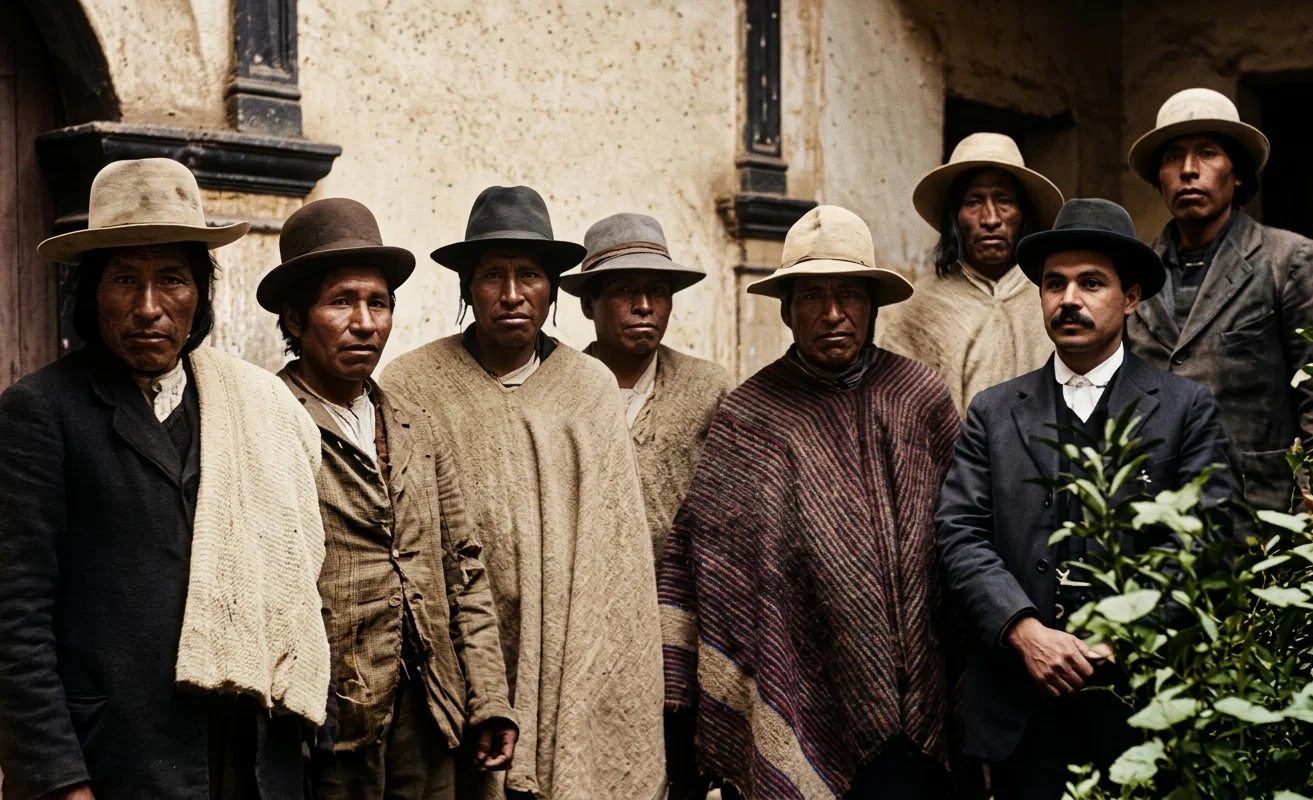
Restored with AI
Indian Chiefs in La Paz, Where for the First Time They Listened to the Hope of a Soon-Coming Saviour
Now is the hour for these neglected and oppressed peoples to hear of Christ and his message for today. They are coming not only in tens but in hundreds. Shall we do our part in faithfully teaching them the message and preparing them to take it among their own people? The question facing us is, How shall workers and means be obtained to meet the needs in the Lake Titicaca Mission?