Lima, Peru

7%

Review and Herald Publishing Association · Takoma Park, Washington, D. C. · Aug 12, 1920

FromReview and Herald, Vol. 97, No. 33.

Read the full edition

Lima, Peru

CHARLES THOMPSON
LIMA is the capital and chief city of the republic of Peru. It is also the headquarters of the Inca Union and Peruvian Missions. A number of our workers live in Miraflores, a beautiful residential suburb of this city. In this suburb is also situated the training school for the Spanish-speaking people of Peru.
The last general meeting we attended in South America was at this place. It was a meeting of the Inca Union Mission. All the workers were called in, and a regular program of instruction was carried on from day to day. In addition to this instruction, reports were given by those who are carrying special responsibility in connection with the administration of the work in these missions, and evening meetings were held for the special benefit of those interested in the truths that make us a separate people.
In company with Elders O. Montgomery, E. F. Peterson, and H. U. Stevens, Elder J. L. Shaw, Prof. W. E. Howell, and the writer reached Lima a few days previous to the beginning of the workers’ institute. The time was spent in divisional executive committee work. Here their budget for 1921 was prepared, and other important matters pertaining to the future policies and work of their division were decided. Our delegation from the States had received a cable from Washington urging our return before July 24. Consequently we planned to sail on July 2, the boat sailing on that date being the only one at the port of Callao that would land us at headquarters in harmony with the request. In thus sailing a few days earlier than we had previously planned, our work in the institute was cut short, but we were able to attend most of the important committee meetings and the first day of the workers’ meeting.
We were glad to meet most of the workers of the Inca Union Mission, and to find them and their families enjoying a good degree of health, and also to find them courageous in pushing the work in their various fields and departments. They were, in return, encouraged by seeing a good growth and advancement in the work.
Prof. H. B. Lundquist has charge of the training school for the Spanish believers. The attendance is not large, but a good beginning has been made, and prospects are bright for earnest workers for the field as a fruitage of the school. This school is conducted in rented quarters, and it was thought advisable to continue in the present location for at least another year, or until the constituency becomes larger and the needs correspondingly increase. We are satisfied that the time is near, however, when this school will need a permanent location in some more rural place, where the environment for training will be more in harmony with our system of Christian education.
Brother E. H. Wilcox, who has had charge of the field missionary and home missionary departments, gave a most interesting and encouraging report. From his report on book sales I quote the following:
“The territory of the Inca Union—Bolivia, Ecuador, and Peru—is a large expanse of country containing more than 1,546,651 square miles, or about one third the area of the United States of America. A large part of our territory is coast land, which in a large degree is an arid desert; the other part is quite mountainous. Across these deserts and mountains the colporteurs travel for days over dangerous roads and lonely trails, seeking those who inhabit these sparsely settled places, and when they find them they learn that only about one out of three can read or write.
“But as we look back and review the past, we cannot refrain from saying, Behold what God hath wrought! When I first arrived in the Inca Union, in May, 1917, I found the work quite disorganized. No records had been kept, so I shall only be able to give a report beginning with 1917. I found only four canvassers in the union, and they were all in debt to the mission. The last year we had seventeen colporteurs, who worked for one month or more, and all, with two exceptions, paid their accounts promptly. Six of these were student canvassers. God has especially blessed these young men. One young man in one week took orders to the amount of 832 soles, practically all of which he delivered. Another in fifteen days delivered enough books to pay his last year’s schooling.
“Books have been placed in the hands of some of the leading men of the country. Brother L. G. Beans and Laurence Pohle have placed our large books in the hands of the president of the Bolivian republic, also in the hands of senators, representatives, bankers, and lawyers; and last, but not least, archbishop and leading Catholic priests have received them. The largest record for the union was made in Ecuador. Brother Lorenz, the superintendent, canvassing in Guayaquil, sold forty-one books, or 400 soles’ worth, in one day, all of which were delivered.”
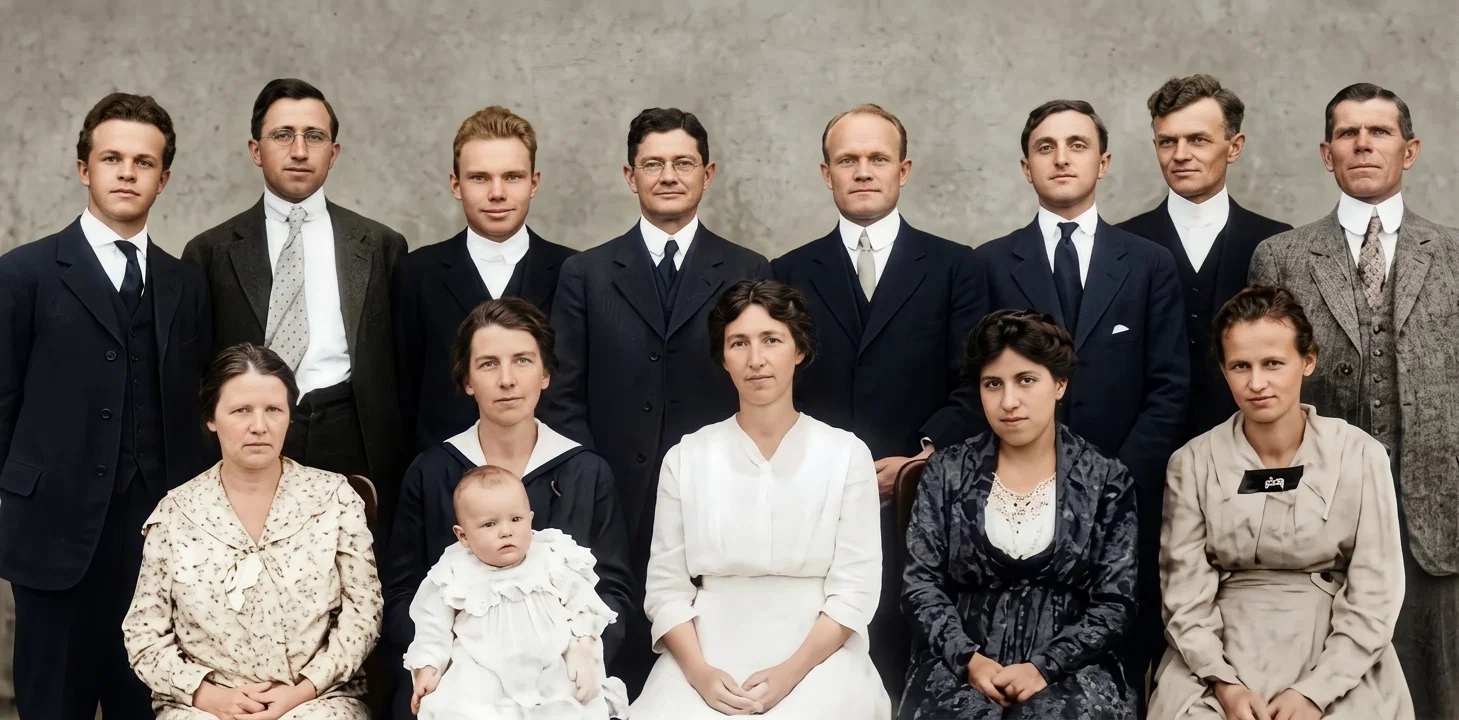
LIMA WORKERSRestored with AI
LIMA WORKERS
Following this meeting these departments will have another leader, as Brother Wilcox was selected to take the superintendency of the Lake Titicaca Indian Mission. This will require that he move to Puno. Elder F. A. Stahl, who has had charge of the Indian work for so long, felt, on account of failing health, that he must seek to recuperate in a lower altitude. So the committee recommended that he settle in Lima and work there, and out from there as his health would permit. Thus the loss to the work in Lima by the removal of Brother Wilcox and his family will in a measure be made good through the coming of Elder Stahl and his family. The departments carried by Brother Wilcox, however, are to be filled by an appointee from the United States, whom they are expecting to arrive soon.
In this connection mention should be made of our work in Ecuador. Time would not permit of our visiting this republic, but we were privileged at this meeting to greet Brother John Lorenz, superintendent of the mission, and Brother Ellis P. Howard, who, with his faithful companion, is devoting his life energies to the Indians of Ecuador. These brethren gave a synopsis of their reports before the executive committee; and while this field seems to be a difficult place for the message to gain a foothold, yet we are glad to report one organized church of fifteen members and other isolated believers at different places throughout the republic. Brother Howard reported favorable openings among the Indians, and made an earnest appeal that help be sent them at once to open a central station where work can begin for these long-neglected peoples. Brethren Lorenz and Howard are stationed in the trying climate on the equator. It may be necessary for them in the near future to recuperate for a time in a climate more favorable, but we believe their hearts are in Ecuador, and that under the direction of the Holy Spirit and the blessing of God they will be enabled to see great things accomplished through their future labors in that field.
Elder E. F. Peterson, superintendent of the union, and the superintendents of the local fields, have the confidence of their associate workers. They are all able to speak publicly in the language of the country, and we believe through their combined leadership and aggressive campaigning, with the full co-operation of their fellow workers in the field, the believers will be multiplied,—a situation greatly to be desired in all the conferences and mission fields throughout the entire South American Division. To this end we solicit the prayers and liberal support of all our believers in North America, and may the Lord of the harvest send more laborers to this needy field, is our prayer.