J. VICTOR WILSON
A few days ago we all went to see a native funeral, and a short sketch of what we saw may be of interest. We arrived before many natives had gathered, and could see them coming from all directions, dressed for the occasion, each carrying from six to twelve assagais.
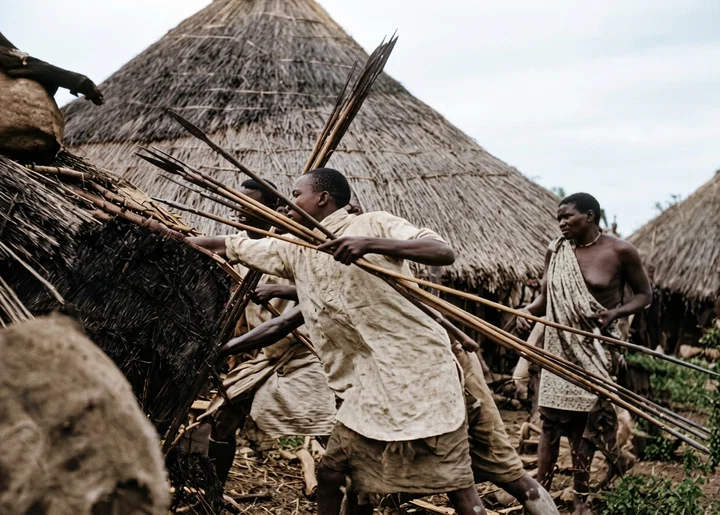
As the women came, they threw themselves on the grave with great force, quite a few times, until taken away by some friend. The men, most of whom had their faces whitened with ashes, came on the hard run, and when near the hut of the deceased, would stab all around with their assagais to frighten off the evil spirits. As we watched the faces of some of the men, they seemed to us to be devils incarnate, and they jumped about more like wild animals than human beings. Two young men began to pull down the house of the dead man (they can be seen doing this in the photograph), but were quickly stopped by one of the old men.
The women and girls marched to and from the grave, wailing as they went, carrying the horns of the cattle that had been killed. Once in a while one of them would run out with the horns, and go through the motions of chasing off evil spirits with them. Another woman walked around the grave, swinging a pot of burning incense.
On all such occasions numbers of cattle are slain, cut up, and boiled and eaten with the hides on; for ifp. 14 the cattle were skinned, they say, the deceased would have hideless cattle in the next world.
As we watched the proceedings, and compared these heathen with our mission boys, a number of whom were with us but did not join in the ceremony, we could not help thinking what a marvelous change the gospel makes in a native. The funeral took place only two and one-half miles from our mission homes. Knowing this, one can better comprehend what a great work still remains to be done for the poor Africans.
Pemba, Rhodesia, Africa.