WHEN entering upon a program to develop a medical center in Shanghai four years ago, little did we understand what was ahead of our church work in the Orient along this line. While it was a remarkable event for the Far East when our people throughout the world responded to the various calls for help to assist in establishing the Shanghai Sanitarium as a sanitarium for the Orient, and a training center for our young people here in the great Far East, whereby they could obtain nurses' training, it seems that God had a still larger program before us here than we had anticipated, for no sooner did we have the main sanitarium completed and open to receive patients, than there was placed upon us an urgent plea on the part of the people in Shanghai to do something for the poor in the great metropolis of Shanghai, which is the sixth city in population in the world to-day. Our patients and friends here in Shanghai urged us to believe that we could raise from the people of this city the funds necessary for such a city branch clinic.
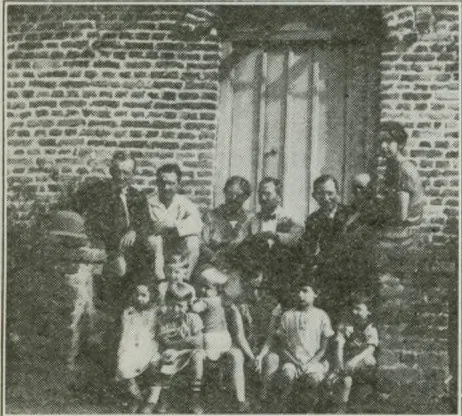
Our Workers with Their Families in Ruanda
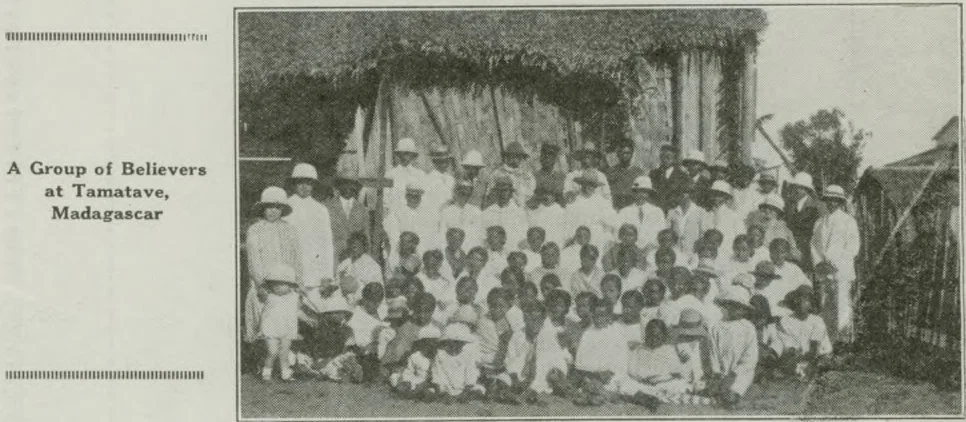
A Group of Believers
at Tamatave,
Madagascar
Our sanitarium quickly filled to its full bed capacity, and it seemed to our brethren that we could operate to advantage another institution in the city with the same medical staff, and give our nurses this very valuable additional training for their work in the inland provinces, which would be almost entirely among the poor who can afford to pay but little. The more we considered the idea of launching a campaign for such an enterprise, the more favorable it seemed to us. We therefore asked for authorization to go ahead and put on a campaign for raising funds for a hospital. J. J. Strahle, home missionary secretary for the Far East, was asked to take charge of this campaign, and we at once prepared a prospectus descriptive of the work we hope to do, and began to approach the public. We set as our goal $65,000, the amount required for the construction of the first unit of such a hospital, and in a little over a month from the time we started the campaign we had nearly reached this amount. As we visited firms and individuals, explaining the character of the work we desire to do, they assured us of their appreciation of the kind of medical work Seventh-day Adventists are carrying on, and expressed their confidence in a very practical way by gifts ranging from $100 to $10,000 local currency. These gifts are given unconditionally. All that any one has asked of us, or even suggested, is that there might be a proper memorial plate placed at the entrance of the department, or ward, or room for which he has contributed funds, leaving the administration of the work wholly and entirely with us.
It should be borne in mind in this connection that there has been, particularly during the last three years, a great struggle going on in China between the Oriental and the Occidental, to the extent that at one time nearly all missionary and business enterprises in China ceased operation, and their premises were entirely vacated . There has been intense feeling on the part of many of the Orientals, that the foreign powers are imperialistic; and many of those engaged in benevolent enterprises and Christian missions in these countries, have been regarded as agents, who, if not actively working in behalf of their governments , are at least depending upon the backing of the officials of their countries. On the other hand, foreign firms and business men in China, because of this past and present tenseness of feeling, have expressed great reluctance to supply contributions or donations that would in any way help the people of China, because of their having closed up hospitals, schools, chapels, and churches already in existence.
In view of these conditions which have existed and do exist, it seemed as if it might be an especially unfavorable time to approach the Chinese for help toward an institution conducted and promoted by us as foreigners, and that it would, on the other hand, be equally difficult to get the foreign community of Shanghai to give to an enterprise whose benefits were to be entirely for the Chinese people.
However inopportune the time for such a campaign may have seemed, as we have moved forward we have met with most unusual success in receiving gifts and contributions from both the Chinese and the foreign community. Many of those who have contributed have been patients in our sanitarium here in Shanghai. They have stayed with us for a few weeks, and as a result of the benefits received, they have responded, when approached, by giving us from $500 to $3,500 to establish a department in this medical institution which is to do for the poor what we are now doing in our sanitarium for those of better circumstances.
I having worked in the early days of our mission enterprise in China, and recalling that during my first seven years' stay in China the highest fee that I was ever paid by a Chinese11for service, was two strings of copper cash (a little less than one American dollar), paid me by an old gentleman for whom I removed a cataract, to me it seems truly remarkable to see men signing up to give as high as $10,000, as the Hon. Tang Shao-yi did just yesterday (Jan. 16, 1929), assuring us that he was going to his friends to get another $10,000 to put with it in order to give us an additional story for housing patients in our new hospital. He is not a man of great wealth, but has great influence in China. He is perhaps the man best known to the foreign community of China and abroad, and is to-day one of the chief advisers to the central government at Nanking.
We are profoundly impressed with the fact that God has the resources at hand for the completion of this work, and that we are entering into the last days of our work, which will triumph gloriously in the earth; also that we have reached a time when those who wish to have a part in the finishing of the work and wish to put their treasures into God's cause, to be used in the saving of souls for an eternal existence, should seriously consider doing so now. We have surely come to a time when there should be no longer a holding back of funds for the rapid advance of this work. The Lord is not dependent upon us. He can raise up men, as well as means, as is evidenced now in all parts of these great fields.
Not only in China are we seeing the moving of God's Spirit on the hearts of men to contribute for our work. We have just returned to Shanghai after having attended the biennial meeting of the Philippine Union Mission. At this meeting, plans were laid for building a small sanitarium in Manila. Sufficient funds were on hand to start a small dispensary building, but as we considered the need of that field, with its more than 11,000 church members and nearly 3,000 young people, we all realized that we were not providing what was needed there, even for a beginning, but that we should arrange to open a small institution, where we could house the sick, and open our doors to the outside public, who were inquiring about our methods of treatment, and were desirous of having such help as our institutions give.
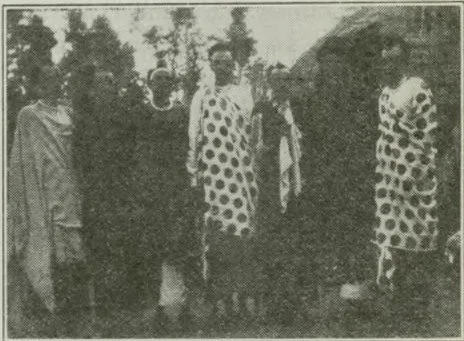
The King of Ruanda (in the center)
And Six of His Chiefs
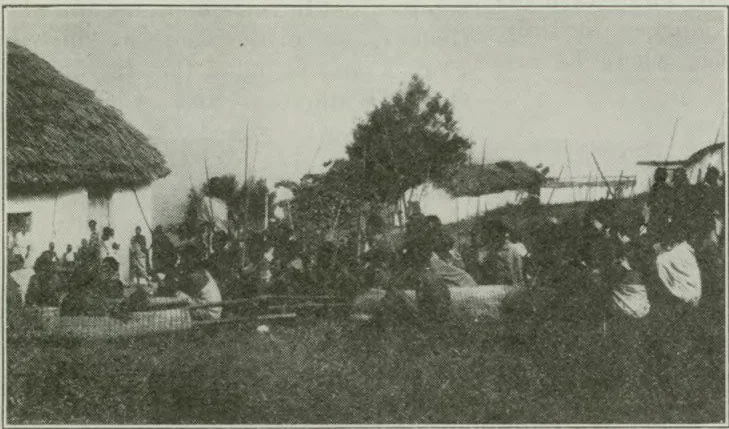
The Sick Awaiting Their Turn to be Treated at Our Dispensary in Gitwe, Ruanda
During various visits to the city of Manila the last two years, I performed sixty-five goiter operations, besides doing other surgery. Dr. Horace A. Hall and his wife, who opened a small dispensary in Manila the first of last October, have fitted up a dwelling house as a small hospital. It has only fifteen beds, but every bed has been occupied, with people waiting for some one to vacate a bed, in order that they might be the next entitled to care in his little dispensary building.
In view of the demand already created for an institution such as we are accustomed to carry on in the form of a sanitarium, it was recommended at the biennial meeting that we try to raise from the public of Manila, 50,000 pesos. The next morning, as I was calling upon a patient on whom I had operated formerly, and was about to leave, the old gentleman, who was the head of the house, whose vision was dimmed by a cataract, grasped my hand and told me to come down to his desk, he wanted to talk with me. As we were going down the steps of his simple little home, he asked me whether it was true that we were planning to build a hospital in Manila. I told him that was what we had just planned to do. Then he asked me if he could not be permitted to help us, and I told him we would be glad to have him, that it would be a great encouragement to us to have the assurance of his help just at this particular time.
He wanted to know what he could do to help. I told him how much money we would require, and that we were asking people in Manila to give, and suggested that he might give us 2,000 pesos to build a department. Immediately he gave me the assurance that he would be glad to contribute. He said he didn't do it for the purpose of having any memorial tablet put on the room, but because he wanted to help us.
Brother Strahle, who had charge of the promotion work for the Shanghai extension clinic, remained in Manila a few days to organize a campaign for raising this fund, and reported, on arriving in Shanghai, that after we left, several men promised help, and definitely subscribed sums. He also said that the liberal attitude on the part of the people in Manila toward the founding of a sanitarium clinic there, seemed to be equal to that here in Shanghai. As this offer from a former patient came as a voluntary and unsolicited contribution, directly following the action of the committee to promote the developing of a sanitarium in Manila, we felt that the time had come when we were to see a great awakening and development in the Far East along the line of building up our medical work, so that it will stand on the same vantage ground as our work in the homeland.
I trust that when our people read of these wonderful providences, they will in no way slacken their own liberality in giving to the needy and pressing calls for means which are more urgent than they have ever been in our history in the Orient; but that these manifestations of God's care may serve as a strong suggestion to them that now is the time to make their investment, not in lands and holdings of this earth, but in the souls of men, for earth's harvest is soon to be reaped.
From all parts of our great field appeals are coming to us for medical workers. Every union mission in this whole Far East wants a small hospital. About six weeks ago Prof. Frederick Griggs and I met with the Central China Union committee for the purpose of giving study to the plan for the development of a hospital in the city of Chengchow in Central China, at the intersection of the Peking-Hankow Railway with the Lunghai Railway, which is the trunk line that runs from the sea through to West China. This is the second most important12place in Central China, and a very rapidly growing city. We looked over several locations as a site for the hospital, and finally, when we returned to the sanitarium in Shanghai, we learned that one of our patients, who had had an operation a few weeks before and was still in the sanitarium, owned large tracts of land in this city. Wherever we go, and our work is known, we find that same hearty desire to help us in our work.
These are days of increased responsibility in connection with our work as representatives of God's message, and now tremendous opportunities are before the church. There are openings in these fields to-day for advance such as we have never met before in all our history. We are urged to open new work in many locations. If we could only find men and place them in our fields, the possibilities of developing our medical missionary program in the Far East would be unlimited. We need the support of the home church as never before in our program of advance in these fields. We should have scores of our trained doctors and nurses coming over to help us at this time; but before we can do this we must have increased budgets in these lands to enable us to take on additional help.