BABYLON—WHAT SHE IS.
By Wm. Covert
BY WM. COVERT.
While the last great message to this earth must fully reveal the Creator and Redeemer, and make known the sign of his authority, it should also describe the apostate power and expose its deceptive workings. This God has done.
The power against which the warning is given is named BABYLON. But when the name is associated with its fullest significance and development, it is called, “MYSTERY, BABYLON THE GREAT, THE MOTHER OF HARLOTS AND ABOMINATIONS OF THE EARTH.” Rev. 17:5.
The term Babylon is first mentioned by Moses in describing the works of Nimrod, the grandson of Ham and great-grandson of Noah.
“And the beginning of his kingdom was Babel [Babylon], and Erech, and Accad, and Calneh, in the land of Shinar.” Gen. 10:10.
Robert Young defines the word “Babylon” as “confusion,” but before this name was given, it seems to have been called the gate of Bel, or gate of God. Babylon is the Greek mode of spelling what is in the Hebrew, Babel.
The origin of the confusion, and consequently of the name Babylon, is traced through the history of Nimrod back to Ham. In him idolatry and all its associate abominations this side of the flood originated. Paul, in speaking of this apostasy, says:—
“When they knew God, they glorified him not as God, neither were thankful; but became vain in their imaginations, and their foolish heart was darkened. Professing themselves to be wise, they became fools, and changed the glory of the incorruptible God into an image made like unto corruptible man, and to birds, and fourfooted beasts, and creeping things. Wherefore God also gave them up to uncleanness, through the lusts of their own hearts, to dishonor their own bodies between themselves; who changed the truth of God into a lie, and worshiped and served the creature more than the Creator.” Rom. 1:21-25.
Much more is said in subsequent verses, telling how men and women departed from the paths of virtue and went to the vilest depths of corruption. And the reason given for this depravity is that “they refused to have God in their knowledge.” R. V. They deliberately separated themselves from the restraining influence of God’s Spirit, and practiced the iniquities which were prompted through their carnal natures.
The leader in these orgies was Nimrod. “And Cush begat Nimrod; he began to be a mighty one in the earth. He was a mighty hunter before the Lord; wherefore it is said, Even as Nimrod the mighty hunter before the Lord.” Gen. 10:8, 9. This man’s name became a byword, and his friends spoke of him as “the mighty hunter before the Lord.” What little is said of Babylon and its early inhabitants in the book of Genesis, is only a prelude to the subject of the great apostasy. In these far-off times it simply begun to assume form and take on power.
The word of God, well-authenticated history, and many a legend of antiquity all speak of the idolatry and sensual character of the ancient people who founded Babylon. Nimrod’s exploits in the chase and his dissolute living made him a great favorite with those who sought for excitement and revelry, while the righteousness taught and practiced by Noah, Shem, and Japheth, restrained and constantly rebuked the habits of the pleasure-loving world. Those who were disposed to follow the word of the Lord, advised mankind to scatter abroad over the earth according to the original plan. Gen. 1:28; 9:1. But the depraved, the pleasure going, and the ambitious naturally sought each other with a view to colonizing and building cities.
“And it came to pass, as they journeyed from the east, that they found a plain in the land of Shinar; and they dwelt there.” “And they said one to another, . . . Let us build us a city, and a tower, whose top may reach unto heaven; and let us make us a name, lest we be scattered abroad upon the face of the whole earth.” Gen. 11:2-4.
We discover in these propositions a desire for fame and renown. These are the people described in the first chapter of Romans, who did not like to retain God in their knowledge: “Being filled with all unrighteousness, fornication, wickedness, covetousness, . . . haters of God, despiteful, proud, boasters, inventors of evil things.” When Paul spoke of the part acted by the people in these things, he said that while they professed “to be philosophers they played the fool.” Rom. 1:22, Fenton’s translation. Yet it became necessary for this very people to organize civil government, and appoint magistrates to protect society from the violence and robbery which had arisen among themselves. Their own course brought upon the world a demand for earthly kingdoms. Therefore as a matter of necessity the apostate position of mankind led out in founding human governments. Satan managed through this condition of things to have idolatrous rites and services incorporated into law and protected as a policy of the state.
Associated with the plan of Babylon was the mighty tower which was afterward named Babel. The intended purposes of this structure were many. The builders desired a great name, and a safe retreat from a possible flood, besides an immense temple for the worship of their false gods. The scheme also included the idea of a universal and perpetual kingdom which would uphold and propagate idolatry throughout the world. They had matters well matured for success.
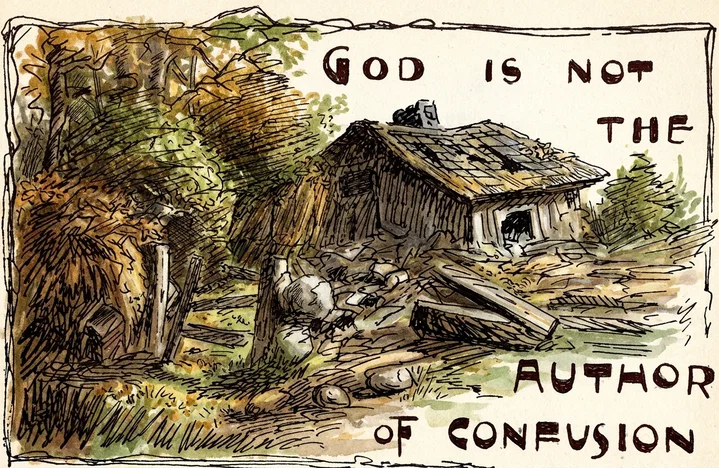
“And the Lord said, Behold, the people is one, and they have all one language; and this they begin to do; and now nothing will be restrained from them, which they have imagined to do. Go to, let us go down, and there confound their language, that they may not understand one another’s speech. So the Lord scattered them abroad from thence upon the face of all the earth.” Gen. 11:6-8.
He did not confound their language for the purpose of abolishing human governments; but it was done to prevent them from working their own ruin. Through this means sinners have been kept from forming a universal confederacy in opposition to their Maker. The tower was called Babel after the confusion, because the name so fully expressed the outcome of their foolishness. As a result they were compelled to do that which they were endeavoring to avoid.
But in scattering they carried with them the principles of idolatry. And that which was united under a beautiful name (the gate of God) to do an evil work before the confusion of tongues, became Babylon in a general sense when they were scattered abroad. In this confused, dispersed condition the idolatry of Babylon was introduced into every nation, kindred, tongue, and people of the earth. It is evident, therefore, that the warning message in exposing Babylon must be as wide in extent as the confusion of tongues into which the tribes of earth have been divided. The Lord made Babylon of their language because a false religion had crept in to be a part of the state. The false religion was not destroyed through the dispersion, but its power was greatly weakened because of the many forms which it assumed.
The seed for all this Babylonish crop of evil was sown by Satan, in his first proposition to Eve, in which he stated that disobedience would not bring death, but that it would result in transforming her into a god. Gen. 3:4, 5. Ever since that time the evil one has constantly affirmed that the dire event which the Lord calls death is only transition, and that departed ones have only entered upon a higher plane of living; therefore surviving friends have been advised to seek to the dead for help and comfort.
It was this teaching which prepared the way for the deifying of the dead. And so sun-worship, the adoration of images, sacrifices to the dead, metempsychosis, the offering of human sacrifices, cannibalism, the doctrine of the immortality of the soul, of eternal torment, universalism, ancestral worship in all its forms, the burning of widows on the funeral pile, or burial with the dead husband, the slaying of servants to bury with the dead master, the invocation of saints, mariolatry, and hundreds of other things by which Christ is denied and the Gospel made void, are all the legitimate offspring of this parent falsehood of Satan.
Babylon in her fullest development is apostate religion incorporated into law and enforced by severe penalties upon unwilling subjects. From this consideration she is called “that great city, which reigneth over the kings of the earth.” Rev. 17:18. In the judgment she will have to answer for all the martyrdom which has ever been inflicted upon the people of God; for “in her was found the blood of prophets, and of saints, and of all that were slain upon the earth.” Rev. 18:24.
That she might have the wider influence, “the great city was divided into three parts,” (Rev. 16:19), embracing in her working force the dragon, the beast, and the false prophet (Rev. 16:13). The dragon as a religious factor includes paganism; the beast is the Papacy, controlling the nations in the interest of her ecclesiastical laws; and the false prophet is that element of fallen Protestantism which is riding in state with the Papacy in her mission of corruption and persecution. This unholy trio composes the great Babylon against which the world is now being warned. But the strongest of these is the Papacy, because it is the most fully organized, and blends its diversified idolatry with the most deceptive and pleasing forms.
“Love not the world, neither the things that are in the world. If any man love the world, the love of the Father is not in him.”