The Beginning of American Foreign Missions.
Said the Saviour to his disciples, “Go ye into all the world, and preach the gospel to every creature.” This charge, sometimes called the great commission, was not the committing of a work to the disciples of eighteen hundred years ago simply, but to all those also who should afterward become followers of the Prince of life to the end of time; for the Saviour elsewhere says that when this gospel of the kingdom shall be preached in all the world for a witness unto all nations, then shall the end come. This shows that the preaching and spread of the gospel were to continue until the end. And so it has been that wherever true Christianity has existed, there have been found those who have felt impelled to carry the glad tidings of salvation to their fellow-men. It has been a general characteristic of those whose hearts have throbbed with the divine impulses of truth, to desire to reveal it to others. Their prayer has been, “Send forth thy light and thy truth;” and their heart’s desire to “give light to them that sit in darkness and in the shadow of death.”
From the many and extended efforts now being put forth on the part of Christians in America to carry the gospel to the heathen in foreign lands, it is interesting to look back and note the beginning of this work in this country. In the early part of the present century were organized the great Bible societies, “The British and Foreign” and “The American.” About the same period marks the beginning of American foreign missions.
Samuel J. Mills was born at Torringford, Conn., April 21, 1783. As soon as converted, it is said, he had a strong desire to go to the heathen with the gospel. In 1806 he entered Williams College, located in Williamstown, Mass. He, with a dozen other students, was in the habit of holding a prayer-meeting Saturday afternoons. At one time, five being present, they were driven from the grove where they had resorted, by an approaching thunderstorm, and repaired to a hay-stack near by for shelter. Here Mills remarked that in studying the geography of Asia the idea of a mission to that continent had occurred to him; and he proposed that the gospel be sent to that dark heathen land, adding, “We could do it if we would.” As the storm was clearing away, he said: “Come, let us make it a subject of prayer under this hay-stack, while the dark clouds are going and the clear sky is coming.” Those present were Samuel J. Mills, James Richards, Francis L. Robbins, Harvey L. Loomis, Byram Green. After prayer they sung the stanza,—
Let all the heathen writers join To form one perfect book: Great God, when once compared with thine, How mean their writings look.
This was in 1806. Their prayer-meetings and consultations continued during this and the following season. In the spring of 1808 a society was formed, called “The Brethren,” the object of which, according to the language of its constitution, was “to effect in the person of its members a mission to the heathen.” This was formed in a lower room in the east college building, and was in secret. The condition of joining the society was a pledge to go to the heathen unless providentially prevented. Says Dr. Hopkins, “This was the first foreign missionary society on the Continent.” The members of this society sought to excite a missionary spirit in the churches by republishing and widely circulating the able missionary sermons of Drs. Griffin and Livingston. They spent their vacations with various prominent ministers, and also sought to awaken a missionary spirit in other colleges.
In 1810, Mills, with some other of his associates, entered the Theological Seminary at Andover. Here they succeeded in forming another society similar to the one started at Williams College. On June 25 of this year, a meeting of ministers was called to meet in the parlor of Prof. Moses Stuart, Professor of Sacred Literature of the seminary, to confer with the young men. Samuel Newell presented their wishes. At this meeting it was decided to bring the subject before the General Association of Massachusetts, soon to meet at Bradford. Here a paper was presented, signed by Mills, Judson, Newell, and Nott, expressing their desire to go as missionaries to the heathen. This made a deep impression on the association, and the result was, the formation of the American Board of Commissioners for Foreign Missions.
In this way began American Foreign Missions. The earnest desires of these young men soon developed into a large and permanent organization. Though so small, quiet, and obscure was the beginning, yet it was destined to come to light, and bless the world with the fruit of their labors. Their noble example was an incentive to others, and other organizations soon followed the first.
As the work grew, allusion was often made to its small beginning, and the wish expressed that the exact locality of the memorable hay-stack could be identified.
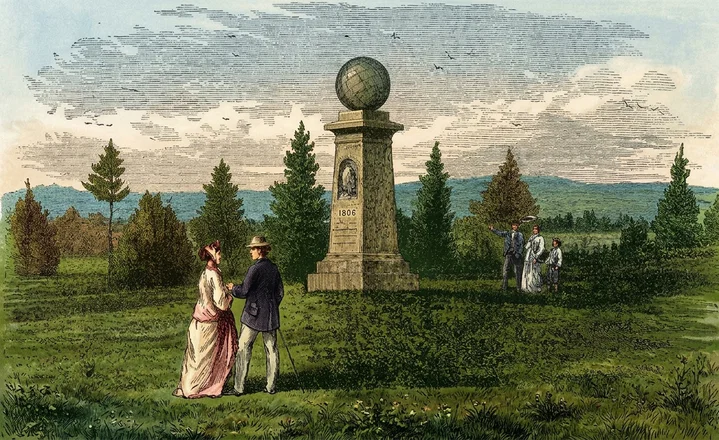
In 1854 the only surviving member of the hay-stack meeting was the Hon. Byram Green. Passing through Williamstown one day, he went to the spot, and marked it with a stake. At the following Commencement of Williams College, the alumni voted to purchase the spot, together with the grove and adjoining grounds, to be called “The Mission Park and Grounds.” This was done, and ten acres were so purchased and inclosed. In 1867 a monument commemorative of the origin of American Foreign Missions was placed on the exact spot where the hay-stack stood. Dedicatory services were held on the grounds soon after its erection. We give a representation of the monument on this page. The following description of it is given by one of the speakers at the dedicatory services:—
As a specimen of fine material and artistic sculpture, it is strictly a Berkshire production, composed of Berkshire marble, quarried at Alford, and wrought in the workshop of “The Berkshire Marble Co.” Its entire length is twelve feet; its shaft, cap, and base, square; its surface, polished; its color, a silver-blue. It is surmounted with a globe, three feet in diameter, traced in map lines. On its eastern face, and immediately below the globe, are inscribed these words: “The Field in the World.” Then follows the similitude of the hay-stack, sculptured in bold relief, and encircled with the words, “The Birthplace of American Foreign Missions, 1806.” Beneath this appear the names of the five young men who held the prayer-meeting under shelter of the hay-stack.
Here, then, is the birthplace of American Foreign Missions. From that one prayer-meeting held in this quiet, humble spot, and the subsequent society formed in 1808, originated not only the first, but a series of American missions. It may be interesting in this connection, to briefly trace the history of some of the young men who were connected with these early missionary efforts.
The date of birth and birthplace of Samuel J. Mills have already been given. He was raised by a devoted Christian mother. She delighted to talk of Eliot, Brainerd, and other missionaries, and once in his presence said, “I have consecrated this child to the service of God as a missionary.” These words made a lasting impression upon his mind. When foreign missionary enterprises came to engage his attention, and he began to think of leaving for distant lands, he consulted his parents. His mother said, “I cannot bear to part with you, my son.” He reminded her of what she had said of him when he was a child. She wept, but never again objected. At the close of his school life in 1812, he was licensed to preach. He then spent three years in missionary labors in the Southern States. He was ordained in 1815. In his travels through the South, he found a great destitution of Bibles. In his report to the Board afterward, he suggested the formation of a national Bible society. In harmony with this, the American Bible Society was soon afterward organized. He was also instrumental in the formation of the Union Foreign Missionary Society, the African school at Parsippany, N. J., and, in connection with Dr. Finley in 1817, the American Colonization Societyp. 695 . He spent two years in New York and other large cities, in promoting the formation of the American Bible Society. In 1817, in the interests of the Colonization Society, he sailed first to England, to confer with British philanthropists, and thence to the western coast of Africa, to select a proper site for a colony of colored people. He died on his return voyage, June 16, 1818, at the age of thirty-four. He has been called the “father of foreign missions in America.” How much the subsequent course of his life was shaped by the early influence of his mother cannot be known. Like Hannah, she early dedicated her son to the service of God, and like Samuel he pursued the course marked out. What the result of his efforts will be, the judgment alone can reveal.
James Richards was born in 1784. With Mills and other intimate associates, he attended the Theological Seminary at Andover. While there he was earnest in awakening a missionary spirit among his fellow-students. He and another young man by the name of Hill were two of the original signers of the memorial to the General Assembly; but, “lest the assembly should be alarmed at the expense of supporting six missionaries,” these two names were withdrawn. After his course at Andover, he spent two years in a medical school, was ordained in 1815, and the same year sailed for Ceylon as a missionary. After remaining here for a time, his health failed, when he took a voyage to the Cape of Good Hope, where he remained four years, continuing to perform missionary work and render important service as a physician. He died in Ceylon, Aug. 2, 1822, at the age of thirty-eight.
Adoniram Judson was born at Malden, Mass., Aug. 9, 1788. The reading of Buchanan’s “Star in the East,” it is said, led him to resolve to be a missionary to the heathen. He graduated at Brown University (R. I.) in 1807, and at the Andover Theological Seminary in 1810. In 1812, under the auspices of the American Board of Commissioners for Foreign Missions, he was ordained as a missionary to Burmah. Very soon afterward he married Ann Hasseltine, and with his wife sailed for Calcutta. On the voyage his views respecting baptism underwent a change, and on his arrival at Calcutta he severed his connection with the American Board, and identified himself with the Baptist denomination, giving his reasons for the change in a work entitled “Judson on Baptism.” This led the Baptists in America to interest themselves in foreign missions, and to the organization of a society now known as the American Baptist Missionary Union. Under this society he founded in Burmah one of the most successful missionary enterprises of modern times. War breaking out between England and Burmah, he was suspected as a spy, arrested, bound with chains, and imprisoned for nearly two years, daily expecting execution. Upon his release he immediately resumed his missionary efforts. In 1826 Mrs. Judson died. In 1834 he married Mrs. Sarah Boardman. During this year he finished the translation of the Bible into the Burmese language, and began the preparation of a Burmese dictionary. In 1845, on account of failing health, he and his wife embarked for America. Mrs. Judson died at St. Helena. In 1846 he married Miss Emily Chubbuck, and in the following year returned to Burmah. His health soon failing again, he set out for a long sea voyage. He died at sea April 12, 1850, after thirty-seven years of active and arduous missionary labor, and his body was committed to the ocean.
Attention might be called also to Samuel Nott, Samuel Newell, Gordon Hall, William Richards, and others who attended the Andover Theological Seminary about the same time as did Mills and Judson, and who with them were instrumental in the formation of the American Bible Society, and the establishment of missions in India, Ceylon, the Sandwich Islands, and other parts of the world; but lack of space forbids.
The object of this article has not been so much to call attention to the men, noble and worthy examples though they may be, as to impress the thought of what great results may come from small beginnings, of how much good may be accomplished by humble and devoted laborers, and of how careful we should be not to “despise the day of small things.” Where are the young men to-day who are ready, willing, and anxious to go to foreign lands and sound the closing notes of the gospel, to ripen the fields for the harvest of the world? W. A. C.