(Continued.)
It now remains to be considered how the definite days can be traced one after the other, around this spherical, revolving world. To do this we have recourse to another diagram, herewith presented.
This is a map of the Northern Hemisphere, on a polar projection. Imagine yourself looking down upon the earth from the north, in a line with its axis. On one side is seen North America, and on the other Europe and Asia with a portion of Africa, with the Atlantic and Pacific oceans occupying their respective positions between them. Imagine this disk revolving from west to east in the direction of the arrow, causing the sun shining down upon it, to appear to an inhabitant of the earth to be moving from east to west. Remember that it is the motion of the earth, not that of the sun, which causes a succession of day and night. In the stationary light of the sun the earth revolves, causing every part of its surface to pass through the light and the darkness. From the stand-point of the sun, sunset is always at “A,” and sunrise at “C”; while “B” is midnight, and “D” is noon. But all portions of the earth pass all these points with each revolution.
Twenty-four meridians are shown upon the map, dividing it into twenty-four equal parts, representing the twenty-four hours of the day. But there are two kinds of day on the earth at the same time, as will appear upon a further study of the diagram. One of these may be called for convenience’s sake, the fixed or absolute day, the other the sunset or local day; the first goes around with the earth; the second goes around the earth. In the diagram these two days are designated by two sets of figures; the outer circle numbers the hours of the sunset day; and these figures remain ever in the same position; the inner circle numbers the hours of the fixed or absolute day; and these are constantly changing. Of the sunset days, there is always one day on the globe, and that complete; of the absolute days, there are always two on the globe at the same time in ever varying proportions (the instant when one day just encircles the globe being so brief before another day begins to come on, that it cannot be measured). The sunset days complete themselves in twenty-four hours, in endless succession; the absolute days occupy forty-eight hours each, before their circuit is entirely completed. The sunset day always has all its twenty-four hours on the globe at once; the absolute day constantly varies in the portion that is on the globe from the least fraction of a second to the whole twenty-four hours.
These statements may at first sight appear to some extent paradoxical; but a further examination of the diagram will, we think, make all plain. We have already found that the dividing line between days lies on the meridian that runs through the mid-Pacific. The map represents the earth in such a position that this line is seen running from the center, or North pole, to the right, and terminating at “C.” That line, as we have also shown, is the dividing line between two days; and the date on the west side of it is twenty-four hours in advance of the date on the east side of it.
But the sunset line at “A” is also a dividing line between days; there is, however, this difference between them: the day line, or as we may better call it, the date line, is permanently fixed to one meridian, and goes around with the globe, while the sunset line is caused by the revolution of the earth, to sweep over every part of the earth’s surface every twenty-four hours.
The sunset line is permanent with respect to the sun; the date line is permanent with respect to the earth. The sunset line, while not changing with respect to the sun, is constantly changing with respect to the earth; the date line, while not changing with respect to the earth, is constantly changing with respect to the sun.
It is on the sunset line that all days have their birth. And it is evident that once in every twenty-four hours, the date line and the sunset line must come together. And it is when these two lines thus coincide, or when the date line passes the sunset line, that the absolute day, marked by the inner circle of figures, has its beginning. The hour marked “1” under the date line, when it first came on occupied the space marked “12,” under “A.” It was then the first hour of the absolute day, and then corresponded to the first hour of the sunset day. When another hour had elapsed, the “1” of this day was opposite the outer “2,” and hour “2” of this day was opposite the outer “1.” As the earth continued its revolution, the “1” of this new day passed the 3, 4, 5, 6, and so on, till it reached the point opposite 12, where it is represented in the diagram. Abstractly considered, that hour is still the first hour of the absolute day, although it has now reached the 12th hour of the sunset day; for it was twelve hours before, that that locality passed the sunset line at “A.” The day that began to come on when the date line passed the sunset line, is, at the time represented in the diagram, twelve hours on. Let us suppose this day to be Tuesday. Then the day just east of that line, and which passes off at the sunset line at “A” as fast as Tuesday comes on, is Monday.
As represented, there are twelve hours each of the two days on the globe—twelve hours of Tuesday from “A” by way of “B” to “C,” and twelve hours of Monday from “C” by way of “D,” around to “A.” But the earth is constantly in motion from west to east in the direction of the arrow, and as fast as the hours of Monday reach the sunset line, they pass off, and Tuesday comes on.
Meanwhile, the date line, as the vanguard of Tuesday, is moving onward with the motion of the earth. When it reaches the noon point at “D,” there will remain but six hours of Monday, from “D” to “A,” on the earth, while Tuesday will show eighteen hours, from “A” by way of “B” and “C” to “D.” Six hours more elapse, and all the hours of Monday have passed off, and the date line has reached the sunset line.
Consider now for a moment what the situation, in this case, would be. The hours of Tuesday would occupy the whole circumference of the world as shown in Fig. 4.
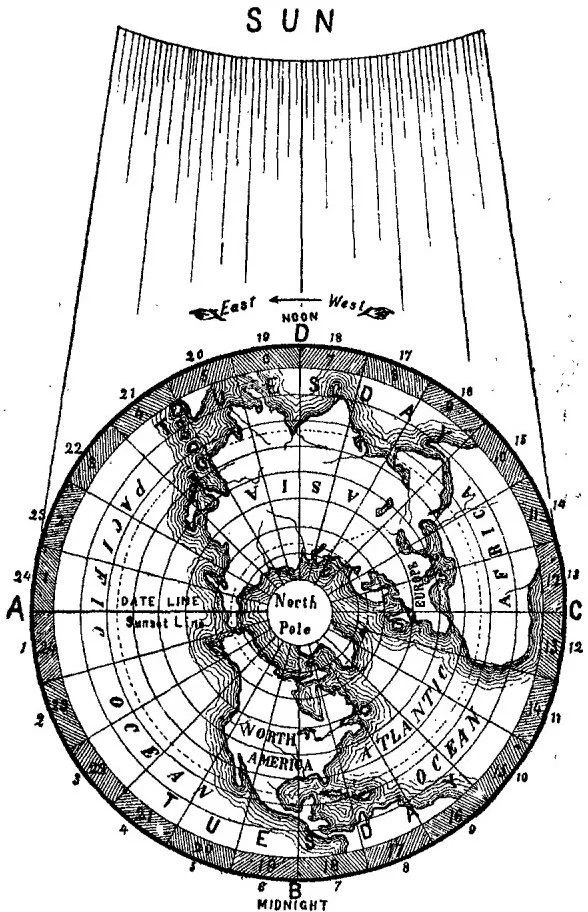
The hour of Tuesday marked “1,” (inner circle) has now reached the sunset line at “A.” But the same hour set out from the same point twenty-four hours before. It has consequently taken that hour twenty-four hours to make the circuit with the earth from “A” around to “A” again. But while this hour has reached that point, and is ready to pass off, the twenty-fourth, or last hour of Tuesday, has but just come on and set out upon its journey; and it will take another revolution of the earth, or twenty-four hours more, to bring that hour around to the same point again. This explains how we can say that it takes a day (the absolute day) really forty-eight hours to complete its circuit of the earth; that is, it is forty-eight hours from the time the first hour of the day begins to come on, till its last hour passes entirely off.
The diagram shows the position when Tuesday just encompasses the globe—when its first hour has just reached its starting-point, and its last hour has just come on. But it occupies this position only during the inappreciable instant while the date line is passing the sunset line; for hour “1” of Tuesday cannot pass on over the sunset line and still remain Tuesday; for that would make Tuesday more than twenty-four hours long, which would be impossible; and besides the sunset line always marks the introduction of a new day. So, immediately, as the date line passes the sunset line, another day begins to come on; and that day, of course, is the one that follows Tuesday; that is, Wednesday. And the date line is now seen to mark the division between Tuesday and Wednesday, as before it marked the division between Monday and Tuesday. Another diagram (Fig. 5) will further illustrate this point.
When the earth has moved on, we will say, sixty degrees, from the position shown in Fig. 4, we have the position shown in Fig. 5. Here we see that the date line has passed on four hours from the sunset line, bringing on four hours of Wednesday; and four hours of Tuesday have passed off, leaving but twenty hours more of that day to disappear, one by one, as they are borne around to the sunset line, as Wednesday, hour by hour, comes on.p. 633
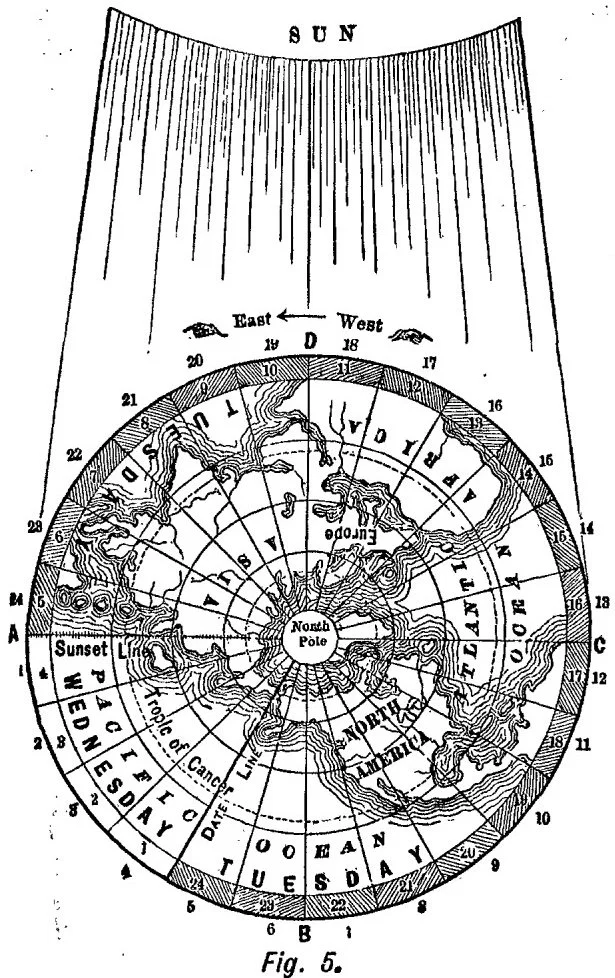
By bearing in mind that the sunset line is permanent with respect to the sun, and is always at “A,” while the earth in its revolution is continually passing that point, and when the date line passes it, a new day is introduced, it will be easy to understand the philosophy of the succession of days on the earth. In the foregoing map, Fig. 5, the white spaces represent the hours of Wednesday. As already stated, four of them are represented as having come on. They are continually entering at the sunset line, as the date line, leading the first hour of that day, moves on. And when all the hours of Tuesday are gone, then Wednesday will, just for an instant, encircle the world, to be succeeded by Thursday, and that by Friday, and so on through week after week, and year after year in unbroken succession.
(Concluded next week.)