There appears to be no abatement in the agitation of the question whether the World's Fair shall be open or closed on Sunday. Some of the Chicago papers have opened their columns to a free discussion of the question. The Chicago Evening Post has not only been devoting from two to three columns daily to the subject for the past month, giving everyone an opportunity to express his sentiment and give his reasons why he thinks it should be closed or opened, but has in each issue printed a ballot, giving its readers an opportunity to vote for or against the opening of the Fair. Below we give the form of the ballot used.
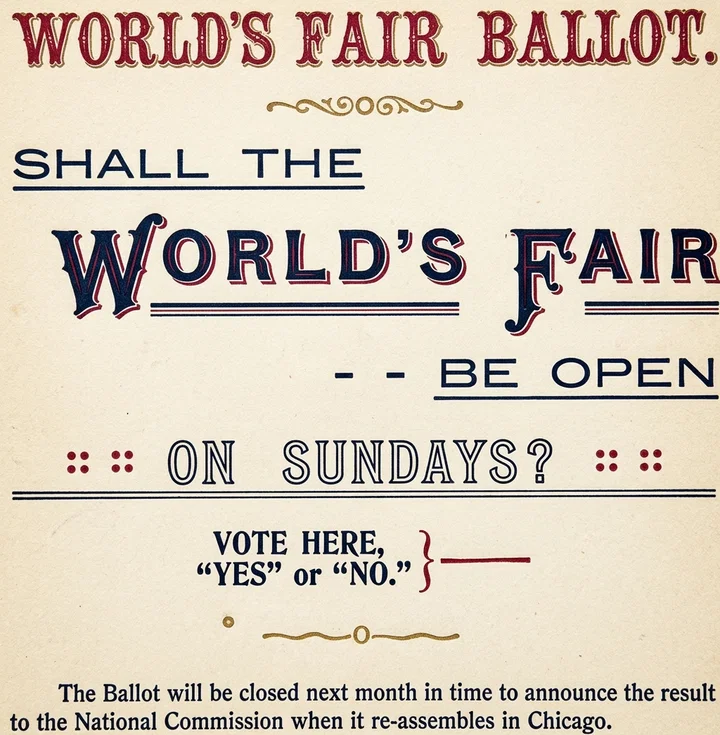
In its issue of Monday, Oct. 27, the Post says:—
The ballot to-day is presumably the fruit of much Sunday meditation, but it shows no diminution of the lead attained by the “noes.” It stands:—
For Sunday Opening . . . . . . . . . . . . . . . . . . 2,904 Against Sunday Opening . . . . . . . . . . . . . . . . 1,360
The following are some of the statements made by various contributors to the above paper:—
Inclosed, find two ballots for the opening of the Fair on Sundays. Let those who vote “no,” stay at home; they have neither common sense nor reason.—A School Girl.
It is certain that there is not a line or a sentence in the New Testament that even impliedly requires a religious observance of that day. Inclosed, find eight ballots for Sunday opening.—N. R. B.
Inclosed, please find twice seven ballots for opening the World's Fair on Sundays, Miss Willard's mystic nonsense to the contrary, notwithstanding. Why should two-thirds of the people be the sufferers all on account of the bigotry, intolerance, and dog-in-the-manger policy of the remaining third?—Veritas, Morton Park.
Inclosed, find eight ballots for having the World's Fair open on Sundays. Why should it be closed? Suppose the people that do not go to church took the notion to attempt to close churches on Sunday. Would that not be the same case as the church people trying to close the World's Fair on Sundays?
If they do not wish to go to the Fair on Sundays, let them stay away from it. But why do these overweening people want to prevent other people from going? This is a point I would like to have some information on. I believe that the majority of the people of Chicago do not go to church. Still they do not try to close the churches on Sunday. The reason is, they are not “cranky.”—Pica Quad.
If the example of Christ's apostles after his resurrection and the way in which he stamped their conduct with approval by invariably appearing to them on the first day of the week, where they were assembled together for his worship, together with the way in which the divine blessing has been bestowed upon the due observance of that day, be not sufficient warrant for changing the Sabbath from the seventh to the first day of the week, then, I think, our Seventh-day Baptist friends, of whom you told us last evening, are in the right of it, and we should join them and the orthodox Jews in keeping holy the seventh day. I inclose four emphatic “noes,” and I do so simply because I find among the commandments, which were written by no human hand: “Remember the Sabbath day to keep it holy.” If that has lost its force and effect, if it no longer calls upon us for obedience, then I know of no authority for resting one day in seven; but I believe that our nation should see to the observance of the fourth, just as much as it does to that of the sixth or seventh, or any of the other commandments in the decalogue.—Edward Young.
Much may be said on both sides as to the advantages or disadvantages of opening the World's Fair on Sunday, but it seems to me that the exhibitors should be left free to do as they please in the matter.
As to the religious phase of the question, all know, or may know by reading the Bible, that Sunday, the first day of the week, is not the Sabbath, for that is the seventh day.
Why do ministers and others speak of Sunday and Sabbath as synonymous?
Sunday was incorporated into the Christian religion by the Roman Catholics. (See “Devotional Catechism,” pp. 101, 174, 351–355 and “Catholic Christian Instructed,” pp. 109–211.)
The Sabbath was instituted at creation, and has never been changed. Jesus kept it, and in Matt. 5:17, teaches us to do the same, for it forms part of the law which he said he came not to destroy. So by visiting the Fair on Sunday, we are not desecrating the Sabbath.—Joseph E. Greenwood, 116 Colorado Ave., Chicago.
The following is an editorial in the Chicago Unity, of Oct. 16:—
The question of the correct use of Sunday in relation to public exhibitions was decided by the managers of the Corn Palace at Sioux City, after the manner of that enlightened and progressive town. The Palace was open every Sunday afternoon, and a concert was given from 2 to 4 o'clock. It was less to listen to the strains of Handel's Largo and Stabat Mater—though this was well worth the effort—than to note the result of this arrangement that the present writer joined the throng and took a seat in the crowded auditorium. The attendance was considerably larger than that on an average weekday; the crowd was quiet and orderly, and manifestly made up to a large extent, of the working people. Men and women, whose care-worn faces and hardened hands bespoke their toilsome lives, came with their children; the clerk and young mechanic, with their sweethearts, sitting side by side with the substantial-looking man of business and the woman of leisure. The sight was noble and inspiring, and the wonder was renewed that there could be any room for discussion on this subject. It is to be hoped that the managers of the World's Fair will heed this example. American public sentiment is strangely behind the times on this question, and the opening of the Columbian exhibition every Sunday would give it a forward growth and impetus nothing else could.
More anon. W. A. O.