Leaving Battle Creek, Tuesday, Sept. 22, at eleven A. M., we reached Lincoln, Nebr., the 23d at noon. Brethren Olsen and Prescott were kindly waiting at the depot, and stepping aboard the electric car marked “Capitol and Union College,” we were soon at College View, where the College buildings and quite a settlement of our people are located. The terminus of the car line is in front of brother Nicola’s store, and brother W. C. Sisley, whose pleasant and comfortable home stands a few steps north, opened his hospitable doors for a home for us during our stay.
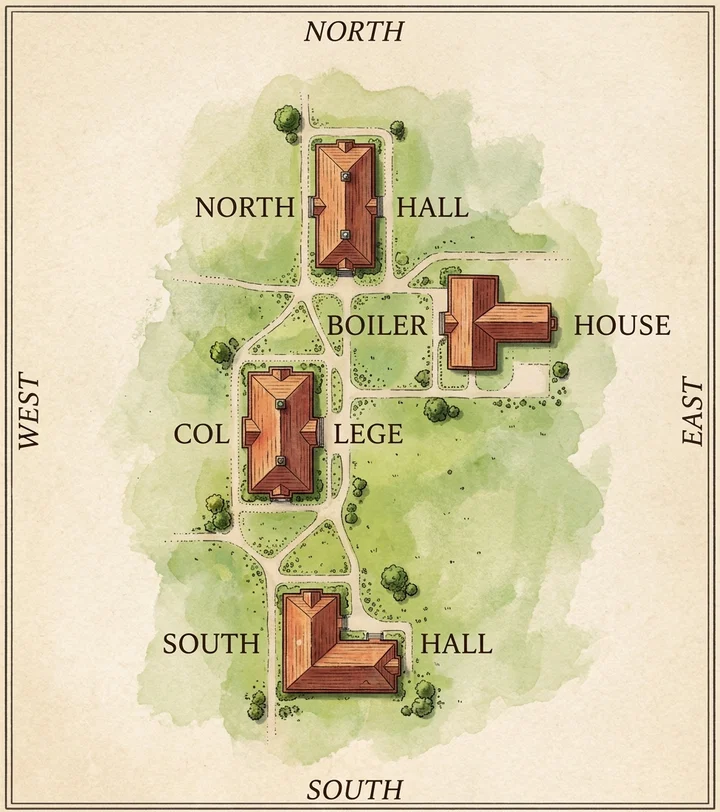
Of the college building and dormitories, it will not be necessary to speak particularly, after what has already appeared in the Review concerning them. The location surpasses in natural advantages any other in the vicinity of Lincoln. The ground is high, sloping away in all directions, that in front gradually taking the shape of a shallow ravine, called in this country “a draw” and descending to a depth of some forty or fifty feet from the level of the college basement. The buildings stand on a line north and south, facing the west, as illustrated in the diagram on this page.
The North Hall is the dormitory for the Germans and Scandinavians, and is the largest of the three main buildings. Its front is on a line with the rear of the College; and the South Hall, or ladies’ dormitory, is set back one half this distance, thus leaving the College in the center, in advance of the other buildings, and bringing them all into the most advantageous perspective, as viewed from the direction of the city, which lies to the north-west. In the rear between the North Hall and the College stands the building which will contain the boilers and engine, ice room, cold storage, laundry, bakery, and electric light plant. From this building a tunnel, high enough for one to pass through easily, runs to all the other buildings, furnishing a passage way for steam and water pipes, and rendering them readily accessible in case of needed repairs, without disturbing any of the surroundings. The utmost care has been bestowed upon the plumbing, heating, ventilation, and all sanitary considerations, to make all the rooms convenient, comfortable, light, airy, and cheerful; and it would be difficult to see where any improvement could be made in these respects.
The North Hall and boiler building are not yet completed; but other departments were so far advanced, as to make it possible to open the school in the English division, Sept. 30, 1891. When all is fully completed that is now under way, it will have cost about $138,000; and nearly $100,000 has been raised from the real estate donated by the citizens of Lincoln toward the enterprise. All bills so far have been promptly paid; there is no existing contract unfulfilled; and the enterprise to this point is free from embarrassment. This is a showing that any educational institution, in the stage of advancement which this has reached, might well be proud to make—a showing which very many have not been able to make. It reflects great credit upon those who have had charge of the enterprise, and under whose management the work has gone forward.
Thursday, Sept. 24, was the day appointed on which to set apart the buildings to the noble purpose for which they are to be used. As the hour of 3 P. M. approached, our own people, resident at College View and many who had come in from other parts of the State, and other States, with a good representation of the citizens of Lincoln, came pressing in till the large chapel was filled to its utmost capacity. Other citizens from the city would have been present had it not so happened that the Republican State Convention was held in the city the same day; and the Methodist Conference was also in session. Ladies from the city very thoughtfully and kindly furnished flowers for the rostrum, by which it was handsomely decorated. Representatives of all the other institutions of learning in the city were invited to be present and take part in the exercises; and most of them willingly responded; but some were prevented by other engagements. The following was the program of exercises:—
1. Music—Marche Militaire (Schubert); 2. Reading of Scripture (Prov. 4:13–18; Job 28:12–28), by Prof. Wm. P. Aylsworth, Cotner University (Christian); 3. Prayer, by Chancellor C. F. Creighton, Wesleyan University (Methodist); 4. Music—Flower Song (Lange); 5. Presentation of College Keys to Board of Managers, by Wm. C. Sisley, Architect; 6. Response by A. R. Henry, President of Board of Managers; 7. Address on Christian Education, by President W. W. Prescott, Union College; 8. Music—Serenade (Haydn); 9. Brief addresses by Chancellor Jas. H. Canfield, State University, and other invited guests; 10. Dedicatory Prayer by U. Smith, Battle Creek College; 11. Music—Andante and Allegro (Mozart); 12. Benediction by Rev. John Hewitt, Episcopal School for Boys.
This program was carried out as arranged, with only two exceptions: Chancellor Creighton being detained by duties at the Methodist Conference, Elder O. A. Olsen in appropriate and fitting terms offered the opening prayer; and Mr. Hewitt, being for some reason absent, the benediction was pronounced by Elder W. B. White, President of the Nebraska Conference. The four pieces of music were finely rendered by the String Quartette of the Conservatory of Music of Lincoln.
Brother Sisley in turning over the keys to the Board of Managers, gave a brief history of the origin and progress of the enterprise to the present time. He referred to the action of the General Conference in the fall of 1889, to establish a college somewhere between the Mississippi and the Rocky Mountains, for the benefit of the States lying in that portion of our country. A locating committee was appointed, which, having examined various localities, at a meeting in Knoxville, Iowa, Jan. 28, 1890, decided that Lincoln, Nebr., was the preferable point, in view of its location, and the generous efforts of the people to bring it to that place. The location having been decided upon, ground was first broken April 10, 1890, and May 10 the first stone was laid. He took occasion to express his thanks to the citizens of Lincoln, especially the business firms with which they have had occasion to deal, for the kindly feeling and the courtesies they have manifested toward the enterprise. And especially was gratitude due to God for his care and blessing, no serious accident having occurred in the progress of the work thus far. He expressed his pleasure in being able to lay off the responsibilities of the work under circumstances so favorable.
Brother Henry, in responding in behalf of the Board, accepted the work as in every way satisfactory and gratifying to them. He could heartily indorse, and desired to add to, the words already spoken in acknowledgment of the friendly attitude of the people of Lincoln toward the enterprise, and the satisfactory manner in which they had been able to deal with them. He said it had been the design as far as possible to deal with Lincoln people both in the matter of labor and material, and that about ninety-five per cent. of the means invested had been spent in that city. He spoke in the highest terms of the constant care, and the painstaking and untiring labors of the architect, assisted by other faithful laborers, in the erection of the convenient, thoroughly constructed, and substantial buildings they had before them; and in behalf of those whom he represented, he cordially accepted the work which was tendered them.
The address of Prof. Prescott was upon the broad subject of “Christian Education,” a most appropriate theme for the occasion. To impart such an education, the highest and only true education which men can receive here below, Union College has been founded; and to this work it is dedicated. Christ as the creator and the redeemer of the world, under God, is the one upon whom all depends, and his work should be the great study of mankind. All lines of education should tend to, and center in, him. To know him aright is everlasting life; and that which is of true value in this world, is that which tends to close up the gap which transgression has made between the sinner and God. So Christian education may be defined as the knowledge of God as revealed in Jesus Christ. It is to learn how, through Christ, to recognize and acknowledge God in everything and everything in God; to know him as a God near at hand and not afar off.
It would not be practicable in this report to attempt even a synopsis of the able address. The theme was considered with reference to three lines of study on which a Christian education should be sought: 1. The study of God’s word, which is a revelation of his eternal purpose in Christ; 2. The study of his works, which are a revelation of his power manifested through Christ; 3. The study of history, which is a revelation of his providence in his dealings through Christ with men and nations.
In elaborating the subject on these lines, many impressive and telling truths were brought out. The word of God in its purity and sacredness was magnified against the looseness and skepticism of modern ideas in regard to the Bible; the works of God were set forth as a visible evidence of his eternal power and godhead; and the fulfillments of his word, as manifest in the events of history all along the stream of time, show how he is working out his purposes to a definite and glorious conclusion. The address was well received and held the audience in the closest attention during the forty-five minutes of its delivery.
Chancellor Canfield, of the State university, followed with brief remarks in a very happy vein. He illustrated the situation, by supposing a family to be living by the side of a vacant lot, upon which by and by there appears evidence that a new-comer is about to locate. They watch the excavation and erection of the building, tender all sorts of advice, and, however busy they may be, scan every piece of furniture that goes in, wonder if it is not a little out of date, if the woman isn’t a trifle older than her husband, if her hair is not a shade too auburn to denote the best style of temper, if the children will be the proper kind to slide down with their boys on their cellar door, etc., etc. At length the new-comer turns the key and moves in, and the time comes for the resident family to call upon him; and then,p. 615 forgetting all their comments, their criticisms, and surmisings, they go in, and, extending the hand of friendship and the voice of greeting, say, “God bless you, my neighbor, come and welcome, and be our friend.”
Then turning to the Board, and making the application, he said that he, as a representative of the State university, as grand, expansive and progressive an institution of its kind as can be found in any State, could welcome Union College to their locality, and bid it Godspeed in its mission. They could work side by side, and co-operate in every good and noble purpose.
After the exercises, many availed themselves of the privilege of looking through the buildings. Favorable comments respecting the architectural appearance of the buildings, and especially concerning the convenience and perfection of the internal arrangements and furnishings, were heard on every hand. The weather was pleasant, and the occasion seemed to be a satisfactory one to all present. A thorn locust hedge of many years’ growth, being trimmed out, makes quite a good showing of trees, for that country, across the front and south sides of the twenty-acre campus; and when others are put in, and the grading is completed, and flower beds arranged, the grounds can be made very fine.
From the College tower a magnificent view is obtained in every direction. To the northwest, about four and a half miles away, lies the city of Lincoln, the many electric lights of which sparkling along the horizon in the evening, afford a novel and pleasing sight. On all other sides a wide expanse of rolling prairie, diversified with grove and field, is spread out before the eye. The College buildings are conspicuous objects for many miles from all directions.
The Board of Managers consists of the following persons: A. R. Henry, President; W. C. Sisley, Secretary; W. B. White, J. P. Gardiner, J. H. Morrison, A. J. Breed, W. W. Prescott.
The following names are enrolled as the Faculty: W. W. Prescott, President; J. A. Loughhead, Principal; C. C. Lewis, Higher English and Hebrew; E. L. Stewart, Mathematics; J. A. Hobbs, Biblical History and Literature; C. Walter Irwin, Greek and Latin Languages; Geo. A. Droll, Natural Sciences; Joel C. Rogers, General History; Ida E. Rankin, Preceptress; Mrs. Cora M. Loughhead, Assistant in English Language; Mrs. Lydia M. Droll, Assistant in Latin; Mrs. Angelia Hobbs, Assistant in Mathematics; Effie M. Rankin, Superintendent of Domestic Department; Alma J. Warren, Physical Culture; Lars Nelson, Steward.
Thus another important enterprise is well begun. And while its promoters have reason thus far to thank God, and take courage, it should be remembered continually that much yet remains to be done. There is at the present moment an urgent need of no small amount of means to make the College and its surroundings what it should be. The institution needs a library, apparatus, bell, clock, and electric light plant. A church, with a seating capacity of some fifteen hundred, should be built immediately. And it cannot be expected that the patronage of the school will at present pay its running expenses. So the question now is, will all who should do so, now avail themselves of the facilities provided for their benefit, by attending Union College? and will all its friends take hold to work in its behalf constantly and vigorously, as if the real work had just begun, which is indeed the case?
Do any ask if it will pay? What is that which pays? or which will pay in the end? Is it treasure hoarded for selfish ends, to be consumed at last? or is it treasure laid up on high? Union College a success, means good accomplished among men, and souls saved in the kingdom of God; and hence Union College supported, means treasure laid up in heaven. Consider what our other institutions have already done; and this is in a condition now where, if sustained, its work will soon begin to show. With a body of God-fearing men and women in charge of the instruction, and a company of earnest students fitting themselves within its walls for more efficient work for the Master, Union College will become a power in the cause, and aid in bringing many souls at last unto glory. So may it be.