THIS word “Israel” is derived from a certain experience in the life of Jacob, recorded in Gen. 32:24–29. Jacob’s life previous to this was one of deceitful trickery. The first account we have is found in Gen. 25:29–34. And his success here intimates that it was not new business with him.
IN the twenty-seventh chapter is a record of his further work. When his brother Esau came to his father to receive at his hand his blessing, his father said, “Thy brother came with subtilty, and hath taken away thy blessing.” Esau replied, “Is not he rightly named Jacob? for he hath supplanted me these two times: he took away my birthright; and, behold, now he hath taken away my blessing.”
FOR this cause Jacob had to flee for his life, leaving his father’s home for a strange land. Wending his way among the hills, the weather-beaten, dusty, footsore wanderer, with a bleeding heart, lays him down to sleep, with a stone for a pillow, and the blue dome of heaven for a covering. Then his mind wanders backward over his wicked, deceitful, supplanting life,—the cause of so many heartaches to his mother, the cause of a consuming rage in his brother, of sorrow and disgrace to his father and the home—his home, his brother’s home, his father’s home, and, O! his mother’s home—which, instead of being a miniature paradise on earth, he, Jacob, had turned into a hell; and he, a homeless, hopeless outcast, was fleeing for his life. The Spirit of God brought these things before him, together with the promises made to Abraham (Gen. 17:1–8), renewed in that awful experience when he is to offer his only son, whom he loved (Genesis 22), and the revelation, or appearance, of God to his father Isaac (Gen. 26:1–5).
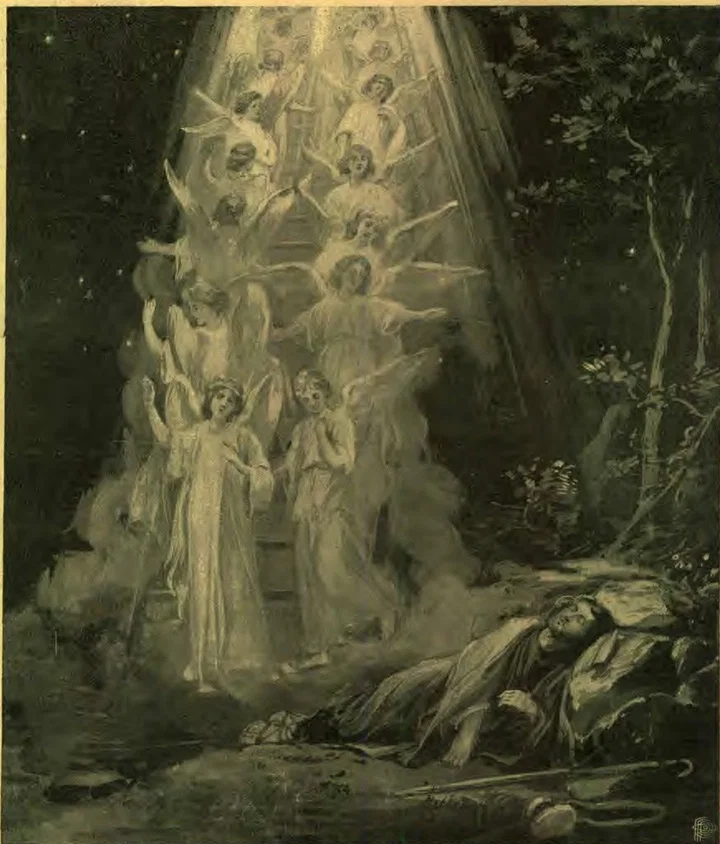
IT is under this scene that his heart begins to soften. The goodness of God is leading the wayward young man to repentance. His tears flow freely, and he cries himself to sleep. He dreams. He sees angels descending and ascending on a ladder reaching from earth to heaven, bringing to him a blessed message of peace on earth, good-will to men, and assuring him of his heavenly Father’s care, loving-kindness, and tender mercies, and of His continual presence.
JACOB awakes, saying, “Surely the Lord is in this place; and I knew it not. . . . How dreadful is this place! this is none other but the house of God, and this is the gate of heaven.” And he sets up his stone pillow for a pillar, and named the place “Beth-el,” “House of God.” This is his first experience in meeting God face to face.
WE pass over his experience in Padan-aram, of reaping the harvest from the seed sown in his own land in his earlier days, to his journey homeward, and his hearing that his outraged brother is coming to meet him with an army of 400 men. Now Jacob begins to pray as he never prayed before. He wrestles with God all the night until daybreak, and says, “I will not let Thee go, except Thou bless me.” And the Angel said, “What is thy name?” And he said, “Jacob.” The Angel said, “Thy name shall be called no more Jacob, but Israel; for as a prince hast thou power with God and with men, and hast prevailed.” Henceforth Jacob’s name is Israel, Prevailer, Overcomer,—and he can do all things through Christ which strengthens him (Phil. 4:13); for God’s grace is sufficient in every time of need.
IN after years, circumstances led Jacob and his family into the land of Egypt, into the house of bondage. Then in course of time God said,p. 2 “I have surely seen the affliction of My people which are in Egypt, and have heard their cry by reason of their taskmasters; for I know their sorrows; and I am come down to deliver them.” Ex. 3:7, 8. And God sends Moses to Pharaoh with this word, “Israel is My son, even My first-born; and I say unto thee, Let My son go, that he may serve Me.”
WHO was it that was in bondage?—Israel. Who was Israel?—God’s son, of whom Jesus Christ was the first-born. Then when God called Israel out of the land of Egypt, out of the house of bondage, He was simply calling His son out of Egypt, and out of the house of bondage. And with this agree the words of the prophet Hosea, “When Israel was a child, then I loved him, and called My son out of Egypt.” Hosea 11:1. Israel is here called the son of God, a child. And to this testifieth the Gospel by Matthew, which quotes this prophetic utterance and applies it to the infant child Jesus. Matt. 2:13–15.
NOW WE are come to New Testament times and New Testament testimony. “If any man be in Christ he is a new creature.” 2 Cor. 5:17. “For by one Spirit are we all baptized into one body.” And “now ye are the body of Christ, and members in particular.” 1 Cor. 12:13, 27. In Eph. 5:30 Paul carries this idea further; for we are not only members of His body, but “of His flesh, and of His bones.” And he adds, “This is a great mystery,” Christ dwelling in your life (heart) by faith, “Christ in you the hope of glory.”
THE Word of God was made flesh, and that flesh was called Jesus, Christ, Son of God, etc. He was filled with all the fulness of God; “for in Him dwelleth all the fulness of the Godhead bodily.” Col. 2:9. And we are to grow up in Him unto a perfect man, “unto the measure of the stature of the fulness of Christ.” Eph. 4:13. For God “hath chosen us in Him, . . . that we should be holy and without blame before Him in love; having predestinated us unto the adoption of children by Jesus Christ unto Himself,” and “made us accepted in the Beloved” (Eph. 1:4–6); that the life of Jesus might be made manifest in our body, in our mortal flesh (2 Cor. 4:10, 11).
NOW WHEN God is speaking the Ten Commandments to Israel, for Israel, He is simply formulating rules for the government of His own house, body, personal conduct, whose house, body, are we. Heb. 3:6. His conduct is ours, and our conduct should be a manifestation of Himself. And this is a revelation of God in us, to our unconverted friends, neighbors, companions, and children. J. J. HUGHES.