DESCRIPTION OF WEST AUSTRALIA.
The colony of West Australia differs in its physical aspect from all the other countries of the Queen's dominions in the great Southern ocean.
Its coast is washed by the mild waters of the Indian Ocean, and consequently is not so deeply indented as those colonies the shores of which are exposed to the strong and mighty roll of the Pacific waves. The inlets are more often obstructed by sand-banks, which forbid the entrance of deep-draught vessels; yet there are quite a number of good harbors, where vessels may discharge their cargoes near the shore.
Stretching along the southwestern coast, the Darling Range of mountains rises abruptly from the plain, presenting attractively its rugged, round-topped peaks, covered with eucalyptus forests. Among these hills, and a little northwest from Perth, the capital of the colony, and from four to six miles from the coast, is a chain of beautiful lakes, whose fertile shores afford luxuriant feed for stock, and sites for most delightful country homes. Near these lakes are the famous Maidin caves, the stalagmitic formations of which are said to excel all others in the world.
The capital city is situated on a pretty sheet of water formed by the Swan River, about fourteen miles from its mouth. Surrounding it, are gardens in which grow bananas, peaches, nectarines, apples, pears, lemons, oranges, guavas, almonds, figs, and other semi-tropical fruits, while beyond these, stretch successive terraces of vines and olives until they give way to the forest-plain, which, in turn, stands against the mountain range in the distance. The town is well built, largely of brick and stone; has large stores, and commodious houses of worship, hotels, mills, and all necessary public buildings. The little town of Freemantle, at the mouth of the river, is built almost entirely of white limestone. It is the seaport of Perth, and contains some Government store-houses, a few hotels, and some pretty dwellings. In the winter season whaling is actively carried on from this point, and the company's furnace ranges, try-pots, baskets of coiled line, lances, harpoons, and the long, sharp boats, suspended over the water, ready for instant action, all show the activity of those engaged in the whaling business.
The country has great advantages in the way of irrigation, abundant supplies of water having been procured from artesian wells of only fifty feet in depth. It is calculated that two men, with an engine, could, by two weeks' boring, obtain a supply of water for the irrigation of 500 acres. One great drawback to the settler, however, has been the existence of a poisonous weed which destroys large numbers of cattle, though on inclosed farms this difficulty is in a measure obviated.
In reference to the climate, Dr. Rennie, who resided in the colony for six years, speaks thus:
“It would be difficult to imagine a more delightful temperature and climate generally than that of West Australia, more especially the winter, which, though invigorating, is never very cold. The summer is warm, but the average heat does not very materially exceed that of the warmer portions of the winter months; and as a general rule, it is free from any depressing effects, readily admitting of active occupation, and of ordinary labor's being carried on in the sun by Europeans. It is almost impossible, by any description I can give, to do justice to the West Australian atmosphere. To be appreciated, it must be experienced. Many a time, on leaving my house in the morning, have I been struck with the wonderful elasticity of bodyp. 647 and mind which the cloudless sky and refreshing atmosphere seemed to develop; and as often has the thought occurred to me, What a splendid climate for a sanitarium!”
In the extreme southwest of the colony, on King George's Sound, a settlement was formed as early as 1826. Through adverse circumstances, however, it did not prosper much for the first thirty years of its existence. But since the establishment of steam communication between England and Australia, it has become prominent as a coaling-station for the ocean steamers. It now enjoys the prospect of becoming a thriving seaport.
The town is shown in the cut presented on the preceding page, as it nestles at the foot of the hill, and on the north shore of Princess Royal harbor, which is only open to the south. On the west the sound is separated by a tongue of land, terminated at its northern extremity by Point Possession. This promontory is sketched in the lower right-hand corner of the illustration. The entrance to the bay on which Albany is located is between Point Possession and Mount Clarence, and is not more than 200 yards across, with a depth of four and a half fathoms, or twenty-seven feet of water.
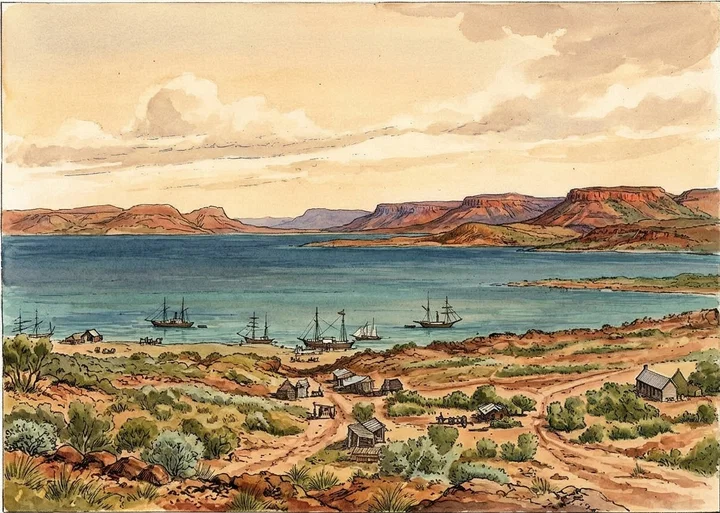
Passing from the extreme southwest of the colony to the farthest point north, to a distance of 1,300 miles, is the little town of Wyndham, situated on the harbor of Cambridge Gulf, which is the nearest landing-point to the Kimberly gold fields. It will be seen from the illustration elsewhere presented that it has hardly yet the dignity of a town, as the buildings are of a very unsubstantial character. But it answers as a base of supplies for the miners, and is likely at some time to become a thriving and pretty town. Fifty years ago, Melbourne, though now one of the most beautiful cities in the world, had a similar appearance to the town of Wyndham, if pictures of its early existence are a true representation of its childhood.
With all its natural advantages, one would suppose that this colony would soon take the lead of all the others in the group. But it still has a blight upon it that all its sister States have shaken off; namely, that of having convicts from the mother country dumped upon its fair territory. True, these have ceased coming for the last few years; but there are still many of the old convicts there, which attaches so strong a stigma to the country as to keep away many who otherwise would make it their future home.
Thus, until this curse shall be fully removed, few will care to remove their families to the country, on account of the scenes and influences attending these abandoned specimens of humanity. The officers appointed over them are not so needlessly severe on the convicts as they were in the early days of the system, but still the influence existing in the locality where they are, is not good. In the early times, flogging among these criminals became an art. Men were trained to it by profession, and when called to exercise their calling, they did it without much compunction, if all be true that is now written about it. We quote from Mr. Garrott, in his “Recollections of Convict Life in Norfolk Island and Victoria”—
“The number of lashes administered daily for years under this fiend—the demon—averaged 4,000, taking the average of the men flogged each morning at from thirty to seventy, and the number of lashes from thirty-six to one hundred. Ten thousand of these were inflicted upon the prisoners because they were not able to perform physical impossibilities, and another 10,000 for having committed no greater offense than having the smallest bit of tobacco in their possession. The mere accusation of attempting to conceal tobacco was certain to entail the punishment of flogging, although the men charged might be guiltless of having done so. No excuse was listened to, and if any defense was attempted, an extra number of lashes was the result, and the charge was repeated again and again. To incur the ill-will of any of the prisoner or ticket-of-leave ‘traps,’ by either word or look, was a terrible crime, from which there was hardly any escape except by murder or suicide.
“On visiting his office each morning to serve out punishment, he [the overseer] would not even deign to dismount from his horse, but, fixing his glass in his eye, would inquire what these, and these, and these, were there for.
“‘These’ were the different lots into which the men were drafted—often forty, fifty, sixty, or more men each day.
“‘Oh, these are for not doing their tasks; these for having tobacco, pipes, knives, tea, or some other prohibited articles; these for insolence; and these for something else.’
“‘Oh,’ he would say, ‘you were here yesterday, the day before, or last week; and—let me see—what was it I gave you? Ah, so-and-so. Well, so-and-so this time,’ being always a rise of from thirty-six to fifty, from fifty to seventy-five, and from this to one hundred lashes; and so on till he had told them all off.
“Then down they were marched to what was termed the ‘slaughter-yard’ or ‘shambles,’ where he would sit or walk about and enjoy the punishment.
“This slaughter-yard will bear description. It was about one hundred feet in length, with six sets of triangles ranged down the center. In one corner stood the pickle-tub, full of salt water and a solution of bluestone, in which the thongs of the ‘cats’ were kept soaking. This solution was used to intensify the pain. Along each wall were two rows of ringbolts—one about one foot and the other five feet two inches from the ground. The men were drafted into this yard in half dozens as wanted, and the number of lashes each was sentenced to receive, called out. They were then seized by their tormentors, each selecting his man, as temper or pique dictated, and choosing one against whom he had a real or fancied grudge.
“These men were hated by their fellow-prisoners, as it was only natural they should be. They were well aware of this, and revenged themselves by inflicting additional punishment on their victims. This is what John aimed at and accomplished, and often when one against whom they had a spite came up for thirty-six or fifty lashes, they would increase the first to fifty, the second to seventy-five, and so on. Explanation only brought further punishment, for if John was present and appealed to, he always indorsed the greater number, with thirty-six extra for being troublesome. If, while under the lash, any of the men offended, as they often did, by either word or look, they were taken from the triangles to the ringbolts, where they were, what John termed ‘spread-eagled,’ which was effected by strapping their legs to the lower ringbolts and their arms to the upper ones. It was simply crucifixion à la Peter, by lashing instead of nailing. If this failed to silence them, the gag was next resorted to. This was a piece of wood, shaped like a top, four inches long, three inches across the large end, and one inch across the small end, with a hole bored through for breathing. A leather strap was attached to the big end, which, passing over the ears, was buckled at the back of the head. The manner of applying it was this: the victim was told to open his mouth; if he hesitated, the small end was placed there, and the other end forcibly struck with the heel of the hand, driving the teeth and gums before it, and in one or two instances death ensued through their being driven into the lungs. One huge ruffian became such an adept at applying the gag that he was always chosen for the office, and he often boasted of having spoiled the beauty of many a man.
“If the gag (in addition to spread-eagling and flogging) failed to silence the maddened sufferers, as it sometimes did, they were bludgeoned into insensibility, and left to come to as they pleased. If, after being thus hung up from ten in the morning until six in the evening, they still, like Job, retained their integrity, they were then placed on a gridiron for the night.
“This instrument of torture was pretty accurately described by Marcus Clarke. It consisted of a rough grating of wood, placed on the floor, on which the man was placed on his mutilated back, and strapped by the ankles, wrists, neck, and shoulders, so that to move was impossible. But the torture of the thing consisted in the fact that the grating did not reach beyond the neck, leaving the head without support. The dreadful agony entailed by twelve hours of this punishment was described by those who survived it, as horrible. But all did not survive it. Several of the poor victims died from congestion of the brain, and at last this diabolical mode of torture was discontinued, and the apparatus removed.”
It is well, too, that the apparatus was removed. As the country became more settled, those fiendish works were inveighed against, until those who practiced them were put out of the way, and more humane men took their places. Finally, all the other colonies except West Australia, refused to receive “home” convicts longer, and so they ceased coming. It will not be long before this colony, too, will have thrown off the incubus which has prevented its rapid advancement, and it will then step to the front as a desirable place for enterprising men of other countries to cast their lot.
In view of this, it is important that a sentiment in favor of the truth should be planted there, that as the country fills up with intelligent people, they may be met, at the outset, with that which will make them wise unto salvation.
J. O. Coulliss.