On the passage from San Francisco to Sydney, in 1885, we formed the acquaintance of a Mr. Dunn, who said he was engaged in the flourishing business in Adelaide. Before opening the work in the latter city, I called on this gentleman at his place of business, and was invited to his suburban home, a costly mansion in the midst of beautiful grounds, kept in the best of order. Before I had opportunity to say much to him, he began to suspect I had come to ask his help in starting a series of meetings; and to cut off any approach in that direction, he looked solemnly at me, calling me by name, and said: “You and I do not see alike religiously, and I cannot help you in the least in your meetings.”
A word of explanation will make the drift of his seemingly abrupt remark obvious. In that country it is customary, when one is to deliver a discourse of any nature, outside of the regular order of religious services, to advertise the name of some man of large influence, as the one who will preside on the occasion. This gives tone and influence to the meeting, because it is virtually indorsed by the man who presides. Without such a presiding officer, a gathering of that kind would be voted beforehand a failure as it would be able to command the presence of only those in the more humble walks of life.
Mr. Dunn being a member of the Upper House in Parliament, and withal a devoted church member, his services were frequently desired as presiding officer of temperance or religious lectures, or on the occasion of laying the corner-stone of some church building. He, thinking I had come to ask him to do a like favor for me, and wishing to avoid any unpleasantness, took occasion to hedge up the way to such a request by the few calm and deliberate, but firmly spoken, words uttered on first meeting me.
Upon being assured that my visit was not to ask any aid whatever from him, but only to renew the acquaintance previously formed, he seemed quite satisfied, and spent much time talking on the resources of the country. He himself, it came out during the conversation, had ten very large flourishing mills in various parts of the colony. He was at that time having still another mill erected at Port Adelaide, which was to cost £28,000 ($135,000); the products of all these found ready sale at home, and in the islands of the Pacific. Meeting this gentleman a month or more after this visit, he seemed much surprised that, having no one to introduce us, and give countenance to our work, we should have succeeded, not only in getting an audience, but in so convincing some that they had adopted the views we advocate. “But,” he added, “I have only the best wishes for you, and hope you may succeed in accomplishing good.”
There were formerly no less than five different tribes of aboriginals having their homes near Adelaide. The native customs and dialects of the Australian tribes all differed from the others in some respects, while in some things there seems to have been quite a similarity. They would all hunt or fish when compelled to from hunger; but their universal custom was, and still is, to leave all hard work for the women to perform. They always carried the burdens, when moving from one point to another, while the men ate, drank, and slept, when and where they liked, without any restraint. Their training in this respect was so complete, that they did not know of any other way; and when some of them first saw some white men having oxen with packs on them, they regarded the oxen as the wives of white men, because of the loads they carried, and thought it strange that they should look so different from the men themselves.
In their ceremonies their practices greatly varied. In some parts, circumcision was practiced, while in others it was entirely unknown. Some tribes followed one pattern in tattooing, others adopted other figures. Some were marked all over the back and breast, others only on one half of each. Some had no notions whatever of religion, others had a distinct belief.
Restored with AI
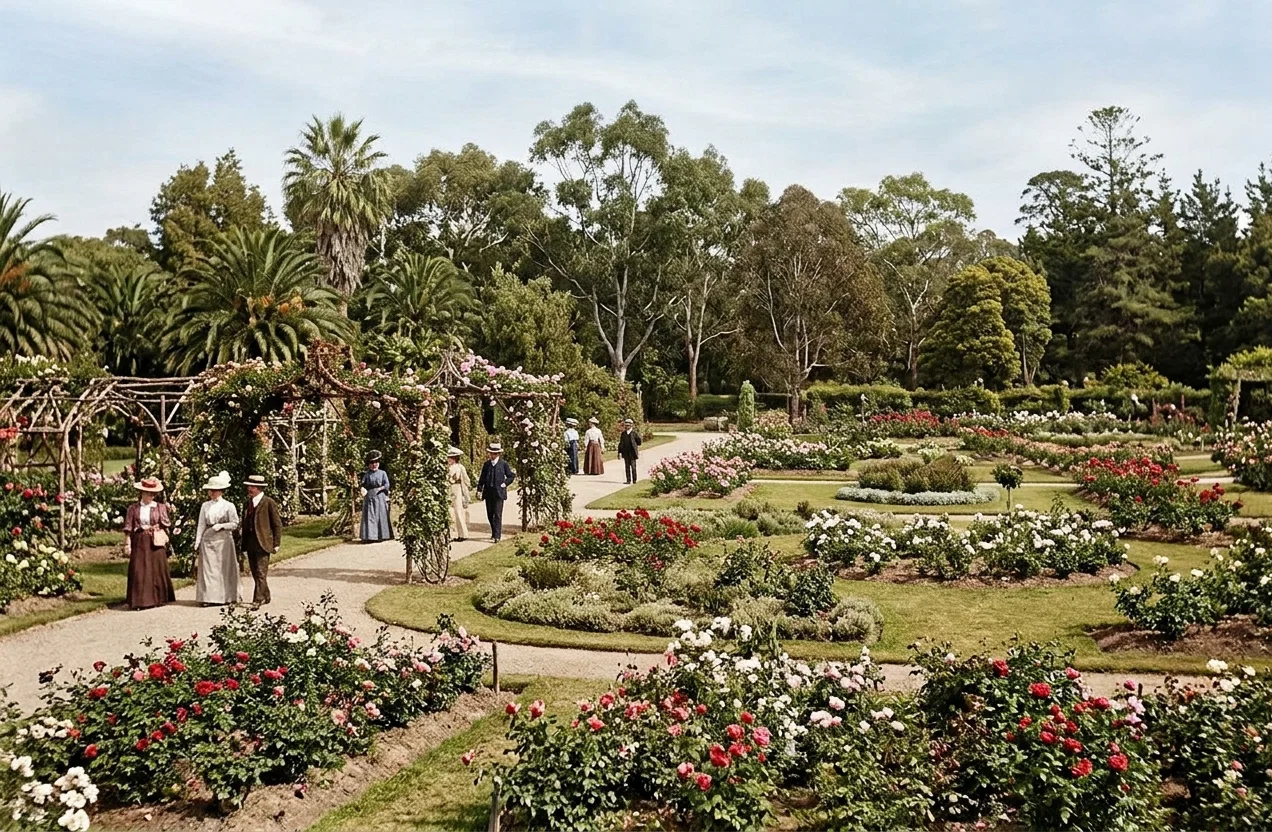
ROSE DEPARTMENT OF BOTANICAL GARDENS, ADELAIDE.
Some had curly hair and very black features, while others were lighter in complexion, with straight hair. These differences, with others that might be mentioned, go to show that the natives of that country had two distinct origins. The intellectual capacity of the aboriginal, is in some respects about the same as that of the American Indian. Their perceptive faculties, especially, seem well developed, as is evidenced by their skill in following certain tracks in the woods. They are also great hunters, when they choose to engage in such exercise. Their manufactures are of a rude nature, being confined to mats, canoes, weapons, etc. No attempt was ever made among them to manufacture clothing of a textile nature. Their garments are universally composed of a simple skin thrown over one shoulder, and fastened on the opposite side of the body, under the arm. Their customary weapons are spears, clubs, tomahawks, and boomerangs. All the spears seen by the writer were simply straight sticks, from eight to ten feet long, with one end pointed, and hardened by being charred. In some cases they were barbed with pieces of quartz or flint, artificially fastened to the spear. In throwing the spear, a shorter and elastic stick was used, having in one end of it a kangaroo’s tooth, which would be inserted into a notch in the spear near its point. The short stick was thus used as a lever, to give more force to the weapon than could be had from muscular strength alone.
It may be interesting to learn how an untutored savage makes a spear straight as an arrow, from a bent and crooked sapling. When the spear has been finished up to a certain point, the black collects a heap of embers and hot ashes from the fire. The spear having been previously well soaked in grease, he squats before his improvised furnace, and lays each crooked part of the spear on the ashes, at the same time pressing it straight, in which form it ever after remains. It is then scraped with mussel shells or broken glass, and is frequently greased, to render it tough and elastic.
But the most singular weapon of all is the boomerang. To make this, the native selects a piece of wood with an elbow forming the curve he desires, and cuts it the proper length—about two feet. It is then worked down to two inches or more in width, with the edge on the outside of the elbow about a half inch in thickness, and the opposite, or inside edge, tapered to a wedge point. It is then greased and held over the fire, the same as in making the spear. When it is well heated, the native twists one end of it slightly, then holding it edgewise, looks carefully along it to see if it has the proper set. The other end is then twisted and set the opposite way, thus giving it a slight screw-like formation. With this peculiar shape, the air acts on it when on its flight, to give it the peculiar circular motion accompanying it. This weapon is thrown with much dexterity by the blacks, though I believe no white man has ever been able to make it perform such evolutions as when thrown by the natives. The writer has never seen great feats performed with the boomerang, although blacks have sometimes come to the city to exhibit their skill in throwing it. But those who have witnessed such exhibitions in the bush, say that they have seen a swan on the wing brought down by its use, as unerringly as though shot with a rifle. In every case the weapon is thrown so that it circles upward, and over back nearly to the spot from which it is started. It requires, however, constant practice, even from childhood, to acquire the art of throwing it properly. But when one becomes an expert at it, he will be able to throw one to the ground in such a way as to make it bound over and over for a distance, and then take an upward flight, bounding back toward its starting-point.
Another formidable weapon used by these blacks was a club made of a heavy wood called myall. It was about three feet long, with a right-angled projection at the heavy end, which gave it something of the shape of a miner’s pickaxe. The handle end of the club was often elaborately carved, and terminated in a knob, to prevent the weapon’s slipping from the hand during a melee, or when dispatching game.
When one of their number dies, these wild people suppose that some enemy has caused his death by sorcery. Therefore, the first night after a man dies, his nearest relative sleeps with his head on the corpse, in the belief that he will be led to dream who is the guilty person. The next day the corpse is carried about on men’s shoulders, the friends at the same time calling the names of different individuals, to see if this makes any impression on the corpse. The name of the person dreamed about is then called, when it is affirmed that the dead has indicated him to the bearers as the guilty one, and to the one designated, vengeance is in due time meted out.
I have spoken of the customs of these people as having prevailed in the past, rather than of their actual existence now, because many of the tribes have become entirely extinct, and the remaining vestiges of tribes that are now found near civilized parts, have given up their savage modes of life, and are cared for by the government, on reservations. Those who inhabit the interior are just the535same in nature and habit as they were when the white man first set foot in the country. It would not be safe for one to fall into their hands, as they have no scruples about taking life. Those who have come under the influence of civilization, are inoffensive, and say little, even when spoken to. Like the Indians of our own far Northwest, they sometimes saunter into the towns, and look around as though to note how fast the white man is increasing about them. But they are soon gone again, perhaps never to return.
Where the black man once lived and prospered, there is now no place for him. The white man has appropriated his lands, and has changed them from a wilderness, to fields of fruitfulness and beauty, a good example of which may be seen in the illustration accompanying this article. Let us hope that the lives of the owners may be as beautiful as the gardens of flowers among which they live; and that they may exchange these for the paradise of heaven, when the Lord comes.