[Condensed from the San Francisco Chronicle.]
I do not think that the people of Madagascar can be considered religious, but they certainly cling to their ancient customs with marvelous tenacity. The most ancient of these, and certainly the most interesting, is the fandroom, as they call it, or the feast of the bath. The main idea of this novel celebration is to worship the queen, and follow her example. In truth, it is a great occasion.
Every year, in November, two weeks and a half are devoted to the fandroom—the annual bath of the nation. At this time the queen bathes in public, in the presence of as many of her subjects as can crowd into the palace courtyard. She wears a loose robe and disappears behind a screen. Here the ablutions are performed amid much splashing. The screen was introduced to satisfy the missionaries. When the queen emerges from behind the screen, her complexion is at least three shades lighter than before. Then all the loyal subjects shout, and, taking it for granted that the queen has bathed, they disperse to their homes and do likewise.
After the bath the Malagasys call upon their friends, as we do on New Year’s. They also make presents, but the presents are always of meat. If you are very popular, probably seventy or eighty pounds of meat may be given you. This you are expected to eat. The Malagasys give meat to the Caucasians, and vice versa, and all the white men on the island would much prefer to receive their Malagasy friends immediately after the fandroom, as the rooms are small and the climate is hot.
The Malagasys were in former times idolatrous. Neither temples nor altars remain in the island, nor are there any traces of sun or moon worship among the natives. But the Malagasy does not care specially for religion. When the queen gave up idolatry, they gave it up also, being willing to have one true God or no god at all, as might be most profitable to them. If there is money to be made through the Christian missionaries, the natives are ready to become Christians at once. Many of them simply believe nothing at all. The Sakalavas, for instance, have no religious convictions. They are, however, naturally honest and truthful.
You can always believe them, and a Sakalava never breaks his simple promise. When he wishes to make an agreement still more binding, he kills a young heifer and broils the liver, which is divided into two parts and eaten by the parties to the contract. All sorts of incantations are pronounced over the liver, and each party expresses his hope that dire disaster may befall him if he fails to fulfill his portion of the agreement. Such a compact is never broken.p. 171
The Hovas, on the contrary, have been converted, to all appearances, but they cannot tell the truth if they try. The Hovas take very kindly to French methods, and in agreements always leave a loophole through which they may slip out. The Hova is a natural lawyer and diplomat.
The native dances are not religious in any sense. They are merely designed to express joy, and a native never dances so well as when he has been drinking domestic rum. Everybody dances, from the governor of the province to the tiniest and blackest slave child. Frequently they sing as they dance, and in their low, rich voices, the effect is like that of a negro melody, but they have little idea of time. Peculiarly enough there is no dancing at funerals or weddings, but when a child is born in the village, all the relatives dance about the house, singing and shouting at the top of their voices.
In Madagascar everything comes down at last to an insatiable desire for wealth. The Hovas, who do not understand the seriousness of religion, will become anything if there is any money in it, and the chiefs turn the natives out of their houses and make them go to church at the rate of so much a head. The missionaries of the various Protestant sects are competitors for native favor. They actually offer a reward to the parents to send children to school. At Ancazhe I took a photograph of the little blacks who were in attendance at the missionary school. Many of their parents received money for sending them there, and some of them were fed and clothed by the missionaries in the bargain. The Methodists have the largest following in the island. The queen’s church at Antananarivo is of that denomination. It is quite a fine edifice and the queen goes regularly.
I believe that the queen is sincerely religious, in spite of an amusing incident which I happened to see. It was on my first Sunday in Antananarivo that I went to the queen’s church. The royal person and all her court ladies were there, and I watched them with interest. All at once I observed that the queen was taking snuff out of a small box. This snuff, made of tobacco and ashes, she placed between her under lip and lower teeth. In a few moments a little cuspidor, which had the appearance of a tin cup, was passed down the pew to the queen, who gravely rid herself of the snuff, and passed the cuspidor to each of the ladies in turn, who also used it. Then they settled themselves to listen to the sermon again, and I held my nose lest I should laugh aloud and be summarily ejected. The operation was repeated at intervals, and reminded me strongly of the women snuff takers among the poor whites of the South. I have seen women in the back counties of Missouri who swabbed their teeth with snuff on the end of a splintered stick, much in the same manner. The fondness of the queen for snuff explains the popularity of snuff taking among the Malagasys, for in Madagascar they all play at the game of “follow the leader,” and the queen is the leader.
One Sunday I entered a village and was attracted by the singing in a large bamboo church, where a native preacher was holding forth. He invited me up to the pulpit and I accepted, but was paralyzed when he followed it up, inviting me to address the natives. I declined on the ground that I could not speak Malagasy, but the preacher overruled that objection by saying that it didn’t matter, as the natives rarely understood the missionaries anyway. Finally the native continued his discourse, which had been interrupted by my entrance.
Afterwards I learned to speak Malagasy, so that I could read it and converse with my attendants. The language is not particularly difficult, but it is not acquired half as readily as French and English are by the natives, who learn to speak in these tongues with ease in a very short time. The natives pronounce the Malagasy words with great rapidity, which makes it difficult at first to understand.
The Malagasy language is singularly rich in proverbs, which the common people constantly use. Almost all of our proverbs have equivalents in their language, and their pithy sayings are indicative of the national character. For instance, the Hovas, who do not believe in honesty, have nothing to indicate that they consider honesty the best policy, which is not a moral precept anyway, but a utilitarian one. The Hovas, however, do acknowledge that “lies behind the back are like fat quail, but when they are discovered they are like lean snipe.” The Hovas also say that “business lies are like early rice,” in that they supply a present need. Another proverb is, “If I am to die, let my friend die, but if my friend is to die, let his ox die.”
To the lazy they say, “You expect the wild boar to come to you, so you don’t go into the forest.” The Malagasy proverb which is the converse of “Nothing succeeds like success,” is, “No one pets the poor calf.” One of the most common proverbs, which shows that the Malagasy appreciates the selfishness of his own nature and of human nature in general, is expressed in this way, “The clothes are dried on the rocks, but when it rains, no one cares that the rocks get wet.” This proverb, which is always on their lips, means, As long as you are useful to me, I will care for you; when you cease to be so, look out for yourself. Another sententious saying is, “Don’t show love like a flood, that comes with a rush and soon passes.”
It is hard for anyone who has never heard them to realize how frequently these proverbs are used by the natives. They make them answer a hundred different purposes and mean many different things. They are very idiomatic and lose much force in translation.
A favorite amusement with the Malagasys is to sit in a circle and propound conundrums to each other. They like to exercise their wits, and many of their riddles are difficult of solution. All of them are original. Some of them seem to an American to lack sense, but all are poetic, and show that the Malagasys observe a fancied and poetical resemblance between things which with us might pass unnoticed.
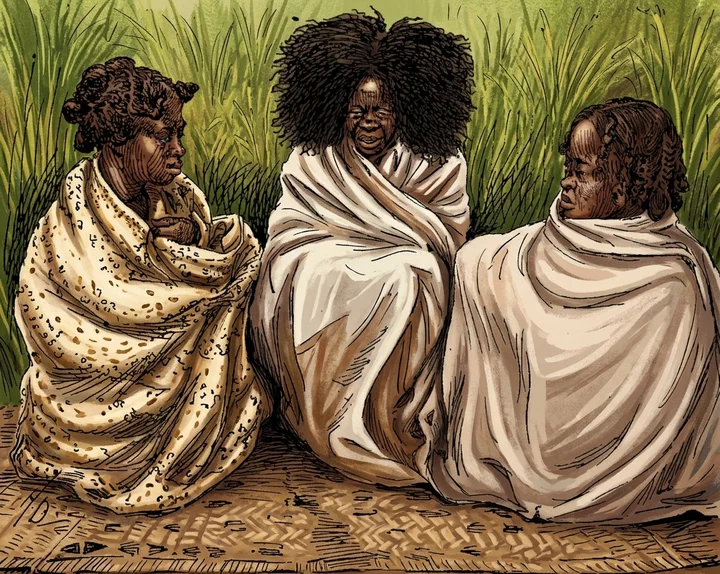
The Malagasys have many peculiar ideas, like those of children. One is the poetic way in which they account for the difference in color between the white and black races. They say, in their quaint speech, that the white man and the black man are both the children of God, but the white man is the eldest son; and in Madagascar the eldest son has all the privileges. Hence they expect that the white man will rule the black brother, but, they add, he must be kind to the younger brother, for his mother watches over him.
Few Malagasys will pronounce their own names. If you ask one his name, he will shake his head and tell you to ask his neighbor. Some tribes will not eat chickens, and some refuse to taste ducks. Others will not pass a certain place. Of course there are penalties attached to disobedience in these things. If a native should do one of these things forbidden by custom, and should then become sick, his illness would be attributed to this cause. If you ask a native his reasons for avoiding these things, he will shrug his shoulders and answer, “Fumba,” that is, it is the custom. The reason they reverence custom so highly is not so much on account of the superstitious dread they have of the consequences, as because of the reverence they have for their ancestors. A sufficient reason for anything is that their ancestors did it. They, of course, must have had a good reason. This almost Roman reverence for dead forefathers is strange when one remembers how very little affection a Malagasy has for his living relatives.