During war commotion, education is always the first to suffer. Altho at present there are only “rumors” of a conflict, still the schools all over the country are in a deplorable condition. A few days ago the professors of the Central University, located at Quito, the principal one of the three colleges in this country, threatened to resign and close up the institution if the government did not pay the six months’ back pay which it owed them. In some localities the parish priests have had to beg charity donations from their congregations in order to help support the poor teachers, some of them almost in a starving condition. Everywhere schools are shutting down because of a lack of funds to continue them. As the state public school closes its doors, the private Catholic school begins and usually flourishes where the other one barely was able to exist. This is one of the ways by which the Catholic Church is regaining its influence in this country.
The postal system is in a bad state in some parts of Ecuador. A week ago the carrier who delivers the mail in the cities to the north of the capital, refused to serve any longer because the government was owing him $1,500. But the other branches of public service suffer, the soldier always gets his pay as regularly as clockwork. Woe to the president that didn’t pay him! There would be another one in office in a very short time.
It seems too bad, however, to see such utterly useless expenditures on rifles, and ammunition, etc. Far better it would be to interlace the country with a system of railroads, running one or two out into the Amazon Valley. Money would never be lost, either, which might be spent on attracting colonists to till the rich, fertile, unworked millions of acres at present covered with forests. The Argentine Republic and Brazil have spent millions on colonization enterprises and have never found them to be losing investments. Buenos Aires is to-day the “Paris of South America.” Rio de Janeiro ranks a close second to Buenos Aires in importance.
Restored with AI
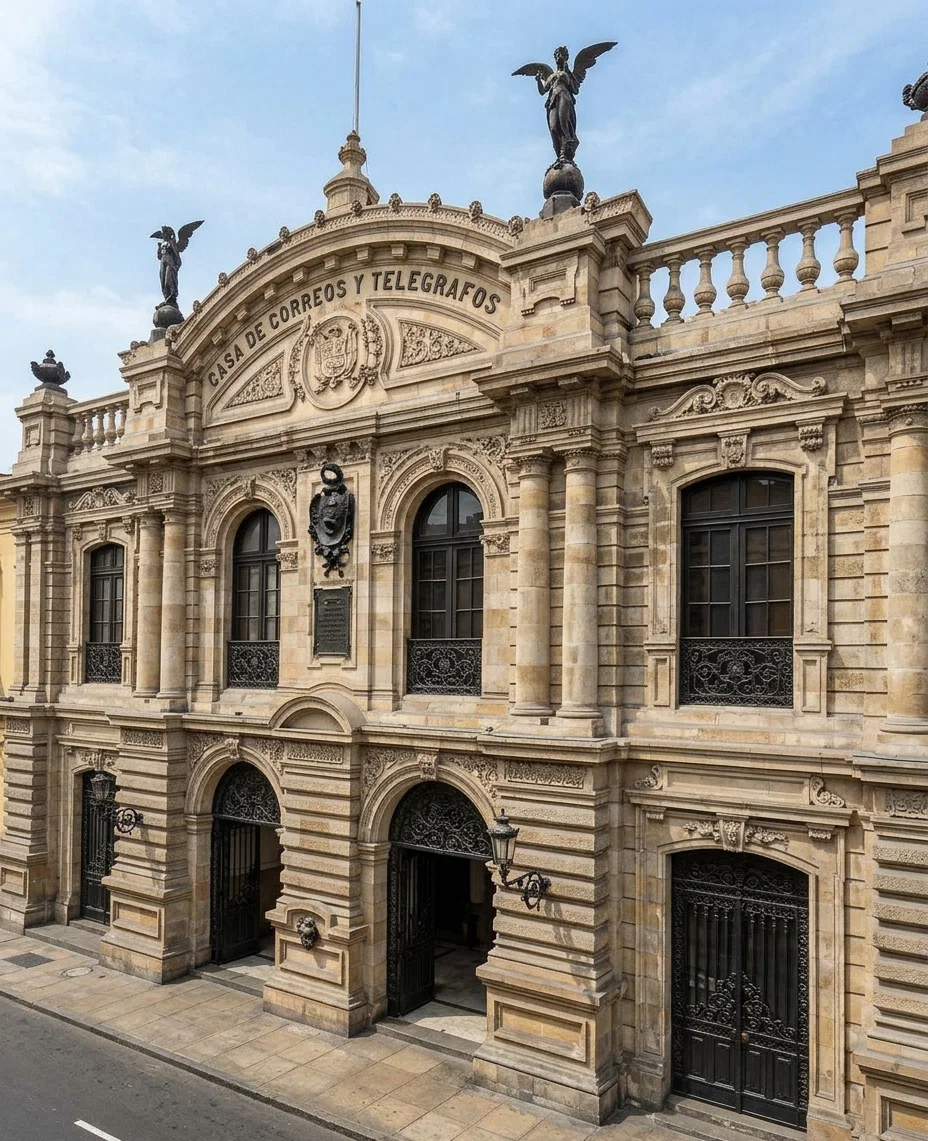
Post-Office and Telegraph Building, Lima, Peru
The Argentine Republic and Brazil, I am sorry to say, have fallen victims to the battle-ship fever. The other republics in South America appear to have caught the same expensive and fatal disease. Peru has a stronger, more powerful navy than has Ecuador. However, the latter country, not to be outdone, has started a public subscription throughout the republic, the money received from which to go toward the purchase of a battle-ship. There is a plan on foot whereby the 1,500,000 Ecuadorians are to give five cents a month. It is expected that in a year’s time a “respectable-looking” gunboat can be purchased with the contributions received. People seem to be quite enthusiastic and are giving liberally.
Restored with AI
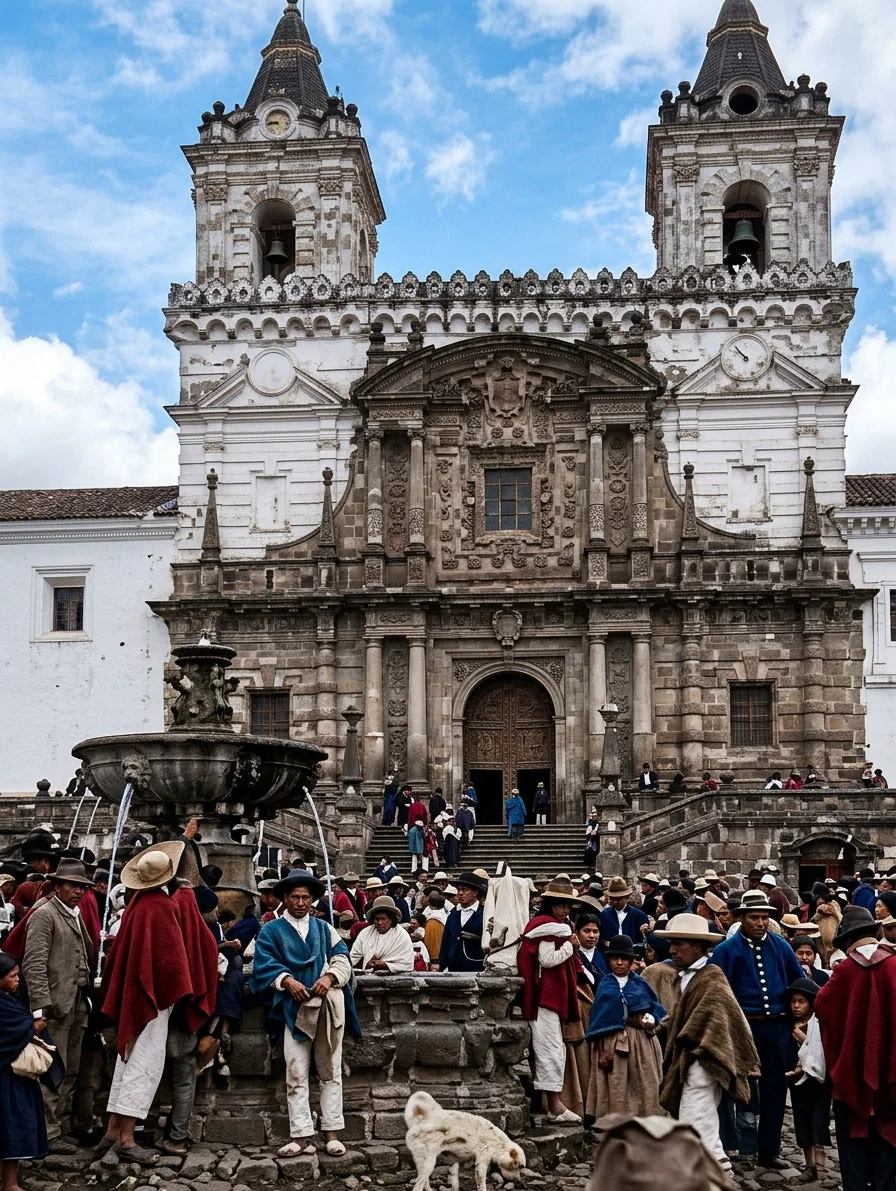
St. Francis Church, Quito
In a religious school in Quito two little girls have begun to solicit subscriptions. They have each headed the list with $10. From a plantation along the coast comes a letter from two other girls:
“Since the patriotism of the Ecuadorian women has been appealed to, we, desirous of contributing something toward the nation’s defense, wove the other day with our own hands some woolen textures and sold them. The product from the sale of the same, together with some money which our father gave us to spend on ribbons and fruit, but which has seemed more pleasing to us to include in this fund, has totaled $5.00, the which we are forwarding on to you. This sum you will please be kind enough to hand over to the Patriotic Committee as a small addition to the ‘sacred’ fund which is destined to purchase elements of warfare in case of an international conflict. Our younger brothers, when we told them to what use the money is to be put, went to their banks and drew out each ten cents which had been carefully put away to buy candy with.”
If boys and girls can give their spending money toward the purchase of weapons with which to kill or wound fathers and brothers of a sister nation, how much more readily should boys and girls, men and women, among us who believe in the speedy return of the Saviour, give of their spare means to carry the Gospel message of peace and love to a world which does not know it yet.
Restored with AI
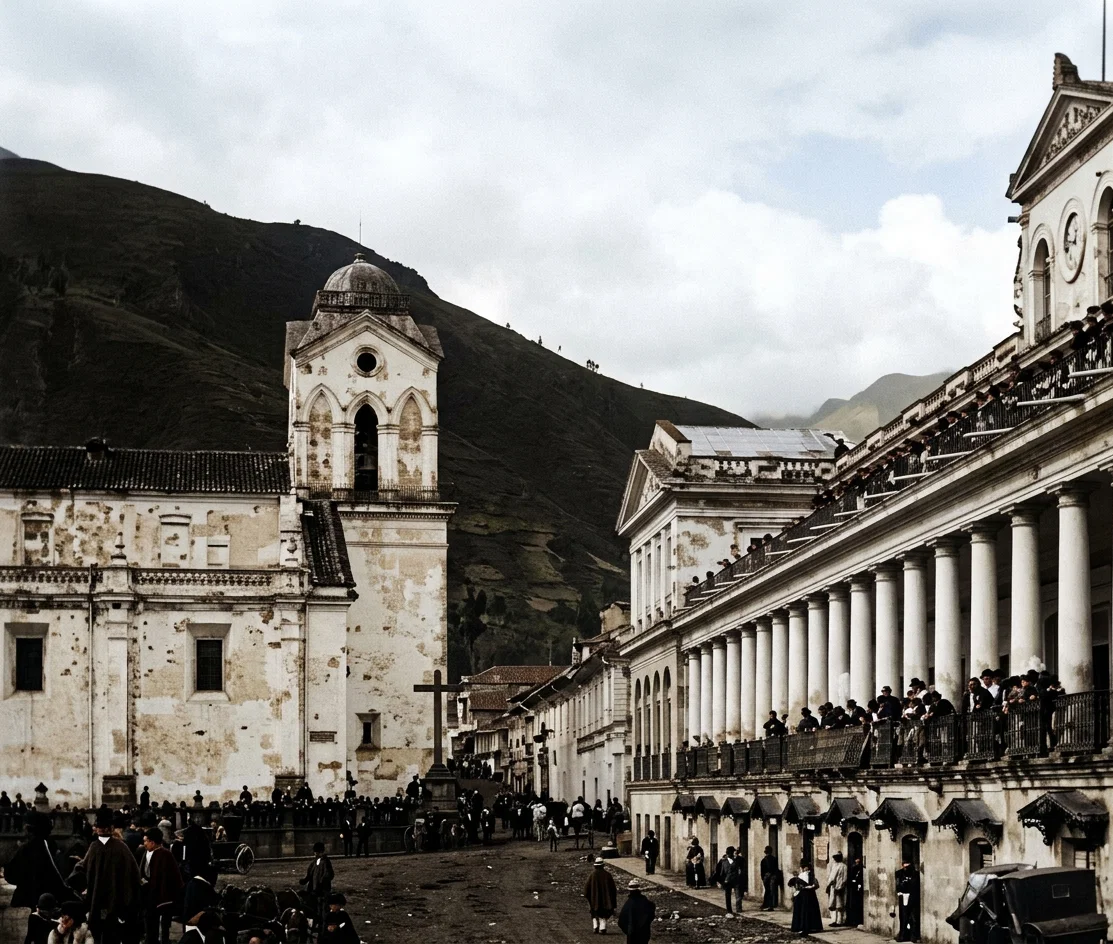
Government Palace in Quito
A priest, in offering his “modest contribution” for the nation’s defense in case it be necessary, writes as follows:
“As a priest I can offer nothing beyond my own humble person toward the national defense, but I can promise you that I shall be at the vanguard of those who are Catholics and patriots. The love of one’s country in the heart of a priest might be interpreted in the following words: ‘I love God; I love my country; and for God and my country I’ll go as far as to die on her altar.’”
Let us meditate a moment on this statement. He says he loves God; but does he love Him really? God is a Being of mercy. He has told us to love our neighbors as ourselves; to do unto others as we would have others do unto us; in the sixth commandment God has forbidden us to kill. If we truly love our God, we will do those things He tells us to do, obeying His commands in all things. How can one Catholic country think of waging a war against another of like belief? And yet such thoughts are common to-day in Ecuador and Peru. And more than one priest has promised to be among the vanguard of those who march forward to sacrifice themselves on their country’s altar. Might not this prophecy of Joel be applied with perfect fitness to conditions as they exist in the worldly churches of to-day: “Gird yourselves, and lament, ye priests: howl, ye ministers of the altar: come, lie all night in sackcloth, ye ministers of my God: for the meat offering and the drink offering is withholden from the house of God?”
The bishop of Cuenca, one of the foremost in Ecuador, lately issued the following “patriotic” circular:
“During the last few months this nation has been in the deepest anxiety regarding the decision which his majesty, the Spanish king, will soon make public in reference to the boundary dispute between Ecuador and Peru. Unfortunately the notice that has come to us, that our neighboring republic is concentrating her military forces near our borders, has tended to further increase this anxiety. . . . The papers from Quito and Guayaquil consider it probable and almost certain that the settlement will be adverse to the interests of this nation. . . . As it behooves us as members of the clergy to set an example in matters of patriotism to all the faithful who have been entrusted to our spiritual guidance, so that we may give no one an opportunity of doubting the love we bear our country, I recommend you, as priests, to aid the army officials all you can in your respective parishes, in order that they may satisfactorily complete the military inscriptions. . . . Instruct your parishioners to enlist promptly and11without being forced to do so, since we are not considering a party fight now, and much less one hostile to religion, but only the proper defense of the fatherland, toward the support of which we are all, as Ecuadorians and Catholics, obliged by conscience to unite, forgetting necessarily our mutual grievances.
“However, taking the fact into account that war is one of the greatest of curses, let us never cease to supplicate God our Lord to withdraw His scourge from our people. Let us, the clergy, and all the faithful, pray to Him—especially during holy mass—to illuminate the mind of the royal arbiter, in order that he may so govern his acts by the standard of justice that in the verdict, which he will soon make public, he may not trample upon our incontrovertible rights, the which if he should do would not cement peace between two sister nations, but only tend to inflame and sow discord among them, a strife which might last for years and even centuries. . . .
“Let every priest in this diocese expose the most holy sacrament every Sunday, . . . and after the giving of the blessing, let three prayers like the following be said: ‘For Ecuador: three paternosters, hail Maries, and glories, with the usual invocations of the most sacred hearts of Jesus and Mary.’ All of this will be done until all fear of a conflict has disappeared.”
But while the Ecuadorian priests are praying that their country may be favored by the Spanish king in his decision, is it reasonable to suppose that the Peruvian clergy are not praying prayers of a like nature?
The dispute between Ecuador and Peru is a very long-standing one. It dates back to a time before the arrival of the Spaniards. The Inca Empire was greatest under Huayna Capac, who had conquered what is now Ecuador, and included Peru, Bolivia, and parts of other countries under his dominion as well. At his death he sowed the seeds of discord by willing what is now Ecuador to his younger son, Atahualpa, and what are now known as Peru and Bolivia to his other son, his first-born, Huascar. Huayna Capac died about 1525. After his death there was a ruinous fratricidal war between the two brothers. Atahualpa conquered in the end, but was in turn taken prisoner by Pizarro and executed in 1532, even tho he had fully paid the tribute demanded for his ransom. “Thus ended a struggle between brothers, which desolated two vast and rich nations and prepared the way for their later conquest by Pizarro and the handful of bold adventurers which accompanied him.” It is to be hoped that we may not see another similar conflict in our own day. Our message must hasten, and wars only cause delays and weary waitings.
Ecuador is drilling her land forces, in order to be ready to occupy the disputed territory in case war is declared, and defend her own against attack. Her eagerness in equipping a navy is that she may properly protect her coast and those distant island possessions of hers, the Galapagos, named because of the tortoises to be found on them. Ecuador fears that Peru might take them in case of war, or that the United States may appropriate a coaling station there after the Panama Canal has been completed. Regarding this archipelago, one of the principal newspaper dailies of this country, published in Guayaquil, has this to say:
“We have shown too much carelessness in allowing our Galapagos Islands to remain in almost a complete state of abandonment, considering, as we are bound to do, the fact that other nations are coveting them, the principal reason for this being that they will be very handy to have after the completion of the Panama Canal. The sovereignty and jurisdiction of Ecuador are not felt there. The small number of Ecuadorians at present residing on the islands, have no further means of communicating with the outside world than by means of a few barks under private management. These leave Guayaquil every thirty days, spending fifteen or twenty days on the trip, and more still if they encounter strong currents or are cast on the Colombia coast, as frequently happens. The colonists live in an almost complete state of isolation, only at rare intervals being able to get word from their relatives and friends.”
The paper mentioned then urges a more rapid service between the islands and the mainland, and continues thus:
“We have two war-ships anchored in the Guayas River, the ‘Cotopaxi’ and the ‘Emancipator Bolívar.’ These boats could establish regular communications, and by means of their presence furthermore carry the ‘soul’ of the mother country to the islands, flying, as they would, our glorious banner, which to the colonists would be a reminder that the air they breathe, the land which they tread upon, and which furnishes them with food, and the sky they gaze upon, form an integral part of the republic of Ecuador, the authority and sovereignty of which are the only ones to be recognized by them and respected in that torn portion of Ecuadorian soil, isolated in the immense expanse of the Pacific Ocean.”
Seeing that Ecuador is bound to have her war-ships, like any and every other nation on the face of this globe of ours, the best use she can put them to is that of carrying passengers and freight from one port of the country to another. Would that all nations might fall in line with the Guayaquil daily’s suggestion; but more likely it seems to me that, instead of overhauling gunboats and forming them into harmless steamers of peace, the steamers before long will be pressed into service and employed in the navies as transportation ships, loaded with marines, cannon, guns, and powder. When this occurs, then will the prophet Joel’s prediction have been faithfully fulfilled. The peaceful pursuits of agriculture and commerce will have been superseded by the warlike one of war. May the angel of the Lord camp about those that fear Him, and protect them, when all these things come to pass. DELWIN REES BUCKNER.