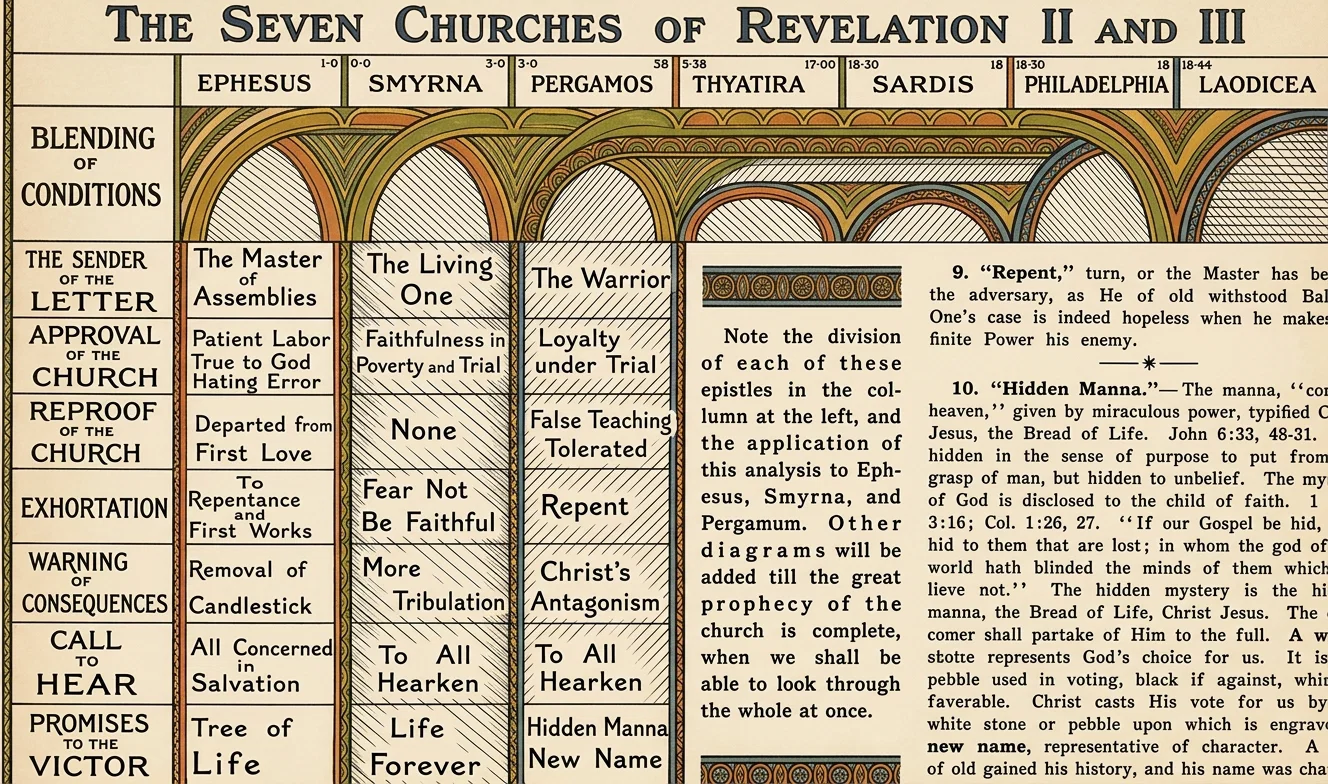
We study two of the typical churches in this number, Smyrna and Pergamum. It might be well to consider briefly the types, the actual churches and towns of Asia Minor. Ephesus, of our last lesson, is no more. The magnificent ruins of the great temple of Diana and the famous theater of the mighty throbbing, pleasure-loving city are about all that there is of her former power and grandeur. Both city and church are no more.
Smyrna was a celebrated commercial city of ancient times. It was less than fifty miles north of Ephesus, on the Smyrnian Gulf, an arm of the Ægean Sea, at the mouth of the little river Meles. Its origin runs far back into antiquity. It was finally destroyed by the Lydians, after which it lay waste for four centuries to the time of Alexander the Great, who began its rebuilding a little distance from the old site. This work was continued under Antigonus, and it soon grew to a flourishing city. The city was destroyed by an earthquake in A.D. 177, but was rebuilt with more than its former splendor by the Emperor Aurelius. While it declined from its former glory, it is today no inconsiderable city with a population of 130,000, and a great central trade emporium. The Turks call it Imzir, even Infidel Imzir, because of its large population of non-Moslems. Most of the Christians are the formal members of the Greek and Armenian churches. The early church, used as a type, has not its antitype in Smyrna.
Pergamos, or better, Pergamum, lies about sixty miles north of Smyrna, in a wonderfully fertile valley in the province of Mysia, of which it was the capital. Through it ran the River Ciacus. Two centuries before the Christian era it was a noted seat of literature and the fine arts, and the residence of the celebrated Attalian kings. Under King Eumenes the library was increased to 200,000 volumes. The art of preparing skins for manuscripts reached here its perfection, and from the place came the term parchment. Mark Antony transported the library to Egypt as a present to Cleopatra. Under Rome its preeminence was maintained. Remains of noted buildings are still in evidence. In this city Æsculapius was worshiped in the form of a living serpent, the god of Pergamos. As the serpent is a type of Satan, so it could be said that Satan had a seat or throne in Pergamos, a type of later manifestations. The town now is poor and mean; there are a few Christians, and remains of a church of a few centuries ago. The early Christians did not have the trials in Pergamos which they had in Smyrna.
The Answer of the Text
[The answers to the questions are from the American Revised Version. Omitting questions, and disregarding sometimes the capitals at the beginning and the period at the close of an answer, the text may be read continuously. In notes and comments both versions are used without designation.]
1. How does the Master address Himself to Smyrna?
“And to the angel of the church of Smyrna write: These things saith the First and the Last, who was dead, and lived again.”
2. What had He recognized in Smyrna?
“I know thy tribulation, and thy poverty (but thou art rich), and the blasphemy of them that say they are Jews, and they are not, but are a synagog of Satan.”
3. What exhortation does the Master offer in view of suffering to come?
“Fear not the things which thou art about to suffer; behold, the devil is about to cast some of you into prison, that ye may be tried; and ye shall have tribulation ten days.”
4. What assurance is given the faithful?
“Be thou faithful unto death, and I will give thee the crown of life.”
5. What earnest call is made to every anxious soul?
“He that hath an ear, let HIM hear what the Spirit saith to the churches.”
6. What is the promise to the overcomer?
“He that overcometh shall not be hurt of the second death.”
The Letter to Pergamum
7. How does our Lord represent Himself to Pergamum?
“These things saith He that hath the sharp two-edged sword.”
8. What did He recognize?
“I know where thou dwellest, even where Satan’s throne is.”
9. For what did He commend them?
“And thou holdest fast My name, and didst not deny My faith, even in the days of Antipas My witness, My faithful one, who was killed among you, where Satan dwelleth.”
10. What reproof does the Master give?
“But I have a few things against thee, because thou hast there some that hold the teaching of Balaam, who taught Balak to cast a stumbling-block before the children of Israel, to eat things sacrificed to idols, and to commit fornication. So hast thou also some that hold the teaching of the Nicolaitans in like manner.”
11. What charge and warning are given?
“Repent therefore; or else I come to thee quickly, and I will make war against them with the sword of My mouth.”
12. What earnest admonition is repeated to all?
“He that hath an ear, let HIM HEAR what the SPIRIT saith to the churches.”
13. What is the promise to the overcomer?
“To him that overcometh, to him will I give of the hidden manna, and I will give him a white stone, and upon the stone a new name written, which no one knoweth but he that receiveth it.”