VENTILATION IN WINTER

8%

Seventh-day Adventist Publishing Association · Battle Creek, Mich. · Dec 22, 1896

FromReview and Herald, Vol. 73, No. 51.

Read the full edition

VENTILATION IN WINTER.

There are but few topics of domestic economy which, in a rigorous climate, are more worthy of careful attention than this. In the warm season, with doors and windows wide open, we are wont practically to live in the open air. But when the cold blasts of winter come, our shivering forms bid us close up the avenues of the unwelcome chilly air. Economy of fuel demands that we keep the cold out and keep the heat in. So strong is the demand that most people are ready to comply even at the sacrifice of every trace of fresh pure air.
With our houses hermetically sealed and the temperature of the rooms raised to a high degree, while every pore of our bodies is wide open, and lungs are gasping for needed oxygen, exposure to sudden and great changes becomes perilous to life and health. Colds, coughs, consumption, pneumonia, and other troubles become common from the cause here mentioned. Pneumonia and all these troubles have increased in a proportion that corresponds with our developing an ingenuity in rendering our living and meeting rooms impervious to fresh air. Our forefathers, who lived in log cabins whose “chinking” gaped wide to wintry blasts, who often awoke on a winter’s morning to find a snow-bank across their beds, knew but little about that terrible scourge, pneumonia. They had plenty of wood, and if their backs got cold while they warmed their feet, they turned around and warmed the other side a while.
It is not claimed that those wintry blasts were the guardians of the health of our fathers. But could that crisp, pure air have been furnished them slightly warmed, and in such copious quantities, they might have escaped not only the pneumonia we have, but also many of the ills they had.
A writer in a late health journal of prominent reputation deprecates severely the weather-strips, battens, double windows, and every other modern contrivance for keeping out anything but the coarsest of cold winds. This writer glories in sleeping with windows open; and in the coldest weather opens wide doors and windows at least once each day.
While it is freely granted that such an arrangement is better than air-tight compartments, baking and steaming with heat and foul air, it is far from the best. Double windows are good things. Double doors are, too. And so are weather-strips, and any other contrivance to keep out sharp, piercing wind, which, when the air supply of the house is cut off, rushes impetuously into the vacuum caused by fires in stoves. Stoves and fireplaces carry off air very rapidly by draft and combustion. To supply this demand taxes crevices under doors, between sashes, under bases, and causes a strong inrush of outside air. Where no other provision is made, these would seem to be a necessity. Without them the air must soon lose its vitality, and respiration become unsatisfactory.
Restored with AI
But if these are not best, what is better?—A better plan is to supply an abundant quantity of pure air by a system under your control. Don’t by all means try to live without the air. Do not depend upon open doors or windows or upon crevices in the same. Strong currents of biting cold air are not good. Introduce fresh air of a temperate quality in a gentle current.
In the first place, American houses are generally too warm. This is a matter of habit. People coming here from other countries at first feel stifled by our toasting temperature. On returning from Australia to this country, the writer had frequently to leave places of meeting, being unable to endure the heat of the rooms. A temperature below 70° is better than one above. Think of the change that shocks the system in going from a stifling room at 80° into the frosty air outside, where the mercury is 20° below!
Such a performance throws wide open the door for pneumonia and other deadly maladies.
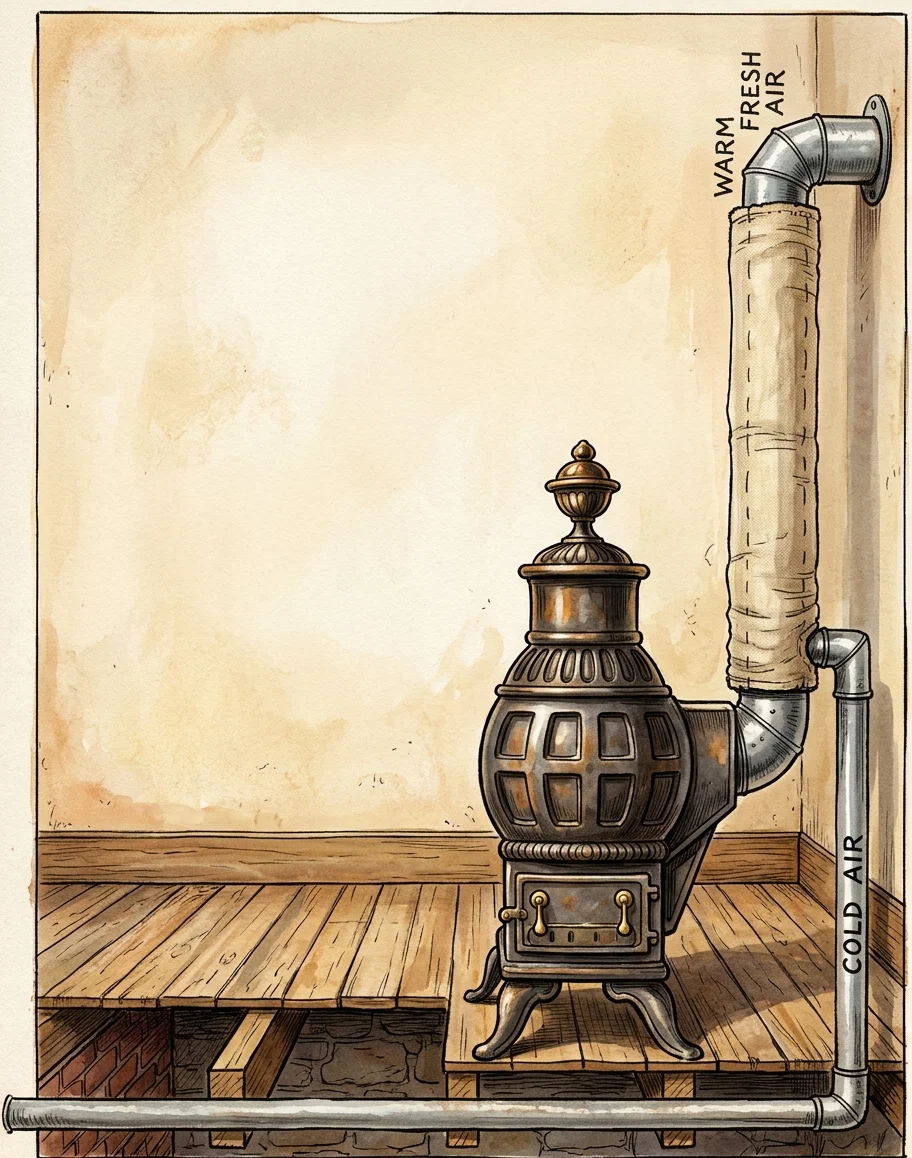
The suggestion may be carried out by laying a four-inch pipe of sheet iron, tin, or wood under the floor, connected at the outside end with a pure-air supply. Bring the pipe up through the floor at the stove. If you can do no better, liberate the air under the stove. A better plan is to heat it by passing it through flues in the stove, or by making an eight-inch jacket or outer pipe around the stovepipe, and letting the cold air into this jacket near the stove, let it out, heated, at the top of the room, as illustrated in the diagram. Or a jacket may be placed around the back of the stove with a narrow space between, and the cold air be discharged into that. In order to take foul air from the room, insert a four- or five-inch pipe into the stovepipe, and let it extend to within three inches of the floor. Foul air settles to the floor, and this simple device will draw it off.
From practical observation we are led to conclude that this simple contrivance for ventilation does not place any extra tax on the fuel supply, but rather diminishes it. There are but few houses where some such plan may not be devised. Some stoves are built with this in view. The absence of languor, headaches, and colds; the comfort and sound sleep that fresh air will produce, will abundantly compensate for all trouble and the little expense. T.