CAPITAL AND LABOR.—NO. 3.
E. T. RUSSELL
(Oklahoma City, O. T.)
Not only does the Bible teach that relief will not come to the poor, but it also teaches that misery is in store for the rich: “Go to now, ye rich men, weep and howl for your miseries that shall come upon you.” James 5:1. “They shall cast their silver in the streets, and their gold shall be removed: their silver and their gold shall not be able to deliver them in the day of the wrath of the Lord: they shall not satisfy their souls, neither fill their bowels: because it is the stumbling-block of their iniquity.” Ezé. 7:19. Truly, trouble awaits the rich; and the storm will soon come in all its fury.
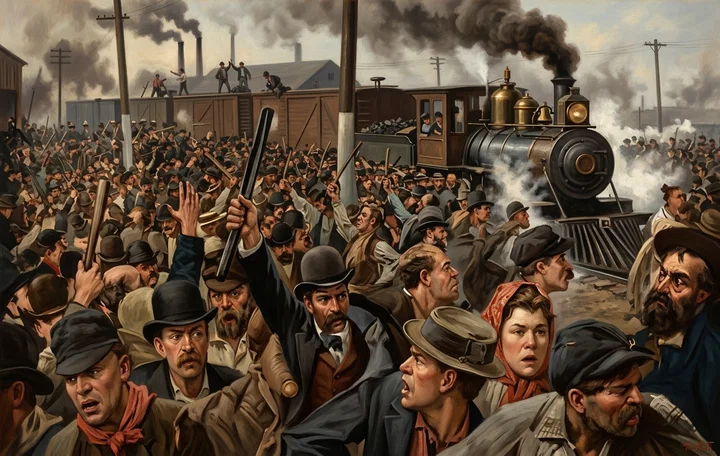
Through developing circumstances, the rich will be compelled to cast their silver and gold into the streets. The present condition of society will produce sure and sad results. Evil in the hearts of the downtrodden and oppressed will grow to a thunderbolt, that will burst with all the horror of an overflowing tempest upon the rich. Too late they will learn the sad lesson that “they that will be rich fall into temptation and a snare, and into many foolish and hurtful lusts, which drown men in destruction and perdition.” 1 Tim. 6:9.
In Ezé. 7:23 the Lord says: “Make a chain: for the land is full of bloody crimes, and the city is full of violence.” The chain will undoubtedly be made by the people as they associate themselves together, as expressed in Isa. 8:12. These associations are formed with the hope that relief will come through them, but their counsel will not stand, because “vain is the help of man.” Not seeking guidance from God in their endeavors to extricate themselves, they will be plunged more deeply into trouble. They will also realize, when it is too late, that by taking counsel of men instead of seeking wisdom of God, they have helped to forge the chain that binds them. It will be a chain forged in the workshop of Satan to deceive and mislead the masses, and plunge them into ruin. God’s method of reforming society and correcting abuses consists in improving the individual members of the community. That is liberty. Confederacy and régime only add to the tyranny of greed the more galling tyranny of envy.
That the land is full of bloody crimes, the following statistics of crime will show:—
| Year | Murders | Daily average | Year | Murders | Daily average |
|---|---|---|---|---|---|
| 1886 | 1,449 | 4 | 1891 | 5,905 | 16 |
| 1887 | 2,335 | 7 | 1893 | 6,615 | 18 |
| 1888 | 2,184 | 6 | 1894 | 9,800 | 27 |
| 1889 | 3,567 | 10 | 1895 | 10,500 | 29 |
| 1890 | 4,290 | 12 | 1896 | 10,652 | 29 |
Between 1891 and 1896 there were 43,472 murders, 723 legal executions, and 1118 lynchings. The increase of murders in eleven years was more than seven hundred per cent. The increase of population during the same period did not exceed fifteen or twenty per cent.
There has been a corresponding increase of all other crimes. The late Judge Parker, of the United States Supreme Court, said: “The question before the people of this government is not the gold standard or bimetalism, but whether proper protection can be given to human life.”
At the present time a light estimate is placed by many upon human life. At the time of the Chicago riot I overheard a man say, “I wish a war would take place, and kill off about two thirds of the people. There are too many.”
The city is full of violence. The city is the center of civilization. It is also the place where the storm will undoubtedly break forth and rage in its greatest fury. Into the cities the masses gather. Thus Lazarus and Dives are brought face to face. Not owning their own property, the poor are forced, by want of employment, by meager wages, and the burden of rents and living, from the comfortable cottage to the miserable tenement, with its fetid air and its foul surroundings. There they form a hatred toward the rich, which ends in cruel plottings against them. Social dynamite is much more easily produced in the impure atmosphere of the city than in the more wholesome surroundings of country life.
At the time of the Reign of Terror in France, the trouble began at Paris and Versailles.
Paris became a sea tossed by the storm. . . . The most beautiful city of the modern world became a horror too awful to contemplate. The rage for blood was caught in other parts; and the cities of Meaux, Reims, Lyons, and Orleans imitated the work done in the capital.—Ridpath’s “History of the World,” Vol. III, pages 653, 656.
In the “Leading Facts of French History,” page 217, we read as follows concerning the period just before the Reign of Terror:—p. 152
While the Assembly was engaged in constitution-making, matters were fast growing critical in Paris. Bad harvests had caused great distress throughout the country. There was scarcity of bread in the capital, and to render the condition worse, thousands of desperate tramps had come into the city, eager for riot and pillage.
Before the fall of the Roman Empire, the pent-up masses in the city of Rome lighted the fires of revolution. The condition of the city of Rome, and also of the rural districts, was almost precisely the same as that described above; and the condition of both France and Rome was but the more complete development of what we see in the United States to-day.
Middleton thus describes the condition of affairs in Rome from the middle of the second century before Christ, onward:—
While Rome had been extending her sway westward and eastward, . . . while her nobles and merchants were amassing colossal fortunes abroad, the small freeholders throughout the greater part of Italy were sinking deeper into ruin under the pressure of accumulated difficulties. The Hannibalic war had laid waste their fields and thinned their numbers. And when peace returned to Italy, it brought with it no revival of prosperity. The heavy burden of military service pressed ruinously upon them, and in addition they were called upon to compete with foreign corn imported from beyond the sea. . . . Farming became unprofitable; and the hard, laborious life, with its scanty returns, was thrown into darker relief when compared with the stirring life of the camps, . . . or with the cheap provisions, frequent largesses, and gay spectacles to be had in the large towns. . . . Their holdings were left to run waste, or merged into the vineyards, olive-yards, and above all, into the great cattle-farms, of the rich.—Encyclopedia Britannica, Article “Rome.”