Thirty miles northwest from Denver, the capital of Colorado, on the Union Pacific, Denver & Gulf Railroad, lies the pretty little city of Boulder. It is one of the oldest towns in the State; and that which gives it special prominence at the present time, is its possession of the State University, one of the foremost educational institutions west of the Mississippi. Although not standing in the lead as a commercial center, Boulder is a mart of no mean importance. Surrounded by a fertile farming country, and in close proximity to rich mines of coal, silver, and gold, it forms the commercial center of a large section of territory. But though closely identified with mining interests, the city is not a mining town in the common understanding of that term; but possesses every characteristic of a modern, well-ordered and cleanly kept city. The buildings are of wood, stone, and brick, the latter largely predominating. Mountain streams of pure, clear water run through the streets, which are deeply shaded by a rich foliage of overhanging trees. The quiet order which prevails in the town is noteworthy. For years it has been found necessary to employ but one policeman, and it has been said that he, on account of a retiring modesty, cannot always be found when it is desired that he should perform some public function. However that may be, it is but seldom that the quiet peace of the city is disturbed by the midnight marauder or by the friend of the flowing bowl. Theft and robbery are practically unknown.
It is from the scenic and climatic standpoint that Boulder prominently excels. Situated in the dry, bracing atmosphere of the Rockies, in a climate radiant with sunshine, and heavily charged with life-giving ozone, it is entirely removed from malarial and malign influences. This, together with its altitude, fifty-three hundred feet above the level of the sea, makes it a desirable place of residence for those who already enjoy life, and a city of refuge for those, who, having lost their health, desire to win back that priceless treasure. Colorado is now the hospital of the world. From every country and clime people come to find in its invigorating climate, release from disease and restoration of health.
And not alone in the sunny sky and dry, bracing breezes does the invalid find promise of a lengthening of days, but in the scenes of material nature as well. The fertile plain whispers of new life. The lofty, snow-capped peaks, lifting up their hoary heads in splendor and magnificence, speak of strength and endurance. The whole scene is one of hope and inspiration, leading the mind away from the sordid cares of life, and firing the soul with higher and holier motives and purposes. From nature the thoughts turn naturally to nature’s God; and in the leafy bower, in the tender, growing grass, and in the lofty mountain heights, is realized the loving care of a gentle Father as well as the omnipotence of him who comprehends the dust of the earth in a balance and weighs the mountains in scales.
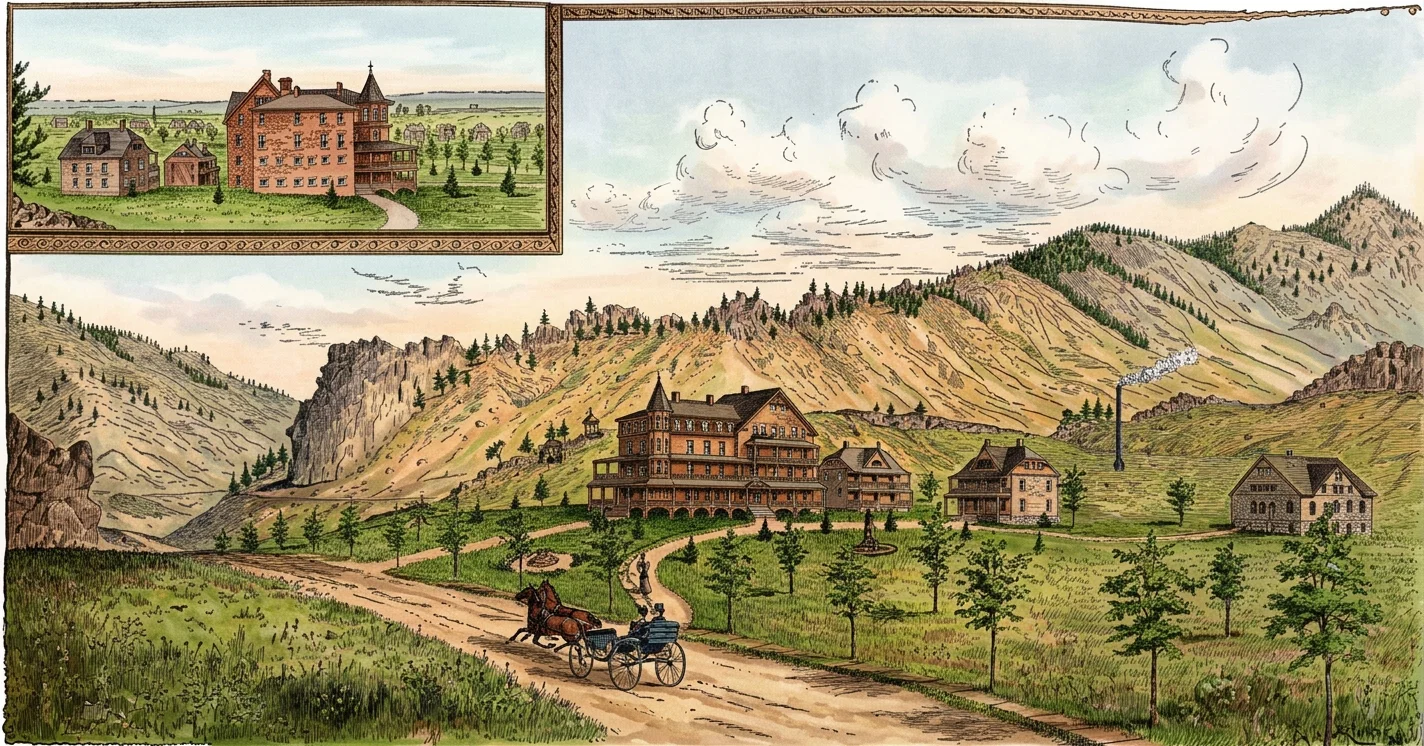
These considerations prompted the erection of our last denominational venture in medical work, the Colorado Sanitarium, which is located at this place. The accompanying cut gives some idea of the institution which has been established. The main building is a four-story brick-and-stone structure, ninety-six feet long, and forty-five feet wide. The large annex on the west gives the building a frontage of over one hundred feet. In close proximity to the main building are two neat cottages. The accommodations thus furnished will permit one hundred patients to find a pleasant and commodious home.
The institution is situated in the most sightly part of the city. From the balconies of the building, a fine panoramic view is presented of the plateau beneath. The pleasant city of Boulder, the distant villages of Marshall and Ni Wot, and the city of Longmont, with the surrounding and intervening country, dotted here and there with little lakelets, present a scene both refreshing and inspiring. In the background, the lofty peaks of the Rockies form a picture of which the eye never tires.
The sanitarium is now well equipped for its work. Over fifty patients, representing some eight or ten different States and Territories, are already enjoying its benefits. Every day witnesses new arrivals, and it will doubtless be but a few weeks before the buildings are crowded to their fullest capacity. The following well-known physicians are connected with the institution: Doctors O. G. Place, W. H. Riley, W. H. Hubbard, G. W. Burleigh, Miss Kate Lindsay, and Mrs. Eva Reed. Dr. Place expects soon to leave the work with which he has been connected from the beginning, and in which he has achieved excellent success, and go to India, to open up the medical missionary work in that important field. It is a cause for sincere regret that Dr. Place is called from the work here, but the long experience and very efficient service of Dr. Riley in connection with the Battle Creek Sanitarium, eminently fit him to take charge of the institution upon Dr. Place’s departure.
To those acquainted with the favorable reception accorded the institution thus far, and with the prospects which are now open before it, it is evident that a very successful future awaits it. Already a number have returned to their homes with the blessings of restored health and strength, and we are satisfied that this class will be greatly increased as the influence of the work widens and extends. But the institution, in order to achieve the highest success, must come in contact with the needy and suffering. The sanitarium cannot go to them; they must come to the sanitarium.459This they cannot do unless they know of its existence and of the advantages they may be able to derive. We sincerely trust that every reader of the REVIEW will feel interested in the enterprise, and will do all in his power to direct to its welcome doors those who may be in need of the benefits it is able to bestow.
It is well known that the climate of Colorado, with such treatments as are employed in our institutions, furnishes a panacea for many ailments. The Colorado Sanitarium is not merely a refuge for consumptives (only about one third of the present number of patients are of that class), but it is designed to give to those suffering from all chronic maladies the same benefits they could receive in similar institutions. It is well known that for disorders of digestion and many kindred diseases, the tonic effect of a high altitude is very beneficial. Many of our people are well acquainted with those in their section who are seeking, on account of their health, a drier and more bracing atmosphere. Why not direct them to the institution where they will be able not only to obtain the climate they desire, but rational methods of treatment as well? A two months’ sojourn at the sanitarium has enabled me to become quite well acquainted with its workings. I am assured of its great value as an agency in our work, and of the possibilities for good which lie before it.
The spiritual interests of the sanitarium family are prosperous. The helpers number some twenty-five or thirty brethren and sisters, who are laboring in love and harmony to advance the interests of the work of God. Regular morning worship is maintained, where all of the helpers and some of the patients come together to seek for strength and wisdom for the day’s duties. Sabbath-school and weekly prayer-meetings are likewise carried on, and Sunday preaching services are conducted in the sanitarium parlor for all who desire to attend. We trust the prayers of our people everywhere will ascend for the success of the work here, and not alone for the work in this field, but for the success of every institution which is among us, and for the work and workers of God throughout the earth.