This vast field, with its hundreds of millions of people, presents a picture which demands the careful study of Seventh-day Adventists. We know that the saving message is to go to every nation, kindred, tongue, and people. And when the Lord Jesus comes the second time, two things will be true: First, “Well done, thou good and faithful servant,” will be said to every one who has acted his part in the closing work, and all such will enter into the joy of their Lord; second, no tribe, nation, nor tongue will be able to say in that day, “We never heard the message.” These two facts are indisputable, and no real Seventh-day Adventist will think of questioning them for a moment. But the logic of these facts demands of every one of us a consecration of ourselves and our means, and a zeal and earnestness such as this world has never witnessed hitherto.
We look with admiration upon apostolic zeal and earnestness and consecration of men and means, but all that will be exceeded. There came a time in the history of the early church when her earnestness and devotion began to wane; worldliness and formality came in, and the power of God went out. But in the closing work of the church on earth, that first experience, from the nature of the case, will not only be repeated, but will be retained until the climax is reached by the ushering in of the great day of the Lord and the coming of Jesus Christ with his mighty angels. If the zeal of the early church had not grown less, it would have increased, and the work would have gone on with ever-increasing strength and power until the end. This is what must be seen in the closing up of this message.
Here is a field which in 1891 had a population of two hundred and eighty-six million souls, a very great majority of whom at the present moment are sitting in darkness and in the shadow of death. The two great divisions are British Territory and the Protected States. The former has a population of two hundred and twenty million, and the latter, sixty-six million, making in this field about one sixth of the earth’s inhabitants.
Now, for this vast mass of humanity what are Seventh-day Adventists doing? As yet we are forced to answer, Practically nothing. At the present moment you have in this great country one canvasser who will soon leave for Australia. Then you have sent here two young ladies who are studying the language and working as best they can. These, with my wife and myself, constitute the entire force here; but what are these among so many? In this country there are more than one hundred different languages spoken. We ought to have at once a few men and women studying some of these languages. This will take time, and therefore the sooner it is entered upon, the better. Territory should be selected, and then a man and his wife sent into it, and perhaps others, according to the importance of the district selected; and let these persons live among the people, and learn the language in the shortest time possible. As soon as they learn, they can begin to use what they have learned in giving the word of God to the people. There ought to be several localities, representing as many tongues, entered in this way at the earliest moment possible.
To do this we need young men and women who have had a fair experience in the work, and who have learned how to trust God day by day. Some who have had no experience, but who have good sense, and whose hearts are filled with love for fallen humanity, could be associated with these. Every such company should have at least one who understands treating the sick, and has some knowledge of simple surgery. It would be a still greater advantage if every one had such knowledge. Such persons will be in demand.
OUR SCHOOL IN CALCUTTA.
In recent years there is a growing tendency to educate the Hindu girls. In 1886 less than one per cent. of Hindu and Mohammedan girls were under school instruction. The situation since then has changed a little for the better. After studying the situation for a time, it seemed imperative that we open a small school for girls. But then the question arose, How shall we secure their attendance? Having finally decided to try the plan, we issued a circular announcing the opening of the school; but at that time we did not know of one that would come. This announcement was printed in Bengali. A Brahman to whom I had given water treatment last winterp. 409 during a severe illness, volunteered to assist me in a canvass of the neighborhood for students. He advised taking with us a Brahman priest,—rather a singular trinity,—and thus equipped, I started out on Sunday, February 16, to make the first canvass. The day’s work was decidedly encouraging, and suffice it to say that in a few days we had a list of about thirty; and on the opening day, March 2, there were twenty-six present. The number soon ran up to forty, when we sent out word that we could take no more this term.
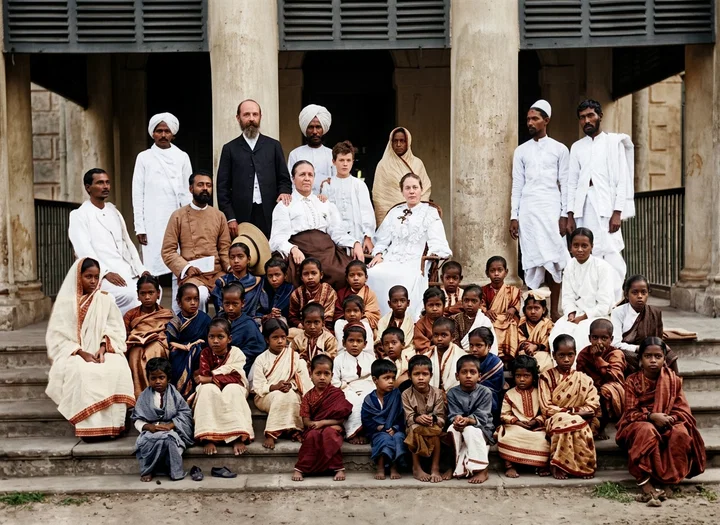
Our first term continued nine weeks, when we closed for the summer vacation, which will continue till the beginning of the rainy season, about the middle of June. Two of our girls were married during the term, and so left; one died of cholera. The accompanying cut represents our school a few days before it closed.
Our experience has convinced us that we must have a school, not only one, but more just as fast as they can be opened. The school problem in small towns will be a simple one, for a school-house can be built very cheaply. Here in Calcutta it will be different. We ought to have a good school here, and to do this we should have a suitable place especially for it. The school has been and will continue to be held in our house till our medical workers come, but what are we to do then? We cannot think of holding it here at the house if we carry on medical work; for we shall not have the room. We dislike to think of discontinuing the school altogether; but what to do toward the end of this year is a question that will engage our attention for the next few months.
The advantages of a school are twofold to us in our work: First, it is of decided advantage in learning the Bengali language; and second, it forms a friendly communication between us and the parents, which is no small consideration in this land where caste rules with an iron hand. The Hindu devotee will die of hunger or thirst before he will consent to take water from the hand of a Christian, or from one of another caste than his own; but on this question I may say something at another time. Then, of course, there are the advantages which the girls themselves derive from a good school. And since there is beginning to be an interest awakened in the minds of the people to have their girls educated, it seems as though this is a call to us to do at least something in this direction.
You and I, dear reader, are debtors to these people, and I feel certain that if you could see even what little I have seen of darkness, superstition, poverty, wretchedness, and oppression, sacrifices would be made that have not yet been dreamed of to give these darkened souls the light of truth. The people I have now in mind are not those who are given to drink. Many of the Hindus do not drink intoxicating liquors at all, but with the mere pittance which these people are able to earn, they are kept in the deepest poverty all the while. This is not true of all, but it is true of millions. We are willing to spend and to be spent, to be deprived of many things that we regarded necessities in America, if thereby others may be helped to a better life; but we look to our brethren in America for help. Devoted men, devoted women, and devoted money are needed to accomplish what must be done in this great, dark India. What will you do, and when will you do it?
D. A. ROBINSON.