BY MYRTA B. CASTLE.
(Battle Creek, Mich.)
“Feed my lambs,” said Jesus; and when he said that, he meant the black as well as the white; but the world has ignored this, and usually, in our country especially, black children have been given a full measure of everybody’s distrust and aversion. They are often the inheritors of the worst characteristics of the white race, as well as of the ignorance and degradation of their own race. Then, with all this fearful legacy, cruelty and neglect and want hurry them into a criminal career. What to do with these criminals by inheritance and force of circumstances, has long been a problem; but while our wise men have often sat inactive because the problem was difficult, now and then others, unaided, have gone to work and solved it, as far as they personally are concerned. They wisely concluded that if they fed with the bread of life as many as possible of the black lambs, there would be fewer black sheep to go to the prison, the chain-gang, or the gallows.
One of those who early became interested in these unfortunates, was Mrs. Almira S. Steele, an educated Massachusetts lady. She went south seventeen years ago to do missionary work among the colored people. She was an experienced teacher, the widow of a Union soldier, and the mother of a little daughter. Her first work was in establishing schools among the colored people of South Carolina; but the Kuklux spirit was so strong against her work there, that the Women’s Home Missionary Society of Boston, under whose support she was working, transferred her to Chattanooga, Tenn. However, in spite of opposition, she managed to found eleven colored schools in South Carolina and three in Alabama.
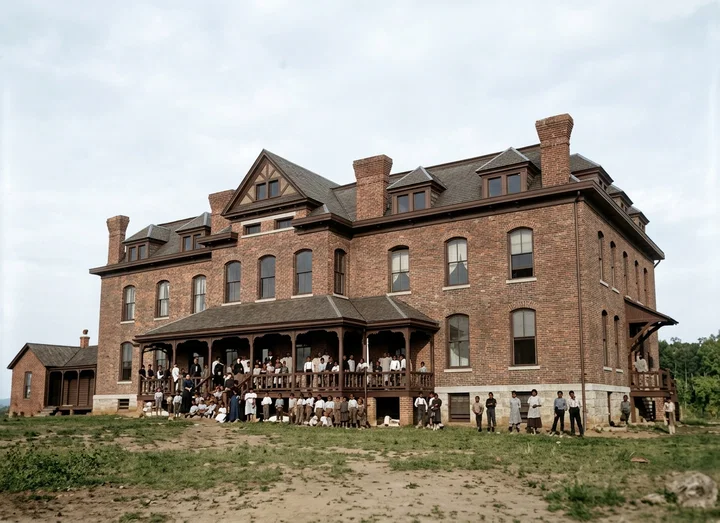
She was removed to Chattanooga soon after a scourge of yellow fever had swept through the city. Many children had been orphaned, and there was absolutely no provision made for the little black orphans. Mrs. Steele applied to the missionary society for aid; it had no orphan fund. She applied to the county; its people were not yet ready to be taxed to save either the bodies or the souls of black children. “Then,” says Mrs. Steele, “I prayed for light, and it came. I saw that I had been deceiving myself. I wanted an orphanage, but I wanted somebody else to build it. I said to myself, ‘Build it yourself. You have money saved from teaching; you have your husband’s life insurance; you have your pension.’ Then I turned to my little daughter, and I said, ‘Darling, we will trust the Lord for our future, and we will use our money to make a home for these little waifs.’” So Mrs. Steele bought a place, fitted it up for twenty inmates, and opened her orphanage with three children. That was twelve years ago, and her home has sheltered and protected more than five hundred since then. Once she was burned out; but with the insurance and six thousand dollars which influential, noble-hearted people of the South raised for her, she rebuilt the home, better than before. Afterward three attempts were made to burn her out, and then she went to the mayor of the city.
“What can you do for me?” she asked him.
“I don’t know, Mrs. Steele,” he answered. “You haven’t an enemy in the city, that I know of, but I’ve heard more men curse you than almost anybody else.”
“Why, what is the matter?” she asked.
“Nothing but that you take in a lot of darkies, and treat them as well as if they were white.”
“Is that all? I’m sorry for them. I’m in this work for life! If you can help me, do so; if not, I’ll apply to my Boston friends to help me get my children there, where we can be protected.”
“I wouldn’t have it known in Boston for anything,” replied the mayor; and very soon after this, some of the leading Chattanooga papers espoused her cause, and the home has not been molested since.
Until lately Mrs. Steele knew nothing of Seventh-day Adventists—did not suppose there were more than ten or twelve in the world. She has long believed in the personal return of Jesus, but only eighteen months ago was convinced that there was no authority in the Bible for a change of the Sabbath day. She is a guest at the Battle Creek Sanitarium, and it was there that a friend and I called upon her to learn more about her work and its possibilities. We found her work to be as truly “rescue work” as if she were working for the people of the slums. She told the pitiful story of a little girl of nine years, who, because she had scribbled a lady’s name on a piece of paper, had been sentenced to several months’ imprisonment for forgery! Mrs. Steele begged that the child be given to her, but was not permitted to take the little wronged one from prison till the shameful cruelty had nearly killed her. For a year and a half she was an invalid. Now she is a healthy young woman of eighteen. What she might have become, if, indeed, prison life had not killed her, but for this large-hearted worker, is too painful to think of.
Thirty of Mrs. Steele’s children are staying for a month or two at the Battle Creek Haskell’s Memorial Home for Orphans, and two are in the home of Dr. J. H. Kellogg. Six more are entered as pupils at the Battle Creek College. When they reach the age of fifteen or sixteen, Mrs. Steele often sends her orphans away to commercial or industrial schools, that they may learn to be intelligent leaders among their own people. Before that, they are taught in the orphanage. Twenty-five of the orphans of her adoption have married, seventeen are teachers, four are studying for the ministry, many are in schools or Northern homes, and the rest are still under her watchful care. Some have followed her in her changed religious beliefs, and she hopes and prays that her love and example may help the rest to see what seems so plain to her.
“Oh,” Mrs. Steele exclaimed, “it’s a trial to bring them up—for they’re often mischievous and naughty. I tell them, Children, it takes a deal of patience to care for your bodies; but I’m after your souls,—this is all a trap to catch your souls! I can’t do much of the great deal there is to do; but I thank the Lord that he’s letting me oil the hinges, so that others may open the door easily which has often swung hard for me. Oh, if people want love, let them take up a work like this, and their lives will be filled with the love of grateful hearts!”
She ought to know, if anybody can, the blessedness of caring for the neglected and despised; that it brings her joy is plain from her countenance and all her words, and also from the fact that she has started another colored orphanage in Atlanta, Ga., and one for whites in Deer Park, Md., which was carried on for five years with the aid of Mrs. S. B. Elkins, of Washington, D. C.
Mrs. Steele’s work is wholly a work of love. She put her earnings and her legacies into the home; then she deeded it to a board of directors, only stipulating that she shall be manager while she lives; and now she works without salary, and trusts in the Lord. Truly love is the mightiest thing in the world; it will reach up to the gates of God for his blessing, or down to the gates of hell to save a soul.