Having recently accepted the truth as held by Seventh day Adventists, after having been a Baptist for about twenty-five years, and a minister the larger part of the time, I esteem it a pleasure to relate some impressions received during a short visit to the above-named college and college home.
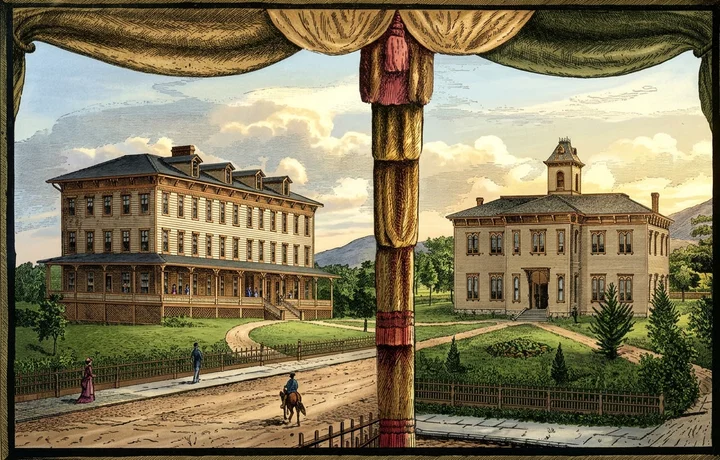
It has been my privilege to visit denominational colleges in other States in the past, and in visiting this one I have found myself contrasting the differences, plainly observable, between it and others. In the first place, all the faculty, and most of the students, are earnest, humble, consecrated Christians, each striving in all of his words and actions to manifest the Spirit of Christ. This produces an effect at once noticeable and pleasing, to a degree never before witnessed by the writer in any institution of learning. While the rules are strict, and the management insists that they be faithfully carried out by all concerned, the admonitions are so kindly, mildly, and quietly given that it seems a pleasure to heed them. In all my experience with institutions of learning in the past, I have never visited one where the faculty seemed to work in such harmony, and where the management had everything under such complete, harmonious control.
Lectures are given by different members of the faculty from time to time, frequently on moral and religious subjects, and an effort is made to inculcate religious thought and practise in all the daily duties of the students, not simply in a formal and routine way, but in the belief that religion is nothing if not practical, ministering to the highest personal development. In all the recitation rooms visited by the writer, the same dignity and high-toned decorum were observable, but so manifestly in the spirit of the Master as to take away all formality and stiffness, making the whole recitation a pleasure to both instructor and pupils. The management has certainly attained a great success in this direction, no doubt by untiring effort; for it is a well-known fact that there can be “no excellence without great labor.” It may be accounted for, in part, however, from the fact that the institution is not a reform school, and young people too incorrigible to be governed at home are not wanted; and if such a disposition should be developed in a student, he would be sent home.
The courses of study consist of the preparatory, Biblical, normal, scientific, and classical courses; besides a primary department, where pupils are prepared for the preparatory department. Music, both vocal and instrumental, is taught all along through the different courses in some form, so that all may learn at least to sing, and those who wish, may become accomplished musicians.
But I must turn now to the Students’ Home, presided over by President Howe, ably assisted by other members of the faculty. The week I spent in the Home was one of the best of my life, not only for the many new truths I learned from the instructors in the Bible course of study and the college library books, but from daily intercourse with the teachers and the students of the Home, who share it as one family, with mutual interests and aims. There seems to be a studied care on the part of all to make the Home life attractive and efficient in the cultivation of those habits which distinguish the refined Christian man and woman.
Soon after the morning worship, breakfast is served in the dining-room below. After breakfast, all make preparations for college recitations, some beginning as early as eight o’clock. At nine o’clock all are required to be at chapel service, after which the time is occupied in recitations in the different class rooms until 1:30 P. M., when recitations are over for the day. Students then return home, and at two o’clock dinner is served, consisting of three courses, and from forty to sixty minutes are occupied in eating. The cooking is all done on scientific principles, and only the very best hygienic foods are used, so that students are assured of healthful living. A few minutes of recreation are given after dinner, when all are expected to spend one and a half or two hours in domestic or manual labor of some kind in connection with the home or college premises. These requirements are made in consideration of the low rates of board and tuition, and for the benefit of the general training it affords. Twelve hours of such labor is required of each student, every week.
After working hour is over, each student can use the time until evening worship as he likes, never visiting the town, however, without permission of the president. At 6:15 the bell rings for evening worship, when all are expected to be in attendance. Then follows the “silent hour,” after which all retire to their respective rooms for study. No talking above a whisper is then allowed in any part of the building, the study hour being continued until 9:30, when all lights must be put out, and the students retire to rest.
I do not feel like closing this article without stating that this college has no endowment, and hence is dependent upon its patrons and friends for its funds. I do not conceive of any way by which one could provide a more lasting benefaction to his fellow man, or more highly honor his Maker, than by contributing of his means to advance the cause of higher Christian education in such a school. Healdsburg College has a greater number of students in attendance this year than last, but I certainly feel that all Adventists and their friends in California should rally to its support, and double the number for the next college year.
In conclusion, allow me to say a few words concerning the social affairs of the College Home. Besides the holidays, when all the pupils are permitted to take an outing and enjoy the day together, the students of the Home are permitted, three or four times a year, to give a reception to the other college students and their friends. These are usually very pleasant and happy affairs. I had the pleasure of attending one on Monday night, beginning at seven and closing at ten o’clock. After the guests had been received by the president and his wife and the preceptress and other managers of the Home, and some time had been spent in social converse, a short musical and literary program was rendered, interspersed with about five minutes of social conversation between the selections, which made the evening pass off very pleasantly. Indeed, the writer does not remember ever having spent a pleasanter evening since becoming a Christian, and certainly not since embracing the third angel’s message. The Spirit of Christ seemed to be manifest in every face, and it was indeed “good to be there.” May the blessing of God continue to rest upon Healdsburg College, and those who have been called to conduct its work.
G. B. Douglass.