Much has been said, by way of description, both of the physical aspect of this land and of the habits and customs of its people. However, a residence here of only a few months has convinced me that while a pen-picture can give something of an idea of the country, it will come very far short of a true and complete description of the people. This is owing largely, I think, to the everchanging condition surrounding them; a description of last year may not be, in every respect, absolutely true this year. Then there is such a mixture of tribes, each having something peculiar to itself, and this mixture causes a modification of many customs, or a dropping of some cherished one and the formation of something entirely new; but while this is true, there are some customs that are common to all, as far as I know. The practise of polygamy and the use of tobacco in some form, seem to be common to all the native tribes.
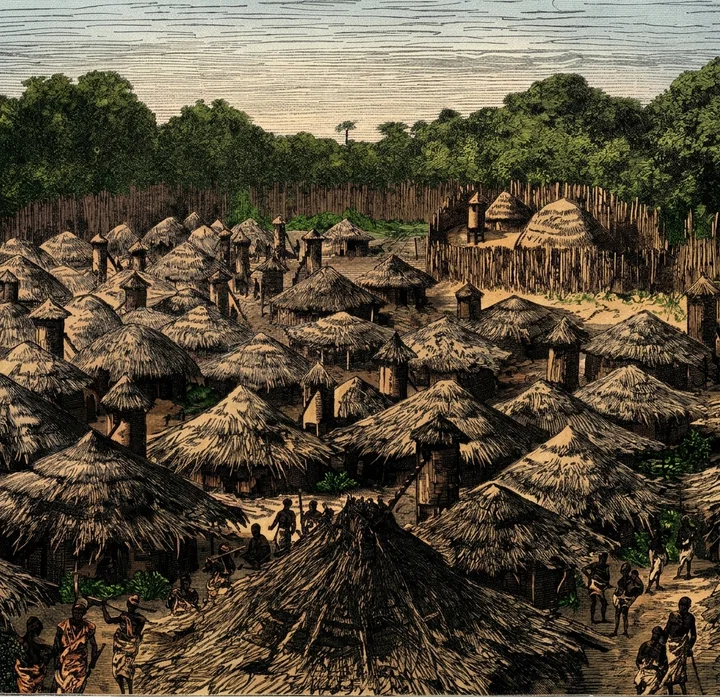
Our pioneer mission station is located about thirty five miles west of Buluwayo, and is usually spoken of, in America, as the Zambesia mission. This name is quite misleading, as this territory is quite distinct from Zambesia, and is known as Matabeleland.
While situated in Matabeleland,—in fact, in the very midst of it,—we have to do as yet with but few Matabeles. The natives on the mission farm are, with few exceptions, Macullakas. In many things they differ from the people in the midst of whom they dwell, and whose servants they have been for many years. In physical endurance and mental perception they are said, by some, to be inferior to the Matabeles, but in morality far ahead.
Here, as elsewhere, polygamy is practised. The man is held to be the lord of the situation, and his wives are only so many servants, who are expected to do his bidding without questioning. They are his property, and he treats them accordingly. The girls are usually sold to be wives as soon as they are physically developed,—many of them being mere children,—sometimes to men several times their own age. To us this looks very inhuman, but I have not observed as much evidence of discontent as one would expect under such circumstances. The women seem to accept the situation as their portion, and usually seem contented.
The price paid for these girls, when bought as wives, varies much. Sometimes a girl brings a cow, or an ox, or several cows, or perhaps goats or sheep; then again a few yards of calico or a few shillings’ worth of beads will buy a wife. Two of the boys we have had working for us have bought wives with their wages. In each instance the wife cost ten shillings, about two dollars and fifty cents.
While in the main there is but little outward manifestation on the part of the wives signifying their discontent, there are cases where young girls have been sold to old men, that are touching indeed. Some incidents testify to the fact that there is some true affection, even among those who have been held down for ages by ignorance and superstition. The native commissioner over this district related to me a case that was quite romantic and pathetic. It was the custom of the king, if he saw a girl that impressed him favorably, to make her his queen. This was often done when he did not live with her. A kraal was given her, with cattle and servants, and she was the ruler of that village. One was chosen by the king, in this way, who had formed an attachment for a young man, and her affection was returned. They determined in some way to extricate themselves from the power of the king. Flight was the only means by which this could be accomplished; for to have it known that they were not submissive to the king, would bring upon them his displeasure, and result in their death as rebels against his authority. So taking their blankets and a small amount of provisions, such as could be easily carried, they quietly left their home by night, and made their way southward toward the territory over which the king had no control.
They traveled by night and hid themselves by day, lest they should be detected, and subsisted on the scanty provision taken for their journey, and such game as the young man could secure with his gun without attracting attention that might lead to their discovery. In a short time they reached a place where they felt they would be safe. But fearing he might be considered an enemy or a spy if he retained his gun, the young man determined to give it up to the authorities at Tati station. So he presented himself to the authorities, gave up his gun, and returned to his camp-fire, not knowing the fate that awaited him there. He reached the place, happy to know that they were now beyond the reach of King Lobengula or his warriors. But a danger of a different kind awaited them, and as the fire burned low, a large lion sprang upon them, and before assistance could reach them, only the trampled and blood-stained bushes testified to the valiant fight he had made for himself and the one he loved. I narrate this not for the romance in it, but to show that true affection is not entirely foreign to these people, who are looked upon by many as no higher than the brutes.
Daily we see the evidences that these people have a better nature than they are credited with having, and the spark of true affection still smolders among them; but where, oh, where are the true-hearted workers who will help to fan this smoldering spark into a flame! True, many things which are done for them they do not appreciate; and because of this, many who have come to labor for them have turned from their professed purpose. My heart aches for these people, and I long to be able to impart to them the knowledge of the One who can revive the flagging energies, and make the whole nature glow with the fire of the love of God. There are possibilities before them, and we appeal to you, dear brethren in America, to come to the rescue, and help now to carry the truths of the last message to this people. How marvelously God has opened the way for this field to be entered! Years in the past the field could only be entered by consent of the chief of the tribe; but now the missionary is the master, and stands where he can exercise all the ability at his command, and no native will raise a protest. Why is this?—To enable you and me to carry the precious gospel to the multitudes. Will we do our duty now? God help us to be true.
G. B. TRIPP.