In two brief chapters we have spoken of primitive methods of flour manufacture. But in our times milling has been reduced to an accurate science. The wheat kernel is carefully dissected, and separated into its constituent parts with as much care as could be taken by a chemist were he to analyze each kernel by itself. It might be well for us to analyze a kernel by hand and microscope, before we see how it is now done by machinery.
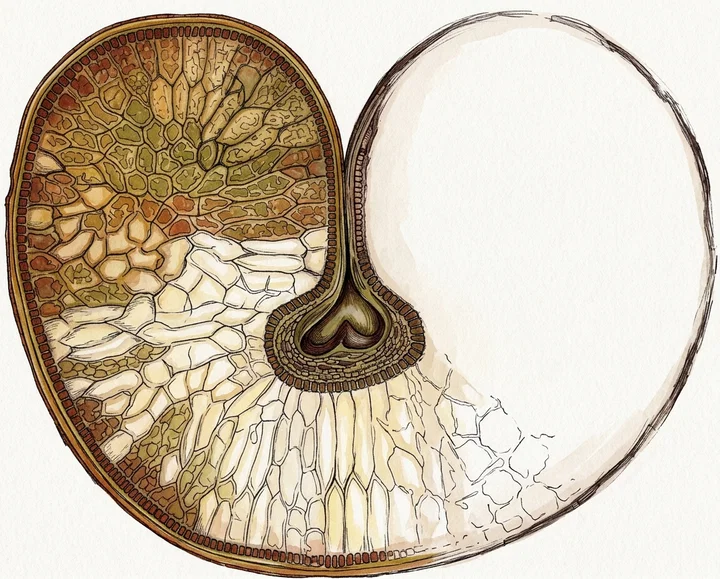
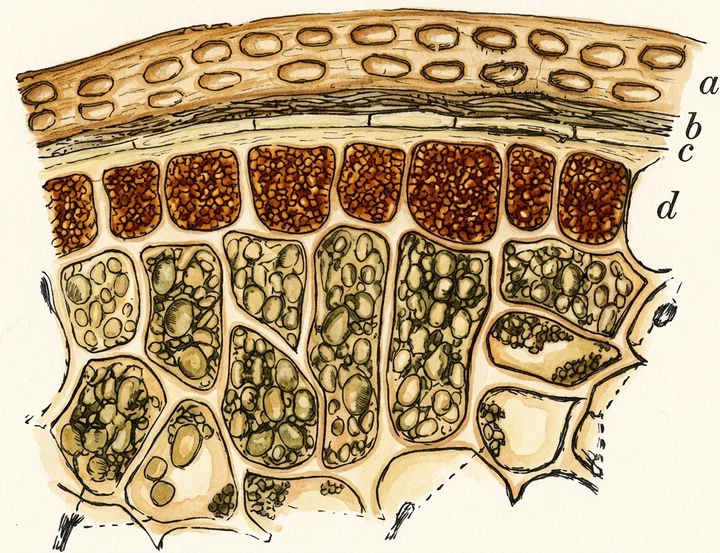
The accompanying diagrams are used by the courtesy of the author of the “Home Hand-Book of Hygiene and Medicine,” J. H. Kellogg, M. D. The first gives a transverse view of a wheat kernel, showing in one section the formation of the kernel; and the other cut gives the formation of a small portion of the kernel magnified. Outside (a) is a woody fiber, or bran; (b) the next layer is woody, but contains also rich nitrogenous matter and “salts,” or mineral elements; (c) and (d) form the envelope of the inner portion, and the most valuable portion of the grain, rich in albuminous substance; (e), (f), and (g) are the starchy portions, which constitute “superfine” flour, the very white flour sought for pastry.
Instead of one crushing or grinding process between massive stones, the modern idea is to disintegrate the wheat by a very gradual process, by means of more or less complicated machinery. In the first place it is necessary thoroughly to cleanse the wheat, and sometimes to toughen the bran. Then, by slightly crushing the kernel between horizontal rollers, the bran is removed. This bran is treated with great care, to remove everything from it except the woody husk. The bran manufactured from our great mills is now comparatively worthless for feed. The material separated from the bran enters into the best grades of flour. The berry separated from its husk is again and again run through the rollers, each time removing some of its outer coat, in the form of middlings. These are run through purifiers, which carry away the dusty, starchy parts, leaving the middlings as clean, sharp particles of meal, at first quite coarse, but with each operation becoming finer.
The best grades of flour are made from these purified middlings and the part that comes from the bran. At last nothing is left but the starchy center. This, with the last grades of middlings and the portions that are dusted out, forms the cheaper, whiter grades of flour.
The better grades of flour are of a yellowish cast, and are granular to the touch. That is, the flour will run out of the hand, and does not pack as solid as the starchy flour. Such flour is rich in gluten and nitrogenous matter. For some stomachs it is better than the Graham flour or meal. The purified middlings are excellent for porridge and gems.
From Charles A. Pillsbury, one of the great Minneapolis millers, whose mills grind twenty million bushels of wheat, or four million barrels of flour, a year, we lately received the following interesting sketch of the milling process:—
“After the wheat is received in the mills, it is passed through separators, where all stub straw, oats, cockle, wild buckwheat, and all weed and grass seeds and shriveled wheat are extracted. It is then put through scouring and polishing machines, to remove fuzz and dirt. If the wheat is exceptionally dirty, it is carefully washed, rinsed, and dried. Before it starts out on the grinding process, it is tempered by water and steam heat, to make the cuticle tough, so that the bran will not pulverize, and mix with the product from which the flour is to be made. As the wheat passes through the first break, it is slightly pressed, the same as if it had received a light tap with a hammer, the object being to free the flour-making material from the cuticle, with the least abrasion possible. From this break the material is conveyed to scalpers, or sieves, where all the middlings, which have been freed by the operation of grinding, are separated. The residue passes alternately through grinding and scalping, the middlings, or best flour-making material, being separated and collected each time, until the cuticle has been divested of every particle fit for first-grade flour. The middlings are made as coarse as possible (resembling coarse corn-meal), so that all lighter particles of dust and dirt can be drawn out by air suction, when they pass through the middlings purifiers. After gradation and purification, which require great care on the part of the millers, the best middlings are ground into patent flour. Lower grades of flour are made from inferior middlings, and “tailings” from bolts and separators. The handling and grinding of wheat may appear very simple to the uninitiated, yet one hundred and seventy-five separations are made in milling, from the time the wheat is received at the mills until the flour is ready for market.” T.