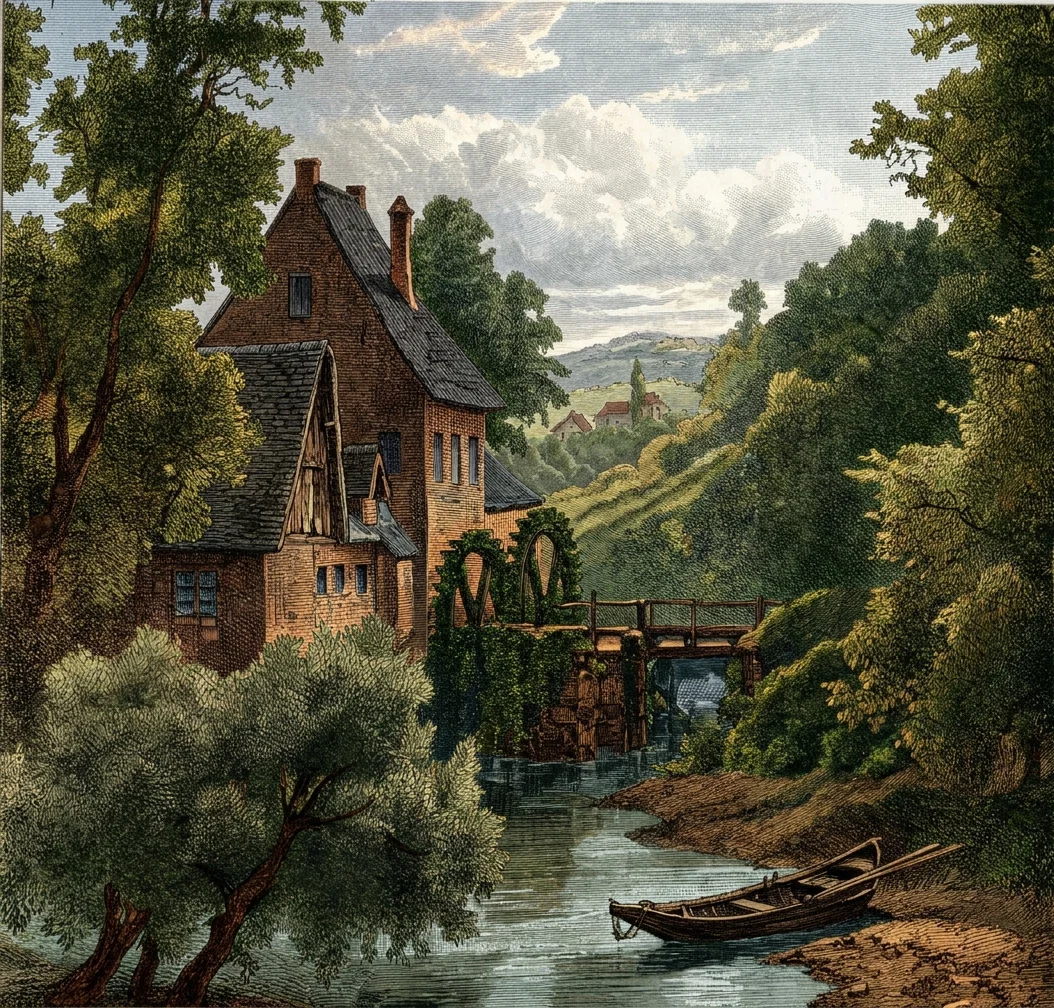
AMONG the early recollections of childhood and boyhood are those of many hours spent at the droning mill by the noisy brook, while waiting for our “grist” to be ground. In those days each man who raised any grain took it to the mill in bags in such quantities as suited his convenience. Every man’s name was on his bags, and his grist was kept standing by itself until its turn came to be ground. By starting very early in the morning, we could generally get our turn so as to get back home before night. Sometimes we went so early as to call the miller out of bed.
With what wonder I used, as a child, to look on those ponderous wheels revolving so slowly, while the water splashed and foamed in a vain attempt to make them go faster. How actively I sympathized with the water, as I watched the little stream of grain pouring so slowly into the mill, and looked at the numerous bags that must be ground before ours, and then thought how hungry I would be. We used to tell the miller, over and over, the story about the tall, hungry boy who declared that he could eat the meal faster than the mill was grinding it. The miller asked him how long he thought he could keep it up, and the hungry boy said he could do it till he starved to death. But nothing we could say seemed to hurry matters. There was an old boat in the stream below the mill in which I paddled and rocked and watched the minnows. But the mill is forsaken now, and the water no longer dashes over the ponderous wheel, which is falling to decay.
These old mills were simply the older fashioned hand-stone mills, of which we spoke last week, greatly enlarged, and run by artificial power. The stones were a hard flint quarried in but few localities. The surfaces were kept perfectly true, and were creased with furrows radiating from the center. Every few days the stones must be taken apart and the grinding surfaces “dressed,” or sharpened, with steel “picks.” This was a nice work, and must be carefully done. The surfaces of the stones, though running very near together, must not be allowed to come into actual contact, or the little corrugations caused by dressing would be quickly ground off.
Restored with AI
The first step of any particular importance in improving milling, was the introduction of mechanical bolting, or sifting of the ground meal. The texture employed for this purpose is silk of a very superior quality, woven principally in Switzerland, and of different degrees of fineness of texture. This cloth, stretched over a six-sided reel about three feet in diameter, and perhaps twenty-five feet long, was so fine at the end where the meal was introduced as to admit of only the finest flour being sifted out. The meshes of the cloth increased in size toward the other end, and a slight inclination of the bolt caused the meal to gravitate that way. Up to a certain point the product was flour. After that it was middlings, or canaille, or pollard, or shorts, whichever one pleased to call it. At last it was bran, which consisted of the husk with some middlings and flour adhering to it. The middlings were fine bran and coarse flour, and contained some of the most valuable portion of the wheat. These two last products were then fed to cows, and splendid cows they made, too. But there was always much dissatisfaction and grumbling connected with this system. Grists were apt to be short; flour was mixed; bags were lost, etc. The country miller, like the country school-teacher, had more than his share of the ills of life, though he was usually fat and smiling in his dusty garb. T.