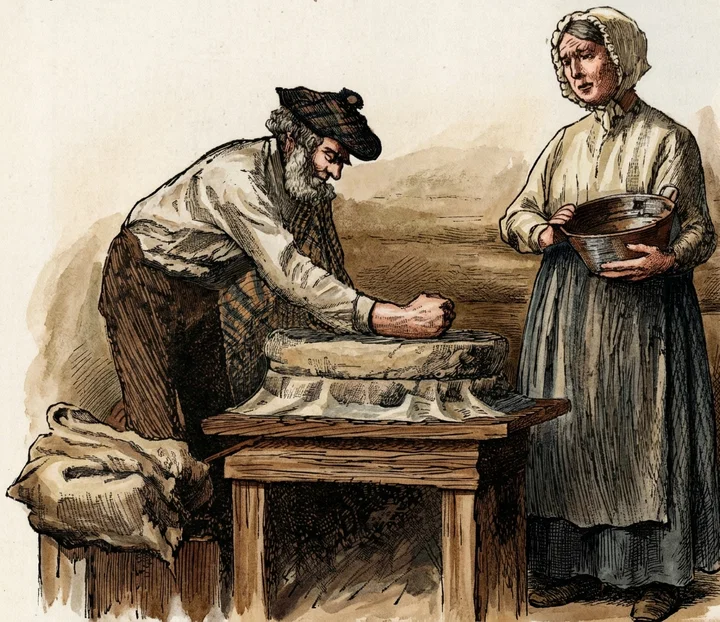
SEVERAL readers having inquired as to the best grades of flour and the different processes of milling, we have thought that a few talks on that subject might be of quite general interest. The grinding, or crushing, of grain is nearly coeval with the human race. The rude implements of our remotest ancestors have not been entirely discarded. The rough stone mortar and pestle is still in use in various savage or semisavage countries. An arrangement of a more convenient kind is shown in the second illustration, this being the variety in use in the South Sea Islands. The more civilized “mill,” consisting of two flat circular stones, the upper one of which is turned by hand, generally the hands of women, is now used by more people than in the Bible days when it was almost the only process known to Scripture. In semicivilized countries which have walked dreamily, half asleep, in the beaten ruts of all past ages, there has been no thought of releasing women from the thraldom of the mill. This primitive method was employed by the pioneers on our early frontiers, as shown in the accompanying picture.
In India many thousands of these “backaching” instruments of toil are in constant use. In the large cities are great warehouses in which many women earn a pittance by grinding the wheat and other grains into meal. The skill attained in this work is surprising. The grinding is done with great exactness, either coarse or fine as it is desired, and as evenly, apparently, as can be done with modern machinery.
The phrase, “The woman behind the mill,” is used in the Bible to indicate the lowest and humblest of servants. There are usually two women employed at the mill, one of whom manages the work, helps to turn the stone, and feeds in the grain through an opening in the upper stone. The other sits behind the mill, and simply turns — a laborious, monotonous, machine-like drudgery. The products of these mills are wholesome and acceptable food. They contain the entire grain, without sifting or separating, and for many ages meal or flour thus manufactured furnished the souls’ material for bread. Whatever of sifting or separating was required was done by hand sieves.
Next week we advance another step. T.