The Eastern Question has for many years been before the world as a point around which the interests of the Old World nations closely cluster. The “Eastern Question” involves the policy and attitude of the nations of Europe toward the Turkish empire; the preservation of the integrity or existence of that empire; and the disposal to be made of its territory in case of its downfall.
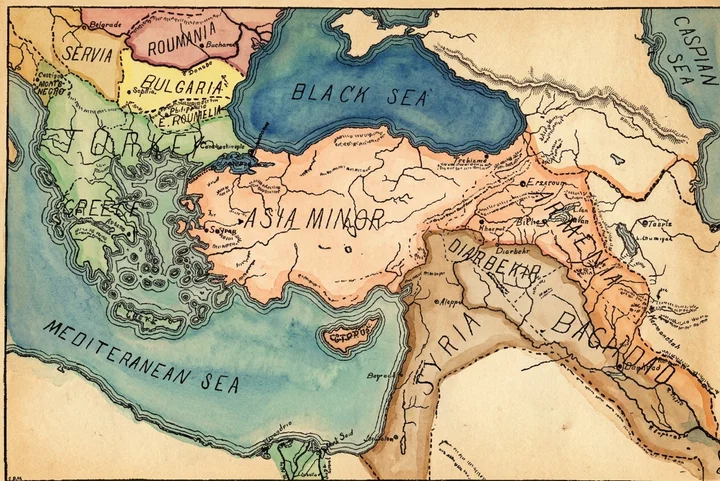
In the days of its strength the Ottoman power held in its grasp a vast expanse of important territory lying in three of the great continents of earth. Northern Africa, eastern Asia, and south-eastern Europe to the southern banks of the Danube, owned allegiance to the Sublime Porte. But for two hundred years that power has been in its decadence. And through the present century the work of disintegration has been going on. It found its first rival in Russia, which has, since the days of Catharine, “before whose genius and resources it seemed as if Turkey must inevitably sink into nothingness,” hunted the Turk with a relentless purpose to accomplish his destruction.
At the close of the last war with Russia, in 1878, a treaty was agreed upon at San Stefano between Turkey and Russia, by which the former lost vast possessions, and terms were agreed upon to which England would by no means consent. Active preparations for a great war were being made when Russia consented to have the matter submitted to a congress of the nations which convened that year at Berlin.
At that time Turkey found her existence to be dependent upon the will of the powers. She had no choice but to accept the terms they chose to dictate, and to be content with the privileges they saw fit to grant. The treaty there agreed upon stipulated the independence of the provinces of Rumania, Servia, and Montenegro, and made important additions to the two latter. Bulgaria was made a tributary principality, with a Christian government; and the frontiers at the mouth of the Danube and in Armenia were readjusted to the disadvantage of Turkey. Bosnia and Herzegovina were ceded to Austria-Hungary. Reform in government and toleration in religion were also required. Prior to the Berlin treaty the Turkish empire embraced in Europe 138,264 square miles; after the treaty it included less than one half as much, or 62,028 square miles.
Article 61 of that treaty reads as follows: “The Sublime Porte engages to realize without delay those ameliorations and reforms which local needs require in the provinces inhabited by the Armenians, and guarantees their security against the Circassians and the Kurds. It undertakes to make known from time to time the measures taken with this object to the powers that will watch over their application.” Article 62 provides for religious liberty and equality in the sultan’s dominions.
It is upon the provisions of article 61, quoted above, that the signatory powers are now endeavoring to mitigate the terrible sufferings of the Armenians, and to compel the sultan to afford to them the guaranteed protection.
At the Berlin Congress a subsidiary treaty of defense, previously arranged between England and Turkey, was made known and accepted. The first article of that treaty is given here:— “ARTICLE I. If Batoom, Ardahan, Kars, or any of them shall be retained by Russia [and they all were], and if any attempt shall be made at any future time by Russia to take possession of any further territories of his imperial majesty the sultan in Asia, as fixed by the definitive treaty of peace, England engages to join his imperial majesty the sultan in defending them by force of arms.
“In return, his imperial majesty the sultan promises to England to introduce necessary reforms, to be agreed upon later between the two powers, into the government, and for the protection of the Christian and other subjects of the Porte in these territories; and in order to enable England to make necessary provision for executing her engagement, his imperial majesty the sultan further consents to assign the island of Cyprus to be occupied and administered by England.”
By the treaty of Paris at the close of the Crimean war in 1856, the Black Sea was neutralized. Russia and Turkey agreed to maintain no warships or arsenals on that sea or its shores. The sultan has also covenanted to leave the Dardanelles open to ships of commerce in times of peace and in war. But the passage of warships is at the discretion of the sultan.
Such are some of the most notable features of the Eastern Question. The continual decline of the inherent strength of the “Sick Man of the East” has rendered the relations of the powers more and more critical. From time to time it has seemed that his day had come; the world would stand in almost breathless expectation of a crash that would involve Europe in a struggle over his remains. But he has developed a wonderful vitality. The fanatical zeal with which the Mussulman is attached to his religion has proved to be a tenacious bond of national cohesion. To him the sultan is the divine agent, the supreme head of the faithful on earth. The government itself has degenerated into a scandalous farce of corruption, intrigue, and cruelty. The public credit is hopelessly buried beneath debts which the nation can never pay. Among the powers that watch around the Sick Man’s couch not one has any interest in the preservation of his life; not one sympathizes with him in his approaching dissolution. With one accord they despise his religion and protest against the bloody cruelty of his despotism. They acknowledge that for the “unspeakable Turk” the world has no further use. But yet he survives. Why he lives is one of the inexplicable problems of human affairs when viewed only in the light of human wisdom. The longer he exists the more atrocious his life becomes. The fearful record that is now being made in Armenia forms the most horrible chapter in modern history. But God has a design in these things. A hand more powerful than all the powers of earth combined, controls the affairs of nations, and works out the counsels of the divine will.
The position of the Turkish empire in prophecy, and the significance of the present situation, will further engage our attention. G. O. T.