The development of the home has kept pace with the advancement of civilization and Christian principles. The first home was a beautiful garden of God’s planting. It needed no walls and doors, for there were no threatening dangers from the natural elements or from unnatural violence. It was the abode of peace and beauty unmingled with anything that could give pain or cause alarm. In the mind loving confidence was closely associated with each spot, and no defense was required, because no danger was lurking there.
Sin changed all that, and in the great transformation mankind found enemies to their peace, happiness, purity, and health lurking in every place. The balmy air, the inviting shade, the glowing sun, the biting frosts, the soaking rain, the stormy tempest,—all became agents of evil as well as mediums of blessing, from which man must seek a shelter. Man’s neighbors became his enemies, and watched him for hurt and not for good; the beasts of the forest became his foes, and even his own domestic pets must be restrained from doing harm.
In such a case, the family, drawn closely together by ties of mutual interest and sympathy, became an exclusive band, a unit in society. For protection, its dwelling-place became a local, definite spot, a fortification, beneath which protection, love, and happiness might peacefully and securely dwell.
Where the domestic instinct is but slightly developed, the family circle is less exclusive, the home is less secure. But true enlightenment promotes the sanctity of the family, and guards its peculiar interests more carefully. It is for the graces of Christ to furnish the crowning glory of home life in that perfect blending of interest that makes parents and children one.
But the defenses about our homes should by no means prevent the outflow of salutary influences into surrounding society. The home should be the conservatory of those plants of heavenly virtue which the rough elements of worldly society would quickly blight, but which, nurtured in those protected places, blossom and grow to bless the world at large.
Home to every one who is so fortunate as to possess or belong to a true home, is the dearest spot this earth can afford. To it the weary husband and father returns with eager steps. Its open door is to him as the gate of heaven. Its light is beautiful, though it be “ever so humble.” To the mother it is her workshop, her kingdom, her garden, and her laboratory. Here she does her life-work, modeling, cultivating, building, and adorning in the likeness of God, performing day by day a work in which angels take delight. To the sacred precincts of home the children flee with their troubles; to it they look for help and encouragement, and here, above all places, they should find their comfort and joy.
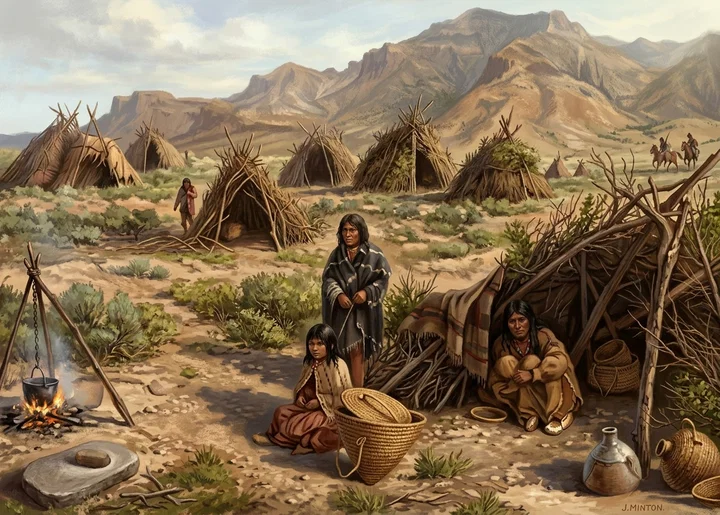
The illustration accompanying this article represents a home of the Ute Indians, of Utah and New Mexico, a race whose domestic ties are few and weak, whose dwellings are rudimental shelters. The Australian natives, about as low down in the scale as any to be found on earth, formerly dwelt in habitations even more rude, consisting of wide strips of bark stood on end against a pole. It is not possible for domestic love to live long in such abodes. The love for the beautiful finds there no encouragement, and the heart finds no home, no resting-place. Other savage nations exhibit the same principle, that the development of the home has always kept pace with the advancement of all that is permanent and desirable in society.
As we contemplate the comforts and blessings which constitute our homes in Christian lands, we have great cause for devout thanksgiving. The question as to what we may each do to show our appreciation of these blessings, and to make our homes more and more what they may be, is one that should deeply interest us.