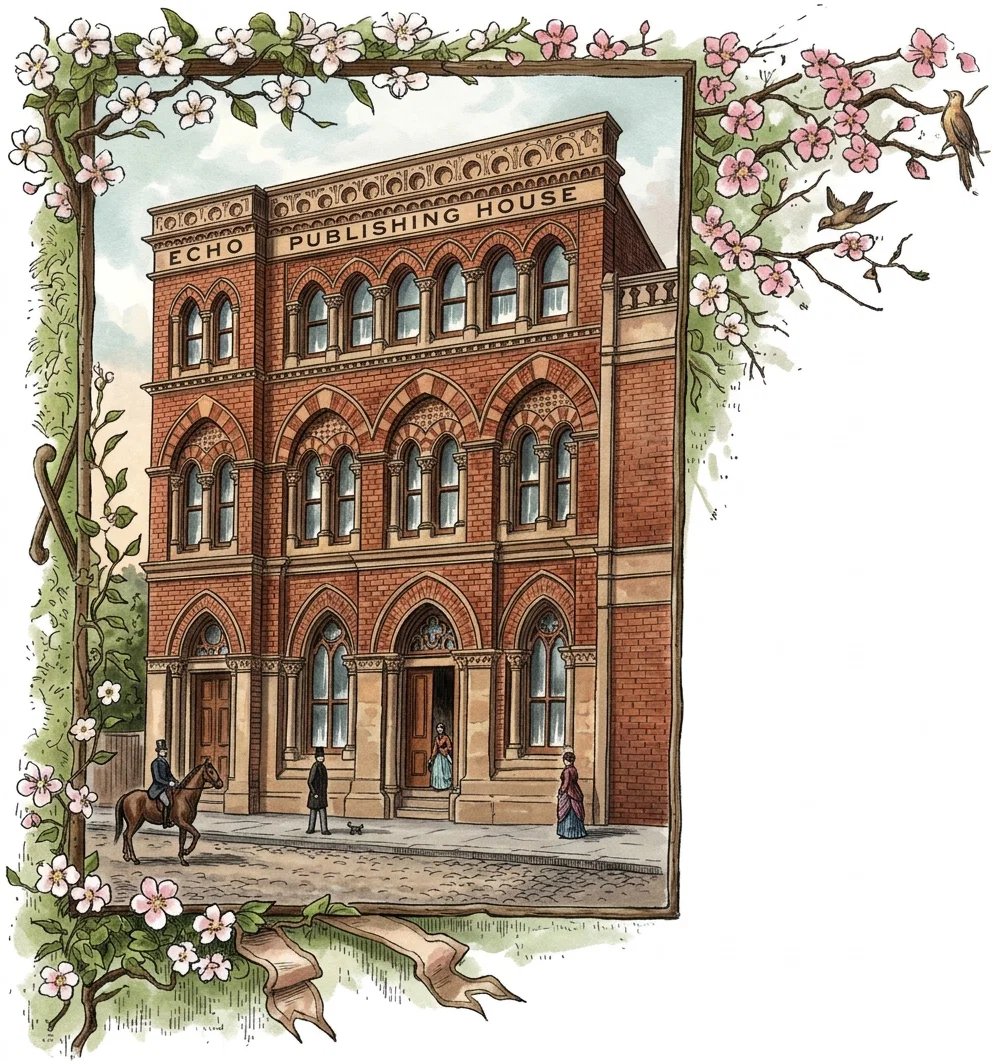
At the session of the General Conference held in 1884, definite steps were taken relative to opening the work in Australia. On May 10 of the following year, a company of ten persons, under the supervision of Elder S. N. Haskell, sailed by the steamer “Australia” from San Francisco. The mission was opened in Richmond, one of the suburbs of Melbourne, on June 17.
In October a small jobbing-press and an assortment of type were purchased, and these became the nucleus of the Echo Publishing House. This press was used in printing necessary cards, notices, and circulars. In November the publication of a monthly journal having been decided on, a small four-page paper was issued as its forerunner. The type for this paper was set in one of the rooms at the mission, and it was printed on a local press at Richmond. With January, 1886, the publication of the Bible Echo as a sixteen-page monthly journal was begun. This made it necessary to secure more convenient quarters, and the work was removed to a building on the corner of Rae and Scotchmer streets, North Fitzroy.
The new premises were entered Dec. 10, 1885. Two rooms were occupied by the publishing work. One of these was the front room, a corner of which, including the shop-window, was partitioned off as a salesroom, while the remainder was a job printing-office. The type for the Echo was set, and the mailing done, in a smaller room adjoining this. A few months later one of the rooms upstairs was used as an editorial and proof-room. Several of the rooms upstairs were occupied as a residence, first by Elder M. C. Israel and family and afterward by brother B. Belden. Soon a gas-engine and a Wharfedale power-press were bought. These were set up in a stable in the back-yard, while the loft was utilized as a folding-room and storehouse. These premises answered the needs of the publishing work for three years, till December, 1888.
The first issue of the Bible Echo, which was dated January, 1886, was printed on one of the city presses, as the machinery at the Echo office was not then in position; but it was all in running order by the time the February number was ready for the press, and from that time all the work has been executed within the office. The first year the circulation of the Bible Echo, including missionary clubs, reached 1000 copies per issue. The paper was continued as a monthly publication until January, 1889, when it was changed to a semi-monthly. Since the first of January, 1894, it has been issued in its present form as an eight-page weekly journal.
In 1888 Elder G. C. Tenney was sent to Australia to take supervision of the business management of the office and the editorial work on the Bible Echo. He reached Melbourne in July, and immediately took steps for the organization of the Conference, the tract society, the Sabbath-school, and the publishing work. A meeting for this purpose was convened in Melbourne, Aug. 29. On Sept. 2, a meeting was held in the special interests of the publishing work. At this meeting it was decided to issue the Echo semi-monthly. And to provide for the expansion of the publishing work, the initiatory steps were taken for the formation of a publishing association and the erection of suitable buildings. For the latter purpose the sum of £750 was pledged.
An allotment of land 33 ft. front by 159 ft. deep was secured on Best street, and contracts were let for the erection of two buildings,—one a two story press-room 36 ft. x 22 ft.; the other, a three-story brick building 33 ft. x 65 ft. In December the press-room was finished, and the publishing work was removed from the old site on Rae and Scotchmer streets, to the new premises. In these very restricted quarters, the entire work of the publishing work was carried on until the completion of the main building in May, 1889. In the single room that formed the second story, the type-setting and proof-reading were done; it also afforded space for the editorial work and the office of the Australian Tract Society. As the building, including the low roof, was of corrugated iron, this one room was often oven-like in the fierce heat of an Australian summer, and the noisy strokes of the press in the room below increased the discomfort. But all hands were cheerful, rejoicing that they were on their own premises and in the hope of better days to come.
The organization of a limited liability company for carrying on the publishing work was completed March 26, 1889. The capital was placed at £10,000, of which £3500 had been taken. The directors chosen were, H. Muckersy, Wm. Bell, M. C. Israel, G. C. Tenney, W. D. Curtis, Henry Scott, and W. L. H. Baker. The officers of the board were, G. C. Tenney, President; Henry Scott, Vice-President; W. H. B. Miller, Secretary; N. D. Faulkhead, Treasurer; A. Carter, Auditor.
The main building was ready for occupancy in May, 1889. In the front, on either side of the entrance hall, were the editorial room and the business office; the printing work occupied the room in the rear. As these rooms were thought sufficient for the needs of the work, the third floor was omitted, and the upper portion of the building made a commodious hall, in which the religious services of the church were held.
In December, 1891, Mrs. E. G. White and Elder W. C. White, accompanied by other laborers, arrived in Australia. The state of the publishing house was carefully considered, and among other things it was decided to increase the working facilities of the institution by putting in the third floor of the main building. This arrangement left the ground floor free for business offices and the book department. The332next floor was divided into two rooms, one of which was occupied as a folding-room and bindery, the other being reserved as an office chapel.
The chapel afforded a convenient place for the small meetings of the church. The printing department occupied the upper floor. In the front on this floor were four rooms,—three of them of good size and well lighted,—designed for the proof-reading and editorial work. The building, as thus completed, has been pronounced by the Inspector of Factories, one of the most healthful and convenient buildings of the kind in the city.
The arrangement of the building just described was completed early in 1892, and it is still in force, except that the chapel has been transformed into offices for the Australian Tract Society. This was made necessary by the transference of the subscription book business from the publishing house to the tract society, which came into effect, Dec. 1, 1894. The tract society also takes the retail book trade and periodical business, leaving the publishing house to act as printers and importers.
For several years after its organization, the Echo Publishing Company attempted little in the way of our denominational work except the publication of the Bible Echo. The tracts and pamphlets handled by the company, as well as the bound books, were nearly all purchased from the London and American houses. In 1893 an edition of “Steps to Christ” was printed, all the work, from the type-setting to the book-binding, being done on our own premises. This work was completed and placed on the market in September. The publication of a series of popular tracts and pamphlets was also undertaken.
In 1893, the first edition of 5000 copies of “Steps to Christ” having been sold, a second edition of the same size was printed. Six new tracts were issued this year, and some old ones reprinted; the total number of pages of tracts printed was 626,000. In 1894, the number of pages of tracts printed amounted to 1,384,000; pamphlets, 936,000, and in four months of the summer of 1894–95, nearly 4000 orders were taken for subscription books.
In May, 1894, the first number of the Australian Sentinel and Herald of Liberty was published. This journal is a thirty-two-page quarterly, devoted, as its name indicates, to the advocacy of liberty in matters pertaining to the conscience. Thousands of copies have been sent to ministers, editors, lawyers, and statesmen; and we have had gratifying evidence that it is cordially received and is accomplishing a good work.
Besides the publication of tracts and pamphlets and the two periodicals that have been named, the office turns out a large amount of commercial work. This is an important and paying line. Arrangements are also nearly completed for the publication of a small illustrated book by Mrs. E. G. White. It is expected that this work will soon be begun. In all the lines that have been undertaken, the work of the office is growing.
In 1889 a stereotyping department was added to the facilities of the office. All the departments—type-setting, printing, book-binding, and stereotyping—are now well organized and equipped, and prepared to do a wide range of work with efficiency and dispatch. The number of hands at present employed in the departments is twenty-four.
Soon after the land was secured and steps taken for the erection of the publishing house, the land boom in Australia burst, with the result that a financial depression set in. The bank panic of 1893 was still more disastrous to the financial and industrial interests of the country. In common with other business houses, we have had these adverse influences to struggle against. But through all the difficulties that have had to be met, the work has gone forward. Our financial standing in the business community is among the best, and our work is received with favor. We recognize in the prosperity that has attended us hitherto the good hand of our God, which has been over his own work. And we go forward in hope and courage.