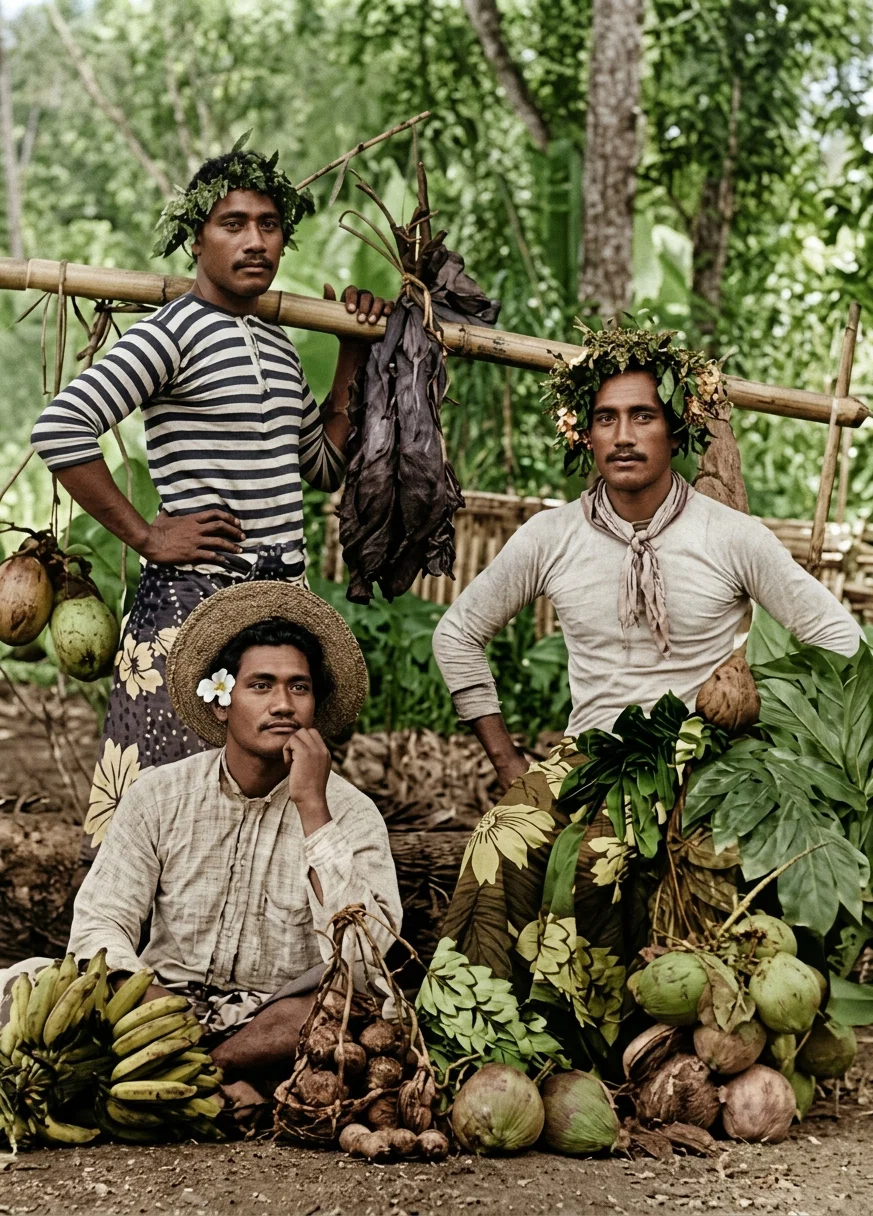
As with many of the South Sea Islands, the Society Islands are also each surrounded by a coral reef, the lagoon within the reef usually affording a calm, quiet harbor. The islands are mountainous in the center, but have some level land along the beach, where the natives make their homes. Though there is plenty of good land in the valleys and upon the hills, they dislike the monotony of living alone, and so build their houses close together, mingling together in a way that would be very obnoxious to many exclusive people of the United States. The mountains are not bare and rocky, but are covered with verdure. Oranges, limes, bananas, pineapples, and other fruits grow wild here. The land is very fertile, but mostly uncultivated.
We are about eighteen degrees south of the equator, and the heat would be very depressing at times if it were not for the ocean breezes. Though we have no real winter, we have much cold wind from the south during the months of May, June, and July, and sometimes feel uncomfortably cold during that time. However, we would not at all consider it cold then if it were not that our systems have become so accustomed to the heat which we experience at other times. There is but little variation in the length of the days here. On our longest day, the 21st of December, the sun rises at 5:30 A. M., and sets at 6:30 P. M.; and on the 21st of June, our shortest day, the sun rises at 6:30 A. M., and sets at 5:30 P. M. So, though having everlasting summer, we do not have those nice, long summer days which we used to enjoy so much in the temperate zone.
For years the most valuable product of these islands has been cocoanuts, and many tons of “copra,” the dried meat of the nut, are shipped to Europe every year to be used in making cocoanut-oil, etc. The nuts are also shipped to other countries. The raising of vanilla has of late become quite a popular industry in Tahiti, and is a profitable employment; for there is always a good market for vanilla at a high price.
Restored with AI
MEN AND PRODUCTS OF TAHITI.
All the most common tropical fruits and vegetables grow here. Oranges, bananas, and pineapples are sometimes shipped to New Zealand, as there is a regular steamer line between there and Tahiti. Limes, mangoes, guavas, alligator pears custard apples, mummy-apples, and rose-apples are found here, also the breadfruit, though that is more like a vegetable than a fruit. We occasionally find a grape-vine, planted by some white man, and grapes do very well here, though they are seldom cultivated. Yams, taro, sweet potatoes, and the plantain, or wild banana, are the most common vegetables. Irish potatoes do not thrive here, but are shipped in, and sold by the pound at a high price. We have melons, and corn grows well in this climate, though it is too warm for wheat and other grains. Some green garden vegetables, such as onions, leeks, cucumbers, lettuce, string-beans, etc., are cultivated by the Chinese; but much labor is required in their cultivation, so the natives never try to grow them.
Sugar-cane seems to be right at home in this climate. There are several mills in Tahiti which make molasses, brown sugar, and also rum. Formerly, cotton was extensively raised, but the price of cotton is so low now that even that which grows of itself is not always gathered. A large amount of flour is shipped in from California and New Zealand, and the bakers, who are mostly Chinese, find that making and selling bread is a very profitable business. Nearly all white families buy their bread, and a woman who makes bread for her own family can rarely be found. When the natives have the money, they buy bread, and many use it every day.
There are many Chinese here in Tahiti, and their energy and thrift are quite a contrast to the slow, inactive lives of the natives. They have many stores in Papeete, and as the natives think that they sell goods cheaper than the white merchants do, they give them most of their patronage. There are but few white people in the other islands, and at Tahiti most of the white people are in or near Papeete. The French people are largely government employees, but few of them being engaged in any business enterprise. The business men are nearly all of other nationalities.
The current coin is Chilean, a dollar of which is worth only about half as much as an American dollar. French money is used for government purposes, but is not so common as Chilean. We have to pay more for clothing here than in the United States; but as cotton clothing is mostly worn, and not much is required in this warm climate, one can clothe himself well at less expense than in the States. All groceries are also more expensive here; for they must be shipped in from some other country. If a person is situated so that he can raise his own fruit and vegetables, he can live at much less cost than where he has to buy these foods. The native vegetables and fruits are raised with but little labor.